The Handshake Hire Comeback

Almost two years ago, I laid the foundational framework for my extensive, countercultural checklist for rating and improving the moral, social, and economic health of organizations of all types and sizes. While this project is still very much in the R&D phase, one standard has remained consistent through testing so far: my three-factor model for hiring. I claim that the three critical factors by which to rate candidates are merit, competence, and character. In this article, I will define each of these factors and show why, while they’re all important, an employer should look to prioritize good character above all (especially merit) in hiring… not despite, but because of how convenient it is to do otherwise!

Merit is more or less how shiny one’s resume looks. It is argued to be the most tangible factor of these three because it is an empirical marker, based on experience and “proof” from the past. This is often the starting point of the vetting process for hiring, and that is fair enough in most cases. A company will have its list of minimal qualifications that may indicate a bare minimum ability to fulfill the duties of the job near immediately. With the overbearing cultural demand for convenience and expediency, it is all too tempting to feed such standards into your search criteria algorithm so that every single candidate who does not meet them is automatically filtered out. There is the distinct possibility that if that’s your approach, you’ll be missing out on considering candidates who have slightly less merit but far more potential. There is also the philosophical error in this approach, encapsulated by David Hume’s “problem of induction”.

Inductive reasoning is that scientific way of drawing conclusions exclusively from past, observed data. Indeed, this is why scientific understanding can never tell us the full truth, but rather indicates which direction to look. It is not on the basis that we have observed the sun rise everyday in history, that it will again tomorrow, just like a tree falling in the forest when no one is around to hear it. Likewise, just because someone’s resume points to experience relevant to this position, it is not guaranteed that they will prove just as effective now. It may also be the case that the content of their resume only reflects how a person’s competence appears, when in essence, they may struggle deeply with transitions, with the new team, or with any number of factors that will differ from their previous positions. A resume can also be fraudulent, which is why references are important. It is not enough to say “I had that job for such-and-such a time and did the work”, especially in light of how hesitant employers are to fire workers no matter how bad they are at a job. How were they in the job, can they work as part of a team, what difficulties did they face/create, etc.? The more broadly we can view the context surrounding a candidate’s merit, the more accurately we can judge whether they’re the right fit. This context is covered by the next two criteria.

Competence is the criterion that can be tested in real time and partly correct for that which merit risks missing. While merit might be an indicator of competence, it can never equate to it. Competence not only accounts for what someone can do now, but what they can potentially do – e.g. how skilled are they at learning new skills or improving further on that which they already excel? One can test developed skills through assessments and provide queries to get a sense for one’s psychometric profile, revealing their areas of interest and natural, cognitive strengths and weaknesses. Such testing may not tell the whole story, of course, or it may not even be necessary if you’re a good enough interviewer. I’ll come back to this soon! Competence here refers to one’s ability to work effectively at a particular task, and given the variance of ways that nearly any task can be done, this takes time to cultivate. The longer you give anyone to learn any task, the better at it they will be even if they don’t have pro-tential, and the more original and creative their approach will be. Pairing time with sustained interest, the more someone can make a task their own, no matter how mundane, the more purpose they will find in it. This is an invaluable asset that employers should cherish and nourish once it is found. It respects the autonomy and agency of the individual who is being of service. The sooner you can identify this, the longer you’re likely to keep them around versus an overqualified, highly competent candidate who will do the task with immediate perfection and almost just as immediately move on to the next job opportunity. There still seems to be a vast middle ground between the hard worker and the genius. Ideal candidacy still depends on something greater, not excluding the duration of time for which you’ll need their services. If you just need someone temporarily, by all means hire the overqualified, underachieving gifted kid on a contract basis!

Assuming we’re in it for the long-term, however…

Character can be loosely defined as the conscious state of a person’s overall demeanor. One’s willingness to be trained, their attitude toward work and life, and the alignment of their values with what the job provides them and vise versa, all fall under this crucial category. A good character has a level of self-awareness that allows the person to observe their own behavior and consider moral variables, such as the awareness and consideration of others, in every decision they make. A good character will not enter into a business transaction with motives other than to be open, honest, and potentially provide a quality product or service, and they don’t let circumstances define them.

For example, a good character and poor character can be equally desperate for money as part of their circumstances. The difference is that a poor character will seek approval from you in the interview process and make promises he can’t keep while hiding his motivations to leave (or worse) as soon as he gets what he wants. A good character in this case will look you in the eye and say “I honestly really need money right now, and I see this job as an outlet for that; but I promise to do my best while working toward a more suitable, longer term career, and I’ll give you due notice when it’s time.” That might not be what you’re looking for, and that is fine too as long as you also make your intention known.

If a candidate you’re considering for hire demonstrates willful, integrous trainability, then they are demonstrating something much greater than mere merit can provide – willingness to learn and maintain mutual respect. This is a combined competence/character trait that will prove invaluable if you plan on keeping the person around for longer than a year or two considering their life context, or, at the very least, it will make the inevitable parting pleasant, respectful, and beneficial to the growth of your network. The negative impact of an employee with poor character cannot be overstated, especially if they are highly competent and merited! Someone who is fully capable with no moral concern can run your resources completely dry, ruin your reputation, and force you into a career change overnight. It has been said by many wise men before: An intelligent man with unearned power will cause far more damage than a weak and ignorant one.

Ultimately, you are responsible for vetting who you join forces with, and perhaps an inability to read someone else character suggests that your own is weak and defenseless, which in itself is a particular form of poor character and, unfortunately, very common.

So, how do you know who you’re dealing with in an interview? How can you tell if you’re going to get played? I do believe there are procedures for vetting this, and perhaps I’ll explore that at another time, but for now, I’m going to take the intuitive, classic approach.

Essentially, if you are a business owner or are in charge of hiring for someone else’s business, you should never finalize a hiring decision without an extended, character-focused, in-person interview, concluding with a handshake, eye contact, and an internal, intuitive “yes” from the depths of your being. This is a very simple, old school step that has been routinely omitted for the ever popular “fully remote” business platform as well as for those which have transitioned to more remote work in recent years.

It does seem that a slow transition, in spite of cultural demand, is the intelligent approach. The demand for convenience has had a large impact on workplace efficiency as well as social connectivity, in far more adverse ways than was intended by creators of the technology that drives this shift. Most people want to clock their hours from wherever they desire to be, whenever it is convenient for them (even though only one third of people are actually equally or more productive working from home), and wait for their direct deposit to show up in their bank account without delay. The same principles of truth, trust, and success still stand in spite of all of this, however. Just like in any other area of life, for employers to uphold divine principles at every level of operation will make all of the difference as to whether their company succeeds through whatever waves that the tide of cultural fluctuation bring next. This is precisely what my organizational health system is designed to ensure.

The resurgence of ancient philosophy such as stoicism, zen, and the Vedas in the contemporary West – although many are misinterpreted and misapplied – provide a basis for accessing these core principles. It has served as a much needed offsetting of the consumer addict epidemic fueled by social media. Even if a candidate for hire takes a little too much interest in such mechanisms, as we all do (and hey, they can be extremely useful for business!), the level of character underneath that culturally altered demeanor will determine whether that candidate is not only a good fit for the work itself but, more importantly, a good person to have around while you’re striving for success.
Writegenstein #2: Philosophy of Psychology 205 (Seeing-As)

How does one play the game: “It could also be this”?

[…] “I see (a) as (b)” might still mean very different things.

Here is a game played by children: they say of a chest, for example, that it is now a house; and thereupon it is interpreted as a house in every detail. A piece of fancy is woven around it.

— aphorism 205 of Ludwig Wittgenstein’s “Philosophy of Psychology” from Philosophical Investigations

It could be this and I see (a) as (b) point to different ways in which one could interpret a material object. That object alone has limited value, if any at all. In a sense, the material aspects of the object are arbitrary compared to the conceptualization of the object on the whole. What is conceptualized of it, i.e. how it is understood, depends on its place in its environment – what use it is to its environment. When children are playing house, they are playing a game. They see a chest as something to use in a game which mimics the game the child sees its parents playing daily and of which they are a part. They do not see it as something with material, mechanical parts as the builder might see it (that is what it would mean simply to see, though the builder may see the bigger picture as well.) They ask “What can we do with this?” and understand the chest to be a house, having already established, and taken for granted, the rules for what constitutes a house.

It does not end there. Playing the game of house is itself a very sophisticated perceptual process. Our ability to formulate and make use of abstraction is perhaps what separates human perception from the perception of other animals – not in terms of form, importantly, but in terms of degree. A cat, for example, will definitely see the chest as something other than a bundle of wood and nails assembled in a particular way. It will almost certainly see it as a scratching post or a place on which or in which to sit or sleep (depending on whether the chest is open or closed and on how tired the cat is), but the cat lacks the ability to conceptualize the chest as anything more than that with which it is afforded these very basic “cativities”, if you will. The reason for this, from an evolutionary standpoint, is that these cativities are all the cat needs to achieve its potential. So, the cat’s abstraction is of the same sort but of a much lower degree than that of the child. The cat’s abstraction is more like that of an infant’s than the young child’s, for an infant, like the cat, only seeks in objects the fulfillment of very basic needs. The only difference between the cat and the infant is the potential of growth and development.

One still might ask “what objective or quantifiable relation is there between a chest and a house?” One should see now, unless one is blinded by a materialist view of reality, that this question now becomes arbitrary because one cannot speak of perception in this example without qualifying the individual subjects’ understanding of it. Perception as we experience it does not seem to be a mere material process. One does not need to understand anything about brain matter to understand something. In fact, it is that understanding that is indeed the goal. One could say that in the cat’s mind there is very little understanding taking place at all, while in the child’s mind there is no limit, especially since the child’s capability for abstract thought will continue to develop. The child understands much more than the cat does. To understand an object, I should say, is to make an abstraction of it – an abstraction that has utility in the greater context of its environment – to allow one to be successful at a game. To see-as, then, is to understand, and vise versa.

Don’t Use Sarahah; Own Your Words!

The problem with the new anonymous messaging app Sarahah isn’t that it creates a platform for cyberbullying (just walk away from your computer screen, jackass); it’s that it is playing a role in the leftist movement against free speech by ridding people of the responsibility of owning their words.

I don’t need to have used the app to know this. It’s obvious. In this time when social media is allowing for people to communicate less and less directly, making them more and more thin-skinned, careless with their speech, and, quite frankly, stupid, this app deals with the free speech problem by cleverly working around it. While most leftist social media platforms attempt to censor content or to simply suspend accounts when people say things that don’t conform to their collective beliefs, Sarahah allows the content to flow freely because no one in particular can claim responsibility for it. It is an anonymous free speech safe space, if you will.

Of course, the app knows who said what, so it allows you the option to anonymously block users if you get an undesirable message, so content can still be managed in that way.

Fair enough.

If someone messages you through the app telling you point-blank “you’re a dumb fuck”, you might not want to hear from that person again since they are lacking the tact and constructive criticism that the app would like of its users, and the same would be the case in real life, you can be sure.

The point I’d like to make in this post is that the Sarahah concept can seem all well and good on its own, but when you put it into a real world context, as with any new product, the users will determine its true identity. (this is through no clear fault of the creator; not every app developer knows enough about human nature to think through every scenario in which someone might use the app differently than he intended… this is why user feedback is so crucial). This post is my prophesy about why Sarahah’s identity will turn out more bad than good and why I would generally advise against using it.

Why Sarahah is Bad for Business

A good business provides a valuable service to the community. In order to ensure that the service continues to grow and improve, it is necessary that the employees work in an environment conducive to the free-exchange of ideas. That might make Sarahah seem like the perfect app, right? Actually, the contrary is true because of what the idea leaves out.

What is just as important as the idea itself is the employee’s taking credit for it. Sarahah doesn’t allow for this, neutralizing the dominance hierarchy within the company. The employer can reap the benefits of having the idea, but he does not have to give credit where it is due. This is convenient for the individuals at the top whose jobs won’t be threatened, and for the human resources department because they will have fewer cases to deal with, but it could hurt the company in the long run when their employees’ intellects are suppressed and promotions are given to the wrong people. This is bad news for female employees who, if they thought they were disadvantaged in the workplace before, will be even more so now, perhaps without their even realizing it. It is also bad for male employees who will inevitably lack the motivation to give any criticism at all.

Here are the differences between how women and men will be affected by Sarahah in the workplace.

Sarahah sneekily caters to the female temperament.

From a personality perspective, women tend on average to be higher than men in Big5 trait agreeableness. This means they are more compassionate, less assertive, tend to underestimate their abilities, and they don’t as often take credit for their achievements. They are also higher in trait neuroticism, which is sensitivity to negative emotion. This makes Sarahah the perfect place for women to speak their minds. They don’t have to give criticism directly, and they don’t have to claim fault if that criticism hurts someone’s feelings.

This might sound appealing to women, but I see it as taking advantage of the woman’s common workplace weaknesses. Though (probably) not intended, the inevitable consequence of this will be that even fewer women will stand out among their coworkers and be considered for promotions. They’ll be comforted now more than ever that simply sitting there and doing their jobs is enough, instead of taking the risks necessary to advance. (Of course, personality studies show that this is a good thing if they want to maximize their mate options, as women prefer mates who are at least as smart and successful as they are) All of this is true for some men as well, but I suspect men in general will encounter a different set of problems.

Sarahah Suppresses the Male Intellect

Since men are more assertive and aggressive, they will still be more likely than women to give criticism face-to-face, and there’s bad news for men who do. If a company begins to rely on Sarahah as the primary means by which to take criticism, then direct dialogue between people will be constricted, not enforced. Any man who does not use the app to speak his mind is taking a dangerous and unnecessary risk. He may get into trouble and risk losing his job if his speech is in violation of company policy. He won’t be able to play the traditional, competitive, risk-reward game that is crucial to his potential to climb the company ladder.

Challenging the status quo is an important way in which men typically show their ability to think critically, articulate, and negotiate – skills that are necessary for managing a good business at all levels. Sarahah suppresses these skills. This will allow HR to keep the hiring process neutralized, so they do not have to promote people within the company based on merit, but rather by whichever absurd and counterproductive standards they choose (e.g. to meet notoriously anglophobic ethnic diversity quotas).

Why Sarahah is Bad for Personal Relations (to point out the obvious)

It might sound appealing to find out what your friends and acquaintances really think of you, but I suspect that the anxiety that will result from not knowing who exactly said those things will far outweigh any positive effect that the criticism may have on you. Imagine walking around at a party where all of your closest friends are present, knowing that half, maybe even all of them have only been able to honestly open up to you anonymously.

A good friendship or relationship should not only be conducive to, but founded on open, honest communication. I know it sounds cliché, but this cannot be overstated given that Sarahah exists to deny that. In fact, we identify who our friends are based on how open our communication is with them, do we not?

Consider this… your primary or best friends are those few who you can be absolutely open with. You know who they are. Your secondary friends encompass a wider circle. They are people you may call on regularly, but the subject matter of your communication with them is limited, whether to specific topics or to a level of depth in general. Your acquaintances are everyone else you know – people you could (and often should) do without.

Which friend group do you suspect is the most likely to send you overly-critical messages on Sarahah? Acquaintances? The people who know you the least?

Hmm, maybe not.

Acquaintances might be the most likely to send you the occasional “you’re a dumb fuck” sort of message. But, since they know you the least, they think of you the least. They care for you the least. They’re the least likely to try to help you. So, I’d guess not.

What about those best friends who use the app? They very well may use it to give you some much-needed advice, but who are they? Though the advice is sound, are they really your friends if they can’t sit you down and talk to you?

You might be disappointed (or even relieved, if you’re a particularly strong person) to find out that some people who you thought were your best friends are really secondary friends, or mere acquaintances, or just snakes and not your friends at all. In fact, any “best friend” who might use the app out of fear of being honest with you, no matter the content of their message, is doing you a huge disservice. They’re simply acting cowardly.

Conclusion: Don’t Be a Pussy

Don’t use Sarahah. Own your words. Be an open, honest, and responsible human, for your sake and the sake of your friends and coworkers. If your company tries to adopt Sarahah in order to take criticism, explain to them the problems that would cause for you and for them. If they insist, then give criticism directly anyway. Get into a fight with those dumb cunts in HR. Get fired. Chances are that it’s not your dream job anyway.

If your friends announce on social media that they just started a Sarahah account, they’re reaching out for help. Take them out for a drink and ask them what’s up. It may require a bit of persistence, but if they’re really your friend, then it will be worth it.

Despite the difficulties in the short-term, the long-term benefits of having straightforward, critical discussions with people will be worth it. You’ll show them that you are worth it, and they will reward you for it. But, of course, don’t do it for the reward; as with anything, do it simply because it’s right.

Tinder Fun With a Feminist

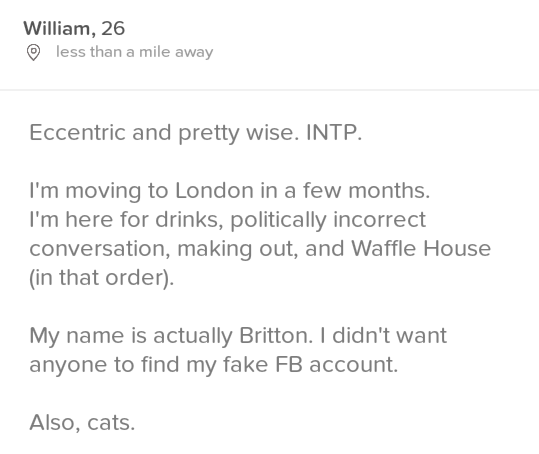
I’m Britton, as you should know, and below you’ll find the bio I wrote for my Tinder profile. If you don’t know what Tinder is, then get your head out of the sand, and read about it here.

2017-05-22 16.49.15

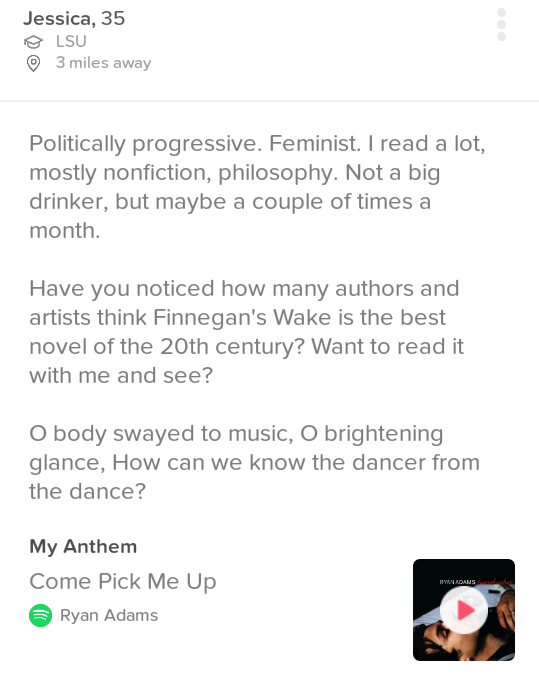
I was in New Orleans the other day, getting my swipe on, and then I came across this fine, older lady.

2017-05-22 12.40.00

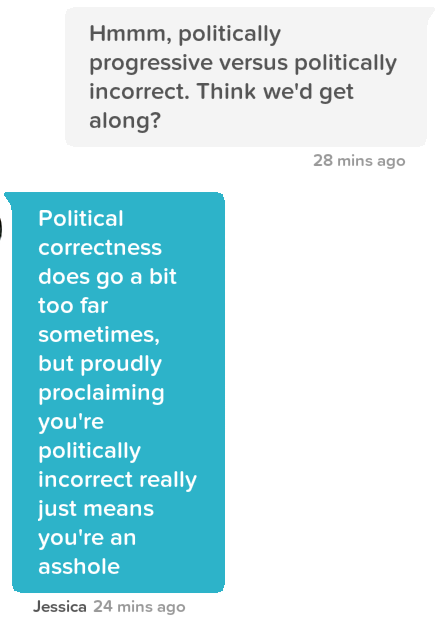
The first things, ‘politically progressive’ and “the f-word”, I admit, probably should have raised red flags before even her shitty taste in music did. Those terms on their own hint at far-left political views, but the two of them together scream ‘SJW‘. However, she was hot, and that’s very rare of feminists, so I read into her words and saw deeper possibilities. I was hoping that maybe we could talk some philosophy, giving her the benefit of the doubt that her knowledge on that subject wasn’t confined to new-wave feminist crap. Hey, maybe she was even a feminist of the second-wave, non-radical kind, and ‘progressive’ just meant that she was kind of liberal and open to reasonable and necessary change. Maybe she’d even have a cat named Elvira. With this optimistic attitude, I swiped right and immediately tested her humor to see how “open” she really was.

2017-05-22 12.24.23

BOOM! No fun or games with this one. Did I “proudly proclaim” that I am politically incorrect? Reread my bio, and let me know. I think I’m just straightforward about what I want out of my Tinder experience. She could have easily swiped me left if my intentions didn’t line up with hers. Looking back, though, maybe I should have ended my first message with a winky face. 😉

2017-05-22 12.26.28

Do you value truth, Jessica? DO YOU? We’ll find out. Also, Jessica, I’ll be addressing you directly from here on. Wait, is it ok that I call you by your name, or would you prefer something else? I don’t want to be too incorrect and risk “invalidating your existence“.

2017-05-22 14.12.41

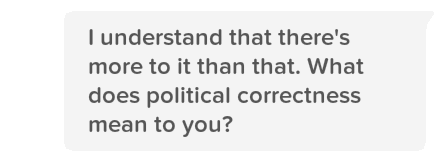
Yeah, let’s define a term together! That sounds like a fun philosophical exercise. Maybe you’ll even return the favor by asking me how I would define the term, and then we’ll find some common ground, bettering both of our conceptions of the world. Learning stuff is fun! You read philosophy, so you agree, right?

2017-05-22 12.29.22

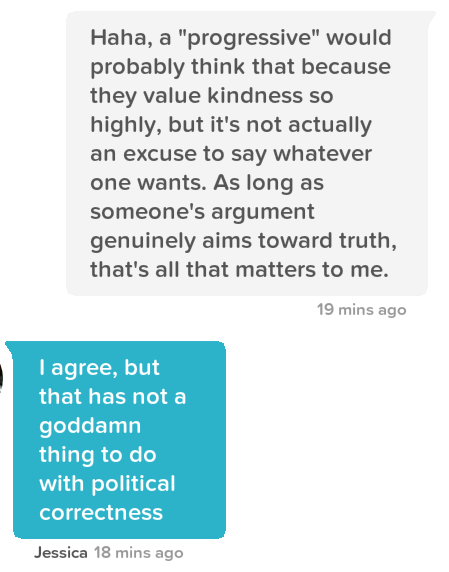
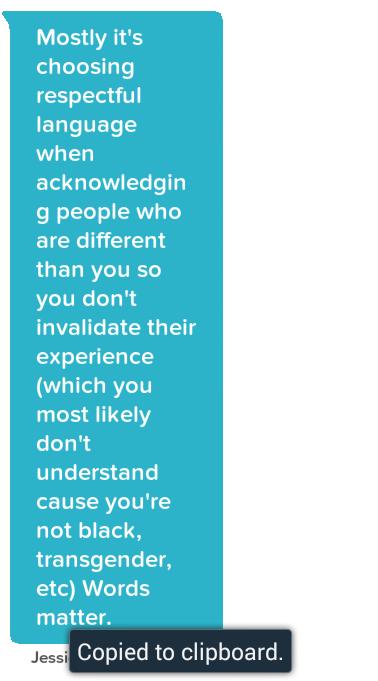
Annnnnd there it is. You pretty much nailed it, Jessica. I’m guilty of whiteness, so there’s no need to ask me what I think ‘political correctness’ means. Your understanding of how language works, on the other hand, seems a bit strange, and the philosophy you read may be of questionable quality. My validity on that topic comes from my education in linguistics and philosophy of language. But, you’re attempting to “invalidate” me because I’m… white? Hmmm.

I don’t think that speech is an activity so consciously aimed toward respect, nor do I think it’s a good idea to blindly respect people at all. In fact, it’s dangerous. I’ll spare you the technical linguistic part of the argument because I’m starting to sense that you have a screw or two loose, but I still must address the respect-issue.

Also, how are you so sure that I’m not black or transgender? If you respected me, then you would have asked about my preferred identity because race and gender are determined whimsically and have no biological basis, correct? No, you should have simply requested a dick pic, Jessica. Truth requires evidence, and I have plenty of it.

2017-05-22 12.31.40

So, maybe there’s more to political correctness than your definition, Jessica, and maybe I know some stuff that you don’t. Maybe you’d be interested in hearing it. Maybe if you weren’t so keen on blindly respecting others, then you wouldn’t be so liable to get mugged and raped in a dark alley in New Orleans. Or, maybe you’d like that because you’d become a martyr for your ideology. At this point, you’re not giving me any reason at all to respect you, but I do fear for your safety. After all, you’re right that the world isn’t a very kind place.

2017-05-22 14.39.072017-05-22 14.40.34

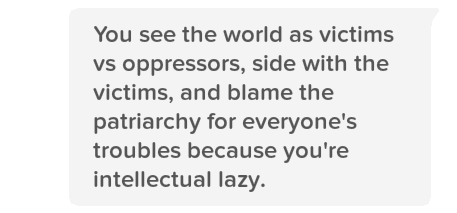
I figured I’d play the “patriarchy” card since you already accused me of being part of it by virtue of my straightness, whiteness, and maleness. What did you expect? Why did you swipe me right if you hate me by default, unless you wanted to hate-fuck me (shit, I may have missed my shot)? I mean, you’ve seen my pictures. Chances are that I’m not black under my clothes. In fact, I’m even WHITER there. Well, actually, there is a very small part of me that is kind of tan.

2017-05-22 12.35.42

2017-05-22 15.00.48

*ignores grammatical errors and moves on*

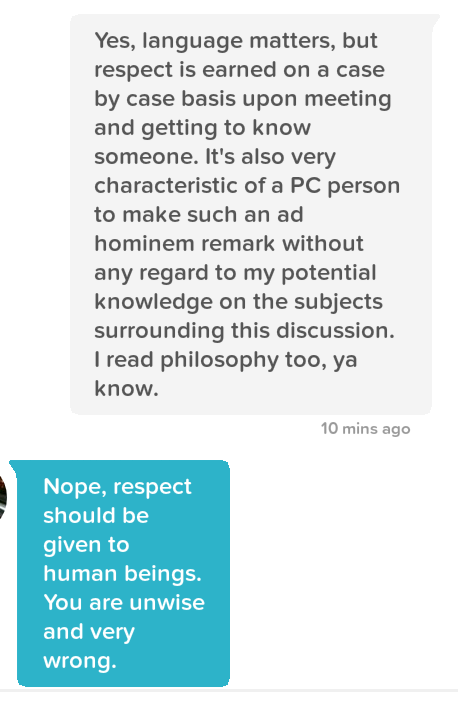
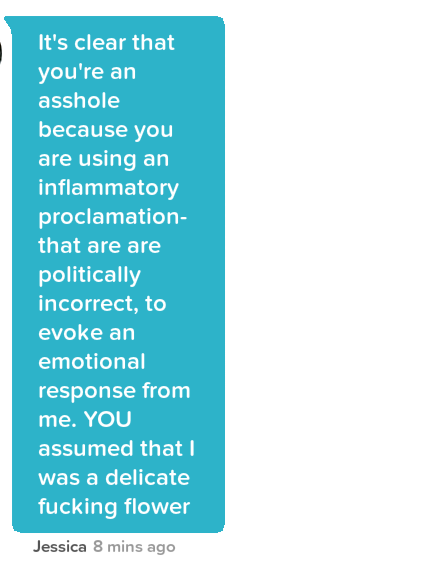
I know I’m an asshole, Jessica. There is no need to repeat yourself. But, does being an asshole make me wrong? No, Jessica, you’re the meanie who committed ad hominem. I also didn’t appeal to emotion to argue my point. You just took it that way. Taking offense and giving it are NOT the same thing. That’s Philosophy 101.

But…do save me! Please save me from my problematic ways so I can be more compassionate like you and make the world a more progressive place! Or, do I need a degree in women’s studies to be infected with your profound wisdom? If it’s LSU that infected you, then you’re right that there is no hope for me because I dropped out of that poor excuse for a higher-education institution after just one semester of grad school.

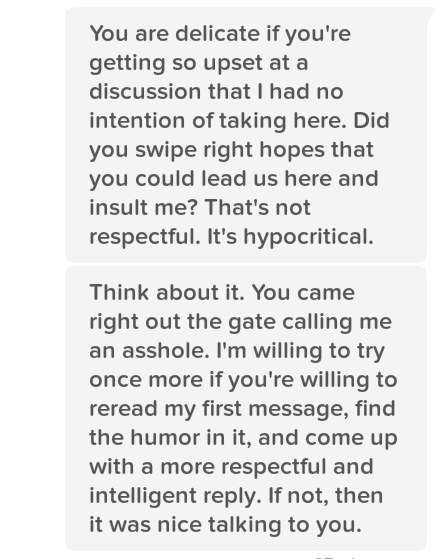
On the other hand, I could help you by revealing your greatest contradiction, and maybe even give you one more chance to get laid by me, knowing well that so few men would have gotten even this far with you. I mean, this is Tinder. Why else would you be here? Yeah, that’s what I’ll do because I want some too. I’ve learned to accept that liking sex makes women delicate flowers and men oppressive misogynists. It’s cool, really, I don’t need to be reeducated. I’ll even let you play the role of misogynist, and I’ll be the victim, and you can oppress deez nuts all you want.

2017-05-22 15.11.27

That’s where it ended. So…

What the hell is going on here?

I don’t think that I need to go into detail about what is going on here. There are plenty people who have done that very well already. For example, Dr. Jordan B. Peterson in this brilliant snippet from the most popular podcast in the world. The general point I want to make is that we are in a strange place where people like Jessica are multiplying exponentially by the semester, thanks to politically correct ideology infecting universities, business administrations, legislature, and now even Tinder (as if Tinder doesn’t already have enough spam)! This is the time for talented and capable people, mostly men, to stop ceding power to the people who live in those boxes; they’re wrong, and they’ve snuck their way into power without truly earning it. To stand up for truth is to stand up for yourself. However painful that may be now, it is absolutely necessary for the survival of our species. After all, if we were all angry, 35-year-old feminist virgins, of course humanity would end.

Since we aren’t all like Jessica, one day we will be without these people completely. Let’s give them what they want: spare their feelings, thus depriving them of the open, truth-seeking dialogue that would mold them into stronger moral beings and free them from the narrow and suffocating constraints of the feminist ideology. Since they aren’t open to that sort of thing, they will eventually self-extinguish under their childless philosophy and rot in the miserable hell that they’ve created for themselves.

“Ideology and the Third Realm” – What is Philosophy?

In Dr. Alva Noë’s book Varieties of Presence, many important aspects of perception are discussed. He makes a convincing case that we achieve contact with the world through skill-based action. Our understanding of a new experience is a collective recurrence, both conscious and unconscious, of past experiences. It is a dense work that deserves the attention of other contemporaries who concern themselves with matters in cognitive science and philosophy of mind. Perhaps I will do a full review of this book at a later date, but for now I would like to focus on a matter addressed in the final chapter entitled “Ideology and the Third Realm” which takes an important departure from the philosophy of consciousness and neuroscience.

What this chapter does is something that every philosopher should do periodically: broadly revisits the fundamental importance of philosophy as it relates to the context of his work. I will be a bit more general than that since I am not  “professional” philosopher. The role that philosophy plays in the world seems to constantly be changing. But is it? Perhaps it is only the popular understanding of what philosophy is that changes. I think that is, in part, the case, but it has more to do with the uses of philosophy. Some of those uses have remained constant since the beginning of recorded thought while others change by the minute. For this reason, it is impossible to pin down. But one need not pin it down. Philosophy exists to be used, and it is set of skills that will hopefully never become extinct. There is no dictionary definition that can sufficiently explain it, much less emphasize the field’s vital presence. I will give a general overview of the chapter but mainly share my thoughts about what philosophy is and why it is not only relevant, but necessary. Before I continue, I should define an important term which will be mentioned several times in this piece.

Q.E.D. (Latin) quod erat demonstrandum –  meaning “which had to be proven”

Many people, in and out of academia, naively think that philosophy deals with questions that warrant a Q.E.D. response. When you take a philosophy course, you often have to write at least one argumentative essay where you choose a position of a philosopher who you have read, you attempt to prove him wrong, and then you attempt to formulate a complete view of your own by supporting evidence. This way of “doing philosophy” is popular in undergraduate, base-level courses. It helps you to develop reasoning skills that can be applied anywhere. This is important, no doubt, but this is not where philosophy ends. Why? First, writing is not even necessary for “doing philosophy”. The only thing that is necessary, I would argue, is thinking. Thinking must be assisted by reasoning, but this is only the start.

This does not imply that we should identify the philosopher as one who locks himself up in his ivory tower and speculates of a deluded, idealized world. To philosophize well, one must also be able to communicate his ideas in some way, and that will involve language, whether spoken or written. This is one reason philosophy courses are difficult: one must already have a certain level of reading, writing, and speaking proficiency to succeed. The full title of the final chapter of Noë’s book is “Ideology and the Third Realm (Or, a Short Essay on Knowing How to Philosophize)”. Since language is such a crucial part of this issue, I will begin by taking a language-based example from that chapter:

‘The King’s carriage is drawn by four horses’ is a statement about what?

a) the carriage;  b) the horses;  c) the concept it asserts;  d) other

Immediately, one might think that the answer is ‘a) the carriage’. This seems completely logical, given how most of us understand language. ‘Carriage’ is the subject of the sentence, so any terms that follow should (theoretically) describe it. It is certainly not ‘b) the horses’ because that is the object receiving the action, and nor can the answer be ‘c) the concept it asserts’ because nine out of ten people in the room don’t know what the hell that means. Right? Good. It’s settled.

Gottlob Frege had other ideas. He thought that a statement about numbers is a statement about a concept. When we attempt to answer the question about the subject matter of the “king’s carriage” statement, we are speaking in conceptual terms. We are not using the statement to assert anything. So, the answer must be ‘c’. He gives more reasons for this, of course, and he makes us realize that there is a sense in which we become confused about what we mean when we say ‘The king’s carriage is drawn by four horses’. However, despite the piercing quality of Frege’s argument, we have a much stronger sense that we are unconvinced by his theory of language.

The problem with Frege’s claim, for most of us, seems to be that he had a preconception of the meaning of the statement ‘the king’s carriage is drawn by four horses’ before he was even asked the question. He had already established that any statement about a number, without exception, is a statement about a concept, so he was able to answer the question without thinking. The problem with our rejection of his claim is that we are doing exactly the same thing. We also answered without thinking. We held the preconception that every sentence is about its subject. This preconception is guided by the larger logical construction by which we understand language, and it is certainly no more correct than Frege’s view simply because nine out of ten people in the room agree that it is (that would be to commit ad populum). We take our theory of language for granted, and perhaps Frege takes his for granted too. There seems to be no Q.E.D. conclusion here. What we are all doing, if we become inflexible, if we stick to our answer to the question without sufficient evidence to support it, is committing what I call the ideological fallacy.

However, subscribing to ideologies is not always a fallacious thing. It is only when the ideology is applied in a dogmatic way that it becomes wrong. When an evangelical christian lives by Jesus’ principle, “love your enemies”, that can have very positive effects. It may minimize conflict in the person’s life. It may allow them to stand strong in the face of racial adversity. It may allow them to accept people more openly, and very often the favor will be returned. However, the favor is not always returned if the christian is careless and thoughtless. Despite his belief that he loves his enemies, participating in radical evangelical activism would invade on others and create more conflict, leaving his conception of “love” to be questioned. It takes Christianity out of context and misapplies it to the world in a negatively ideological way. There is nothing about the beliefs in themselves that are illogical, destructive, or even wrong. It is in how they are used will determine that. I will use another example. Evolutionary biology can study preserved skeletons of million-year-old homo erectus figures and learn about how we sapiens evolved three stages of evolution later. This could contribute to our understanding of how humans will continue to evolve (or devolve). However, evolutionary biology can only contribute a small piece to the puzzle of predicting the future of humankind. It needs influence from many other fields to even begin to solve any of its own problems. So, when Richard Dawkins uses the broad concept of evolution to attempt to disprove creationism in any one of its countless forms, he is taking his work out of context and applying it in a radical, dogmatic, negatively ideological way. There is nothing about evolutionary biology, as a field, that is wrong. It is a highly-useful method of inquiry. But there is still plenty we do not know about how humans have evolved. We generally just accept that they did with the minimal evidence that we have just as the evangelical accepts his own conception of loving his enemies based solely on Jesus’ teachings. In this case, both parties look equally silly.

Of course, the example above presents two extreme cases. Although we answer this “king’s carriage” question one way, Frege answers it in another, and we seem to have to agree to disagree, there is still a sense in which both sides think the issue is objective in nature and that it deserves further discussion. In order to have this discussion in a logical, respectful, open manner, we must become philosophers, and one may not need to go school to achieve this. Alva Noë wonders how we might categorize our dealing with the “king’s carriage” question. It is not in the realm of the material (e.g. biology), nor is it in the realm of belief (e.g. religion). It seems to be within some third realm. Noë begins to explain with this quote:

The point is not that Frege or we are entitled to be indifferent to what people say or would say in answer to such a questionnaire. The point is that whatever people say could be at most the beginning of our conversation, not its end; it would be the opportunity for philosophy, not the determination of the solution of a philosophical problem. (Noë, 173)

at most…“, Noë says “(what other people say is) the beginning of our conversation… the opportunity for philosophy…” This is another reason philosophy is so difficult! At the very most, when our view stands in opposition to another, we may only have the opportunity to do philosophy. We rarely get there. When we do get there, two or more people are concerning themselves with the third realm of a problem. What is the third realm? It is the realm of possibilities with minimal influence from ideologies. It is abstractly objective yet, as I will explain later, not in the realm of matters Q.E.D.

Where is this third realm? Well, ‘where’ is the wrong question. Bertrand Russell once said of philosophy that it is “in the no-man’s land between science and religion” because it always seems to be under scrutiny from both sides. Perhaps, in some cases, this is correct. It can serve as a mediator between two extremes, but, on the surface, this only explains one of unlimited applications of philosophy.

Upon first reading or hearing Russell’s quote, one might be inclined to place philosophy in between science and religion because it deals with reason over belief (like science) and thought without quantifiable experimentation (like religion). This would be a shallow interpretation that lacks crucial insight. Russell was perhaps a bit too concise for the average interpreter. He did not mean, as I understand him, that philosophy is inside the space between science and religion. It has deeper implications which resonate with those of Noë (despite the fact that Russell was a logical positivist, and Noë is a phenomenologist, so they would probably have a duel for other reasons). Explaining philosophy has nothing to do with where we should fit it in relation to other fields. It has to do with how we can apply its skills, and in that way it is most unique. Those skills are skills of thought. Developing those skills first requires one to look inward, rid himself of bias, and then turn outward to consider all possibilities. This is still only the beginning. Once we achieve this skill of thought, what do we do with it? We continue to practice and improve it. How? The answer is simple, but the application seems, in some cases, impossible. We communicate.

We share our ideas with others who have, to some degree, developed the skill of clear thinking. Of course, communication, whether written, oral, or otherwise, is a practical skill in itself that will be developed naturally, mostly prior to but also simultaneously, alongside the skill of thinking. We tend to adapt our ability to communicate only to the situational extents that we need them, and that can be limiting. When doing philosophy, anyone can participate, but only to the extent that they can think clearly. Philosophy tests those limits, which is why both science and religion so often scrutinize it. Though they deal with subject matter that seems contradictory, (mechanistic) science and religion do have one general thing in common: dogmatic ideology. Philosophy, on the other hand, is perhaps the only field that dedicates the elimination of dogmatism as one of its primary goals.

Doing philosophy is not only about increasing the degree to which people can think, but about being open to different forms of thought as well. What is fortunate in this regard is that each person in the conversation, if one is to find himself in such a conversation, has probably achieved their skill of thought through different means. For example:

There may be one who developed his thinking through philosophy itself, who rigorously studied informal logic to learn how not to commit errors in reasoning. He also may be able to contribute history of thought to the conversation and explain why certain schools of thought are obsolete in academic philosophy. There might also be a more scientifically-minded person who, in a graduate school lab, performed the same experiment under the same conditions hundreds of times, but got variable results. He questioned why this was happening (if the laws of physics are supposed to be constant), so he turned his research to the inconsistencies and realized that uncertainty transcends mathematical equations. He is now able to think more broadly about his work. There might also be a Buddhist in the group who practices intensive meditation. He can turn off influence from his sensory world and walk on hot coals without getting burned, or he can submerge himself into freezing-cold water without catching hypothermia. He is able to clear his mind from all unnecessary matter. Each person achieves the same thing – to think clearly, skeptically, critically – through different means. They each learn from one another and gain a broad range of insights.

Also, and perhaps most importantly, each person in the conversation should be genuinely interested in learning new perspectives in order to improve their own points of view. There is a sense in which someone may have achieved access to the third realm of conversation to a lesser degree than the others, and at a deeper point in the discussion, he gets flustered and has to back out. This is perfectly fine as long as he does back out, at least until his temper cools (if he does not back out, he will disrupt the conversation). He has pushed his boundaries of clear thinking to a level that the others have not, and that can be a very constructive or destructive thing, depending on his mindset. But it is vital that all parties directly involved maintain self-preservation throughout the conversation. If there are any unsettled nerves, it is almost certain that at least one participant is not being genuine, but rather, is too outwardly focused and is perhaps ultimately trying too hard to prove himself right or the others wrong. Although they might seem to contribute insight to the conversation, they will inevitably expose themselves as operating from within an ideology, thereby rendering themselves a nuisance. Philosophy is no activity for the pretentious or egocentric, contrary to popular belief. In fact, the absolute contrary is the case.

Do any philosophical questions warrant a Q.E.D. response? (Does philosophy ever prove anything?)

No. In case this is not already clear, there are, in a sense, no “philosophical questions”. There are only philosophical approaches to questions. Approaching the third realm of a problem requires one to be, as stated earlier, abstractly objective (or perhaps objectively abstract). There are limits to how objective one can be, no doubt, but the aim of advancing thought is to learn more and more about the world and how those in it think, so we can improve on that, both individually and collectively. It exposes dogmatism and reveals the sheer grey-ness in any concrete matter. Need I give examples as to when this might be useful? I challenge anyone to give an example of when it is not, and thereby present an opportunity for doing philosophy! This is why philosophy is so widely-applicable.

To draw an analogy – toward the end of Noë’s final chapter, he mentions Immanuel Kant’s aesthetic view that the reality of one’s response to a work of art is based in feeling – it is not contingent on his ability to explain it. Similarly, Clive Bell described a “peculiar aesthetic emotion” that must (first) be present in something for it to be considered art. It is that feeling you get when you listen to a beautiful composition, watch a film that evokes tears, or look at Picasso’s Guernica after you have heard the gruesome story behind the painting. I had experienced this aesthetic emotion many times, but it was my former professor at the University of New Orleans, Rob Stufflebeam, who, whether he intended to or not, led me to realize that all of those experiences involved the same exact emotional response. Perhaps only for those who have experienced it, it is certainly something that need not, and often cannot be explained.

Likewise, a philosophical approach to a problem is, instead of an emotional experience as with art, at its very best, an all-encompassing intellectual experience. It is not a heated argument, nor is it even a controlled debate. It is a respectful, open-ended discussion about ideas between two or more people in an intimate setting. It raises the awareness of each involved to a broad level of skepticism that, perhaps very strangely, brings with it an aura of contentment. It is obviously not the same feeling one gets with the peculiar aesthetic emotion, but it is parallel in the sense that when you are part of it, you really know. That reality seems to transcend explanation.

Final Thoughts

Alva Noë has developed this idea about perception: “The world shows up for us, but not for free. We achieve access to it through skill-based action.” It is a combination of developing our conceptual and practical skills that allows us to understand the world and live in it. Achieving access to the third realm of a question, as I would consider it, is one of those countless skills. It comes more easily for some than for others. Just as one person might naturally have ideal physiological makeup for learning how to swim (lean, broad shoulders, webbed feet, etc.), another person’s brain might seem to be better wired for clear thinking. Everyone, to some degree, with the proper amount of training, can swim. Likewise, everyone can, with practice, think clearly. The more one practices by looking inward, ridding himself of bias, and working up the courage to subject himself to critique, the more he can contribute to the conversation in his own unique way. How much one wants to participate is solely up to him, but to not participate at all is to miss out on a hugely important (and my personal favorite) part of the human experience.