Writegenstein #2: Philosophy of Psychology 205 (Seeing-As)

How does one play the game: “It could also be this”?

[…] “I see (a) as (b)” might still mean very different things.

Here is a game played by children: they say of a chest, for example, that it is now a house; and thereupon it is interpreted as a house in every detail. A piece of fancy is woven around it.

— aphorism 205 of Ludwig Wittgenstein’s “Philosophy of Psychology” from Philosophical Investigations

It could be this and I see (a) as (b) point to different ways in which one could interpret a material object. That object alone has limited value, if any at all. In a sense, the material aspects of the object are arbitrary compared to the conceptualization of the object on the whole. What is conceptualized of it, i.e. how it is understood, depends on its place in its environment – what use it is to its environment. When children are playing house, they are playing a game. They see a chest as something to use in a game which mimics the game the child sees its parents playing daily and of which they are a part. They do not see it as something with material, mechanical parts as the builder might see it (that is what it would mean simply to see, though the builder may see the bigger picture as well.) They ask “What can we do with this?” and understand the chest to be a house, having already established, and taken for granted, the rules for what constitutes a house.

It does not end there. Playing the game of house is itself a very sophisticated perceptual process. Our ability to formulate and make use of abstraction is perhaps what separates human perception from the perception of other animals – not in terms of form, importantly, but in terms of degree. A cat, for example, will definitely see the chest as something other than a bundle of wood and nails assembled in a particular way. It will almost certainly see it as a scratching post or a place on which or in which to sit or sleep (depending on whether the chest is open or closed and on how tired the cat is), but the cat lacks the ability to conceptualize the chest as anything more than that with which it is afforded these very basic “cativities”, if you will. The reason for this, from an evolutionary standpoint, is that these cativities are all the cat needs to achieve its potential. So, the cat’s abstraction is of the same sort but of a much lower degree than that of the child. The cat’s abstraction is more like that of an infant’s than the young child’s, for an infant, like the cat, only seeks in objects the fulfillment of very basic needs. The only difference between the cat and the infant is the potential of growth and development.

One still might ask “what objective or quantifiable relation is there between a chest and a house?” One should see now, unless one is blinded by a materialist view of reality, that this question now becomes arbitrary because one cannot speak of perception in this example without qualifying the individual subjects’ understanding of it. Perception as we experience it does not seem to be a mere material process. One does not need to understand anything about brain matter to understand something. In fact, it is that understanding that is indeed the goal. One could say that in the cat’s mind there is very little understanding taking place at all, while in the child’s mind there is no limit, especially since the child’s capability for abstract thought will continue to develop. The child understands much more than the cat does. To understand an object, I should say, is to make an abstraction of it – an abstraction that has utility in the greater context of its environment – to allow one to be successful at a game. To see-as, then, is to understand, and vise versa.

Don’t Use Sarahah; Own Your Words!

The problem with the new anonymous messaging app Sarahah isn’t that it creates a platform for cyberbullying (just walk away from your computer screen, jackass); it’s that it is playing a role in the leftist movement against free speech by ridding people of the responsibility of owning their words.

I don’t need to have used the app to know this. It’s obvious. In this time when social media is allowing for people to communicate less and less directly, making them more and more thin-skinned, careless with their speech, and, quite frankly, stupid, this app deals with the free speech problem by cleverly working around it. While most leftist social media platforms attempt to censor content or to simply suspend accounts when people say things that don’t conform to their collective beliefs, Sarahah allows the content to flow freely because no one in particular can claim responsibility for it. It is an anonymous free speech safe space, if you will.

Of course, the app knows who said what, so it allows you the option to anonymously block users if you get an undesirable message, so content can still be managed in that way.

Fair enough.

If someone messages you through the app telling you point-blank “you’re a dumb fuck”, you might not want to hear from that person again since they are lacking the tact and constructive criticism that the app would like of its users, and the same would be the case in real life, you can be sure.

The point I’d like to make in this post is that the Sarahah concept can seem all well and good on its own, but when you put it into a real world context, as with any new product, the users will determine its true identity. (this is through no clear fault of the creator; not every app developer knows enough about human nature to think through every scenario in which someone might use the app differently than he intended… this is why user feedback is so crucial). This post is my prophesy about why Sarahah’s identity will turn out more bad than good and why I would generally advise against using it.

Why Sarahah is Bad for Business

A good business provides a valuable service to the community. In order to ensure that the service continues to grow and improve, it is necessary that the employees work in an environment conducive to the free-exchange of ideas. That might make Sarahah seem like the perfect app, right? Actually, the contrary is true because of what the idea leaves out.

What is just as important as the idea itself is the employee’s taking credit for it. Sarahah doesn’t allow for this, neutralizing the dominance hierarchy within the company. The employer can reap the benefits of having the idea, but he does not have to give credit where it is due. This is convenient for the individuals at the top whose jobs won’t be threatened, and for the human resources department because they will have fewer cases to deal with, but it could hurt the company in the long run when their employees’ intellects are suppressed and promotions are given to the wrong people. This is bad news for female employees who, if they thought they were disadvantaged in the workplace before, will be even more so now, perhaps without their even realizing it. It is also bad for male employees who will inevitably lack the motivation to give any criticism at all.

Here are the differences between how women and men will be affected by Sarahah in the workplace.

Sarahah sneekily caters to the female temperament.

From a personality perspective, women tend on average to be higher than men in Big5 trait agreeableness. This means they are more compassionate, less assertive, tend to underestimate their abilities, and they don’t as often take credit for their achievements. They are also higher in trait neuroticism, which is sensitivity to negative emotion. This makes Sarahah the perfect place for women to speak their minds. They don’t have to give criticism directly, and they don’t have to claim fault if that criticism hurts someone’s feelings.

This might sound appealing to women, but I see it as taking advantage of the woman’s common workplace weaknesses. Though (probably) not intended, the inevitable consequence of this will be that even fewer women will stand out among their coworkers and be considered for promotions. They’ll be comforted now more than ever that simply sitting there and doing their jobs is enough, instead of taking the risks necessary to advance. (Of course, personality studies show that this is a good thing if they want to maximize their mate options, as women prefer mates who are at least as smart and successful as they are) All of this is true for some men as well, but I suspect men in general will encounter a different set of problems.

Sarahah Suppresses the Male Intellect

Since men are more assertive and aggressive, they will still be more likely than women to give criticism face-to-face, and there’s bad news for men who do. If a company begins to rely on Sarahah as the primary means by which to take criticism, then direct dialogue between people will be constricted, not enforced. Any man who does not use the app to speak his mind is taking a dangerous and unnecessary risk. He may get into trouble and risk losing his job if his speech is in violation of company policy. He won’t be able to play the traditional, competitive, risk-reward game that is crucial to his potential to climb the company ladder.

Challenging the status quo is an important way in which men typically show their ability to think critically, articulate, and negotiate – skills that are necessary for managing a good business at all levels. Sarahah suppresses these skills. This will allow HR to keep the hiring process neutralized, so they do not have to promote people within the company based on merit, but rather by whichever absurd and counterproductive standards they choose (e.g. to meet notoriously anglophobic ethnic diversity quotas).

Why Sarahah is Bad for Personal Relations (to point out the obvious)

It might sound appealing to find out what your friends and acquaintances really think of you, but I suspect that the anxiety that will result from not knowing who exactly said those things will far outweigh any positive effect that the criticism may have on you. Imagine walking around at a party where all of your closest friends are present, knowing that half, maybe even all of them have only been able to honestly open up to you anonymously.

A good friendship or relationship should not only be conducive to, but founded on open, honest communication. I know it sounds cliché, but this cannot be overstated given that Sarahah exists to deny that. In fact, we identify who our friends are based on how open our communication is with them, do we not?

Consider this… your primary or best friends are those few who you can be absolutely open with. You know who they are. Your secondary friends encompass a wider circle. They are people you may call on regularly, but the subject matter of your communication with them is limited, whether to specific topics or to a level of depth in general. Your acquaintances are everyone else you know – people you could (and often should) do without.

Which friend group do you suspect is the most likely to send you overly-critical messages on Sarahah? Acquaintances? The people who know you the least?

Hmm, maybe not.

Acquaintances might be the most likely to send you the occasional “you’re a dumb fuck” sort of message. But, since they know you the least, they think of you the least. They care for you the least. They’re the least likely to try to help you. So, I’d guess not.

What about those best friends who use the app? They very well may use it to give you some much-needed advice, but who are they? Though the advice is sound, are they really your friends if they can’t sit you down and talk to you?

You might be disappointed (or even relieved, if you’re a particularly strong person) to find out that some people who you thought were your best friends are really secondary friends, or mere acquaintances, or just snakes and not your friends at all. In fact, any “best friend” who might use the app out of fear of being honest with you, no matter the content of their message, is doing you a huge disservice. They’re simply acting cowardly.

Conclusion: Don’t Be a Pussy

Don’t use Sarahah. Own your words. Be an open, honest, and responsible human, for your sake and the sake of your friends and coworkers. If your company tries to adopt Sarahah in order to take criticism, explain to them the problems that would cause for you and for them. If they insist, then give criticism directly anyway. Get into a fight with those dumb cunts in HR. Get fired. Chances are that it’s not your dream job anyway.

If your friends announce on social media that they just started a Sarahah account, they’re reaching out for help. Take them out for a drink and ask them what’s up. It may require a bit of persistence, but if they’re really your friend, then it will be worth it.

Despite the difficulties in the short-term, the long-term benefits of having straightforward, critical discussions with people will be worth it. You’ll show them that you are worth it, and they will reward you for it. But, of course, don’t do it for the reward; as with anything, do it simply because it’s right.

Tinder Fun With a Feminist

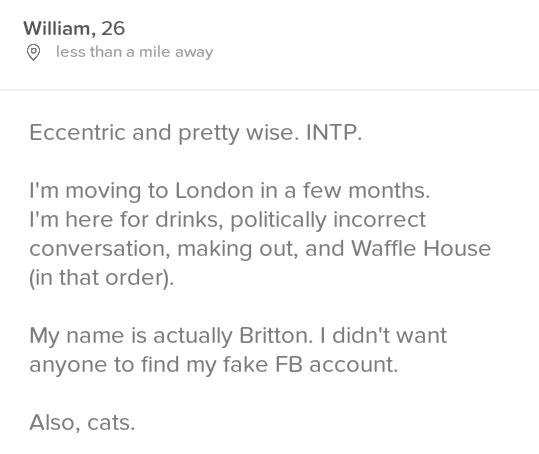
I’m Britton, as you should know, and below you’ll find the bio I wrote for my Tinder profile. If you don’t know what Tinder is, then get your head out of the sand, and read about it here.

2017-05-22 16.49.15

I was in New Orleans the other day, getting my swipe on, and then I came across this fine, older lady.

2017-05-22 12.40.00

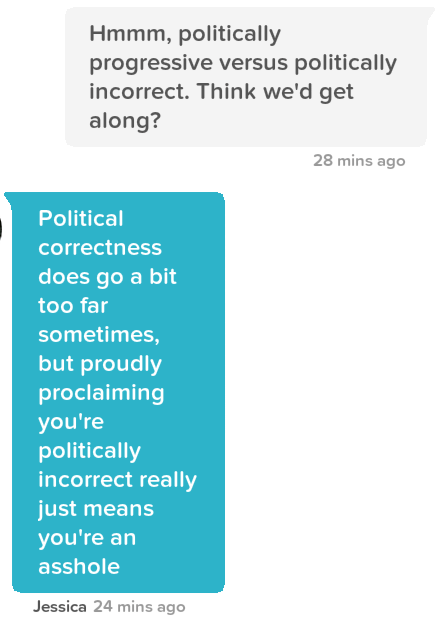
The first things, ‘politically progressive’ and “the f-word”, I admit, probably should have raised red flags before even her shitty taste in music did. Those terms on their own hint at far-left political views, but the two of them together scream ‘SJW‘. However, she was hot, and that’s very rare of feminists, so I read into her words and saw deeper possibilities. I was hoping that maybe we could talk some philosophy, giving her the benefit of the doubt that her knowledge on that subject wasn’t confined to new-wave feminist crap. Hey, maybe she was even a feminist of the second-wave, non-radical kind, and ‘progressive’ just meant that she was kind of liberal and open to reasonable and necessary change. Maybe she’d even have a cat named Elvira. With this optimistic attitude, I swiped right and immediately tested her humor to see how “open” she really was.

2017-05-22 12.24.23

BOOM! No fun or games with this one. Did I “proudly proclaim” that I am politically incorrect? Reread my bio, and let me know. I think I’m just straightforward about what I want out of my Tinder experience. She could have easily swiped me left if my intentions didn’t line up with hers. Looking back, though, maybe I should have ended my first message with a winky face. 😉

2017-05-22 12.26.28

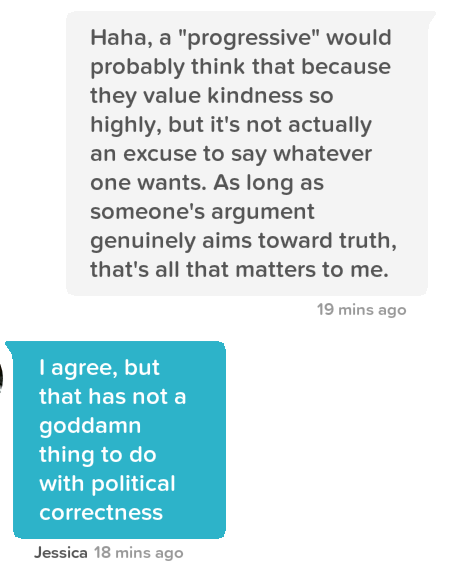
Do you value truth, Jessica? DO YOU? We’ll find out. Also, Jessica, I’ll be addressing you directly from here on. Wait, is it ok that I call you by your name, or would you prefer something else? I don’t want to be too incorrect and risk “invalidating your existence“.

2017-05-22 14.12.41

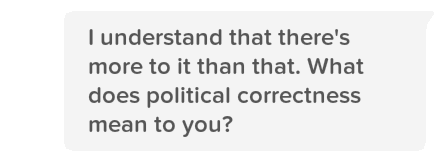
Yeah, let’s define a term together! That sounds like a fun philosophical exercise. Maybe you’ll even return the favor by asking me how I would define the term, and then we’ll find some common ground, bettering both of our conceptions of the world. Learning stuff is fun! You read philosophy, so you agree, right?

2017-05-22 12.29.22

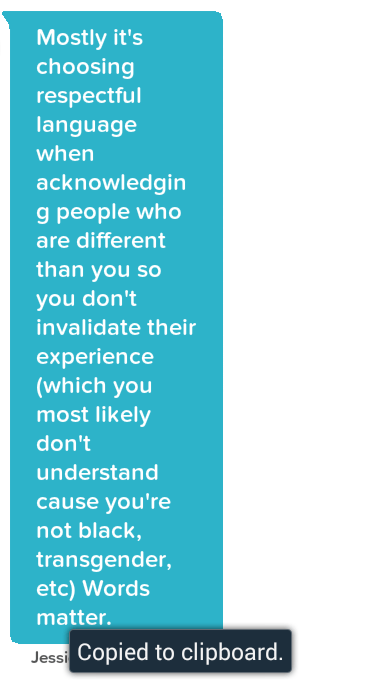
Annnnnd there it is. You pretty much nailed it, Jessica. I’m guilty of whiteness, so there’s no need to ask me what I think ‘political correctness’ means. Your understanding of how language works, on the other hand, seems a bit strange, and the philosophy you read may be of questionable quality. My validity on that topic comes from my education in linguistics and philosophy of language. But, you’re attempting to “invalidate” me because I’m… white? Hmmm.

I don’t think that speech is an activity so consciously aimed toward respect, nor do I think it’s a good idea to blindly respect people at all. In fact, it’s dangerous. I’ll spare you the technical linguistic part of the argument because I’m starting to sense that you have a screw or two loose, but I still must address the respect-issue.

Also, how are you so sure that I’m not black or transgender? If you respected me, then you would have asked about my preferred identity because race and gender are determined whimsically and have no biological basis, correct? No, you should have simply requested a dick pic, Jessica. Truth requires evidence, and I have plenty of it.

2017-05-22 12.31.40

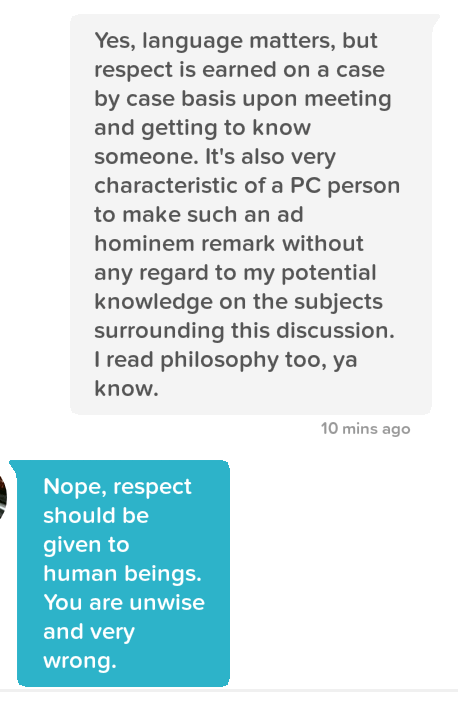
So, maybe there’s more to political correctness than your definition, Jessica, and maybe I know some stuff that you don’t. Maybe you’d be interested in hearing it. Maybe if you weren’t so keen on blindly respecting others, then you wouldn’t be so liable to get mugged and raped in a dark alley in New Orleans. Or, maybe you’d like that because you’d become a martyr for your ideology. At this point, you’re not giving me any reason at all to respect you, but I do fear for your safety. After all, you’re right that the world isn’t a very kind place.

2017-05-22 14.39.072017-05-22 14.40.34

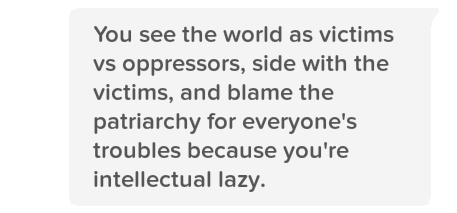
I figured I’d play the “patriarchy” card since you already accused me of being part of it by virtue of my straightness, whiteness, and maleness. What did you expect? Why did you swipe me right if you hate me by default, unless you wanted to hate-fuck me (shit, I may have missed my shot)? I mean, you’ve seen my pictures. Chances are that I’m not black under my clothes. In fact, I’m even WHITER there. Well, actually, there is a very small part of me that is kind of tan.

2017-05-22 12.35.42

2017-05-22 15.00.48

*ignores grammatical errors and moves on*

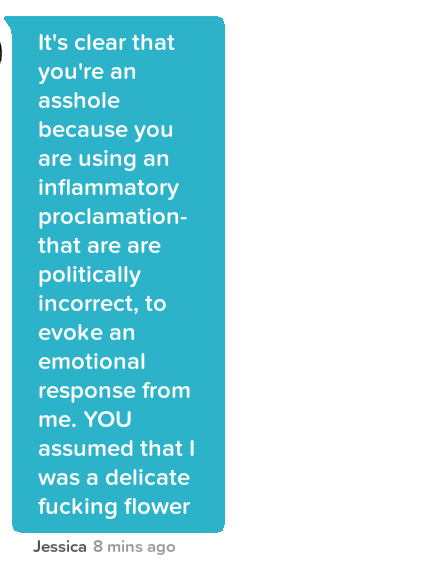
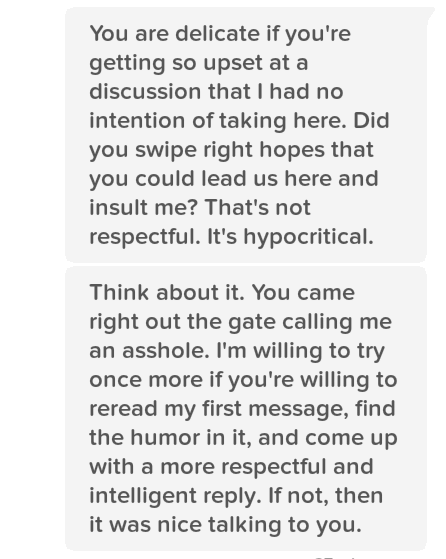
I know I’m an asshole, Jessica. There is no need to repeat yourself. But, does being an asshole make me wrong? No, Jessica, you’re the meanie who committed ad hominem. I also didn’t appeal to emotion to argue my point. You just took it that way. Taking offense and giving it are NOT the same thing. That’s Philosophy 101.

But…do save me! Please save me from my problematic ways so I can be more compassionate like you and make the world a more progressive place! Or, do I need a degree in women’s studies to be infected with your profound wisdom? If it’s LSU that infected you, then you’re right that there is no hope for me because I dropped out of that poor excuse for a higher-education institution after just one semester of grad school.

On the other hand, I could help you by revealing your greatest contradiction, and maybe even give you one more chance to get laid by me, knowing well that so few men would have gotten even this far with you. I mean, this is Tinder. Why else would you be here? Yeah, that’s what I’ll do because I want some too. I’ve learned to accept that liking sex makes women delicate flowers and men oppressive misogynists. It’s cool, really, I don’t need to be reeducated. I’ll even let you play the role of misogynist, and I’ll be the victim, and you can oppress deez nuts all you want.

2017-05-22 15.11.27

That’s where it ended. So…

What the hell is going on here?

I don’t think that I need to go into detail about what is going on here. There are plenty people who have done that very well already. For example, Dr. Jordan B. Peterson in this brilliant snippet from the most popular podcast in the world. The general point I want to make is that we are in a strange place where people like Jessica are multiplying exponentially by the semester, thanks to politically correct ideology infecting universities, business administrations, legislature, and now even Tinder (as if Tinder doesn’t already have enough spam)! This is the time for talented and capable people, mostly men, to stop ceding power to the people who live in those boxes; they’re wrong, and they’ve snuck their way into power without truly earning it. To stand up for truth is to stand up for yourself. However painful that may be now, it is absolutely necessary for the survival of our species. After all, if we were all angry, 35-year-old feminist virgins, of course humanity would end.

Since we aren’t all like Jessica, one day we will be without these people completely. Let’s give them what they want: spare their feelings, thus depriving them of the open, truth-seeking dialogue that would mold them into stronger moral beings and free them from the narrow and suffocating constraints of the feminist ideology. Since they aren’t open to that sort of thing, they will eventually self-extinguish under their childless philosophy and rot in the miserable hell that they’ve created for themselves.

Who Has Midlife Crises and Why

Psychologist Carl Jung spoke of a process called ‘individuation’ whereby one gains an elevated degree of self-awareness and is therefore able to take crucial steps toward cultivating his ideal personality (i.e. ‘self actualization’ in Maslownian terms). In layman’s terms, this process is called a ‘midlife crisis’. My proposal is that this is a period of growth that everyone experiences, and the sooner it happens, the easier it is to overcome.

According to social convention and many professional circles of psychology, a midlife crisis is considered a bad thing. For example, a psychiatrist named Sue may claim to have seen this instance many times before. Sue describes it empirically as stress at work and in the family that has accumulated over time, and then it was suddenly unleashed in different forms. This places the blame on the individual for not communicating his inner thoughts and feelings as they arose, so Sue will offer her therapy services to fix the problem by teaching better communication.

A neurotherapist named Ben might also claim to have seen this many times before, but he will take a more materialist approach. Ben will confine the problem to the brain by assuming that something simply went wrong with his neural functioning, and that the matter is beyond his control. He might suggest that the only solution is to undergo neurotherapy in his clinic to realign normal neural pathways in the frontal lobe of the brain.

Both the Sue and Ben, as well as most people in general, see this crisis as a problem that needs to be fixed, and that the only way to do that is via the specific methods in which they have been trained. “I understand. Let me handle it. You can trust me.” is what they will tell their potential patient. Given their wall of shiny degrees in there cozy, inviting office, it is difficult to turn down their offer no matter the cost, as long as they can convince you that you need it.

More likely than not, both Sue and Ben are acting in their own self interests first. They are business people as well as medical professionals. Indeed, the term ‘crisis’ itself carries a derogatory tone, and the professionals have learned to capitalize on that. Their outward warmth, their technical language, their comfortable offices, their alleged understanding the situation, etc. are tactics that they use to keep their business running. That is not to say that their practices are completely useless, but rather, that either service will likely have more or less the same effect for the very same condition because neither comes close to attacking the root of the issue. In fact, they unknowingly focus on fixing the same exact thing (outward communication of inward feelings) since language expressions are actually channeled through the frontal lobe of the brain!

Meet my friend Jay. Jay is 38 years old, and he is an officer in the military. To this point, Jay has led a respectable life of service and duty. He is a devout Christian, goes to church every Sunday, and does community service with his church. He worked hard in high school and in Boy Scouts; he graduated and became an Eagle Scout; he went to college, worked hard, graduated, joined the military as a lieutenant, worked hard, got married, worked hard, had two kids, and then he continued to work hard to maintain that for the years following. Jay is a doer: Make a decision, work hard at it, and you will lead a successful life.

Jay never really questioned the position he was in, and things seemed to be going great, but then, seemingly out of nowhere, he began to have what is commonly known as a midlife crisis. He became a bit depressed and self-conflicted. His temper shortened, and he frequently had emotional outbursts at his wife and kids. With some reluctance, he finally agreed to grant his wife’s request and seek help. He began going to Sue, the psychiatrist, both alone and with his wife. Things seemed to improve for one or two days following each session, but then he would revert back to his ordinary behavior. Sue’s methods weren’t really working for Jay. He got impatient and started to believe that the process was being prolonged, and that he was spending more money than he needed to.

Jay began to seek other forms of help, and then he discovered Ben’s neurotherapy practice. Upon first meeting Ben, he felt a bit more confident moving forward. Ben explained, using much technical jargon, how important the brain is in processing information and making decisions. Though the claim that the brain is important is true, indeed it is necessary, he went on to convince Jay further that his methods were “more scientific” than traditional therapy because they are “backed by modern neuroscientific research”. Jay became convinced that neurotherapy was the answer, and he began treatment. After a few months, however, as Jay’s optimism wore off, so did his patience; his behavior took the same turn that it did before and after psychiatric therapy. He began to feel misled into thinking that these therapists were offering a sure-fire, algorithmic solution that was actually, in some sense, a scam. It turns out that he was right.

The absolute root of a “crisis” is unknown to Sue and Ben because it is, in the conventional sense, unknowable. A crucial part of it deals with knowledge that does not likely have its foundations in the material world, nor is it solvable by simply making a few practical, sure-fire adjustments in one’s everyday life. Therefore, it should come as no surprise that most people like Jay have so much trouble wrapping their minds around something that is different in nature from their materialism-based work and education and their practical, habit-based personal lives, especially when the people who they put their trust and money in are misleading them. It is difficult for them to realize that there is more to themselves than their brains, bodies, and the feedback they gather from the external social and material world. This was exactly Jay’s predicament. He wanted to put his trust into a system to manage his life from the outside-in, but nothing was working. He was forced to turn inward and deal with it himself.

There is a continuous process of personality development in everyone, and without its sufficient maturation, one simply cannot optimally handle the stresses of life. Understanding a midlife crisis, or any crisis for that matter, and taking steps to solve it is a personal journey. It requires one to discover, embrace, and cultivate the auxiliary side of the personality in conjunction with the continuing development of the dominant side. What I am alluding to is certainly not to have solved this puzzle for everyone, necessarily, but rather that it is each person’s job to solve their own puzzle for themselves. There is indeed a highly-effective model one can keep in mind to better understand the self and its place in the world: the cognitive functions as described by Carl Jung.

Immediately, one might question this method. Good. You should, but don’t question it without knowing anything about it, or at least in a way that presupposes bias. It is a continuously developing theory outside of institutional psychology. The reason for this is simply that it does not seem to fit the existing ideology of institutional science on a broader scale: materialism – all reality in the universe is founded on and comprised of quantifiable matter and energy. I have explained in several previous posts, just as well as several professional scientists and philosophers have explained in recent years, why science must move past the materialist worldview in order to progress, no matter the cost. That is not up for debate, so I will prevent any further discussion on the matter by saying this: To dismiss Jungian psychology on the basis of their being “no evidence” for it presupposes that the only evidence is the type that materialism relies on. This is circular reasoning. There in fact has been no materialist attempt to disprove it to begin with. In other words, to stick to such an unsupported principle is to assume it is “guilty until proven innocent”, as in wrong-until-proven-by-materialism. The premise for my proposal here is about people. All people are unique, but there are baseline psychological tendencies by which we operate. This is, as we should all agree, indeed obvious upon any amount of close observation of one’s social environment. That, I will submit, is in itself a form of evidence worthy of a discussion. Having said that…

Each person’s dominant cognitive function, according to Jung, is either introverted or extroverted, and either a mode of judgment or perception. There are two ways of making judgments (thinking and feeling) and two modes of perception (sensing and intuiting). If one’s dominant function is inwardly perceptive, say, introverted intuiting (Ni), then his auxiliary (secondary) function will be an outward mode of judgment, either extroverted thinking or feeling (Te/Fe), to balance out the dominant function.

Of course, everyone necessarily has the capacity to both perceive and make judgments, to extrovert output and introvert input, to think and feel, to sense and intuit; we otherwise would not be able to survive in any social or professional setting. We all do all of those things to varying degrees, indeed. One of those functions, however, is naturally dominant. It is our own personal “standard operating procedure” under normal conditions. When we are confronted with a crisis, we are forced to operate with more depth; i.e. we must work harder do deal with the death of a loved-one than to decide what to wear to go to church, obviously. This does not mean we abide by our SOP more closely than usual. In fact, it implies the opposite: that we must be more flexible about our dominant function. We need balance between our most dominant modes of perception and judgment in order optimally deal with stressful situations. The auxiliary function is what we all struggle with cultivating at some point in our young adulthood to middle-aged lives. It is the one that is more repressed, but it is necessary to use in support of our dominant function if we are to deal with crises healthily.

Whether one is introverted or extroverted in general depends on whether his dominant function is introverted or extroverted. An introvert will likely develop his extroverted auxiliary function earlier in life than an extrovert will develop his introverted auxiliary function because, especially in extroverted-dominated western societies like the United States, functioning in an extroverted fashion is forced upon introverts. Extroverts more easily fit in right from the start, but they have personal crises later in life.

Jay, for example, is Te (extroverted thinking) dominant, which means he is an extrovert with left-brained thinking tendencies. He is outgoing, decisive, and abides by cold, hard, logical systems (e.g. mathematics, law, protocol, etc.) to make judgments about reality. This is very useful in his military environment which values this type of rule-based reasoning very highly. He has a wide circle of social and professional connections and makes a good living. From the outside-looking-in, he is viewed as a success by his peers; the American dream is very Te-focused, and Te-dominants (and Fe) are the most likely to buy into it. However, on a more personal level, as he is learning in his midlife, he is only outwardly, not inwardly, organized. An introverted thinking-dominant (Ti) personality, by contrast, will have a well-structured, internal set of logical rules and principles, but to other people, he may seem outwardly messy and disorganized because he dismisses conventional rules.

For his entire life to this point, Jay has identified himself based on the rules that he followed (by his commanding officer at work, by the Bible in his moral decisions, and by his wife at home). He lived the first half of his life constantly focused on planning for the future and managing himself in an outward fashion. He was accustomed to getting things done – acting now and thinking later. Now that things have settled down, there is no more planning to be done. What is he to do?

The answer is: Don’t do anything. Think. Process. Reflect. Jay’s most obvious problem is that he was not able to turn inward and think independently, apart from the rules set before him. He had been so busy living up to standards external to himself, he had never even considered himself to be a conscious, independent, introspective being. In fact, he was afraid to because he naively associated introspection with feelings, and feelings with weakness. That, after all, is the popular opinion in American culture.

Jay’s midlife crisis is common among all left-brained judging (Te or Fe dominant) personalities, who encompass about half of the American population according to psychologist David Keirsey who was a leader in modernizing Jung’s principles in the 70s and 80s. This process manifests itself in different ways and at different times.

First thing’s first: we need to change our terminology. This crisis is not really a “crisis” at all, in fact; it is a period of growth whereby the extrovert discovers the introverted side of his or her personality, or the introvert attempts to align his internal rules with outer reality. Jay’s dominant function, as I have mentioned, is called extroverted thinking. It is a way of making judgments: being quickly decisive and taking impartial action based on established rules. What he lacks is a cultivated ability to inwardly process the information that he is acting on. That function is a mode of perception. Jay’s perceiving function, once cultivated, will act as the support for his decision-making, and will improve that process to a huge degree. The perceiving function specific for Jay is called introverted sensing (Si). This function collects data based on personal experience, traditions, and principles for the sake of themselves. His personality suits the military and other managerial positions perfectly. When his auxiliary Si is underdeveloped, he follows the rules and doesn’t question them, while almost entirely neglecting his own interests.

What it means for Jay to develop his auxiliary Si function is to improve the way he collects and interprets data and flexibly adapts his existing principles to the constantly-changing environment. This is an internal process. It will improve the way he perceives himself in relation to the data as well as the way he perceives the data itself. He will use this introverted Si perception in conjunction with his dominant Te judgment to make well-rounded decisions.

I used Jay as an example because he possesses the most common type of Jungian personality construction among men in the United States (ESTJ according to Myers-Briggs). The most common type for females (ESFJ) is very similar (Fe/Si dominant/auxiliary instead of Te/Si). If you don’t relate to Jay or his Fe counterpart, that is fine. There are 14 other forms of cognitive functioning, according to Jung. And that is not to take anything away from the individuals within each of those categories. As with anything, there is an immeasurably wider variety of uniqueness among individuals within each group than there are generalized differences among the groups themselves. Having said that, Jungian cognitive typology is not more than a guideline, albeit a very effective one, to keep in mind as one deals with the struggles of life. At the same time, however, don’t blame anyone other than yourself if you reject the system out of principle alone amid a personal crisis.

Cheers!