Tinder Fun With a Feminist

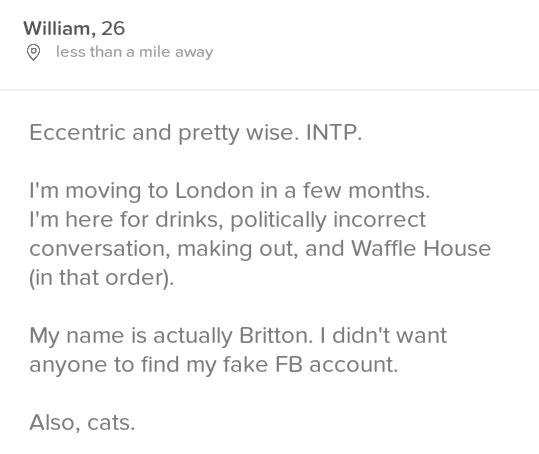
I’m Britton, as you should know, and below you’ll find the bio I wrote for my Tinder profile. If you don’t know what Tinder is, then get your head out of the sand, and read about it here.
2017-05-22 16.49.15

I was in New Orleans the other day, getting my swipe on, and then I came across this fine, older lady.

2017-05-22 12.40.00

The first things, ‘politically progressive’ and “the f-word”, I admit, probably should have raised red flags before even her shitty taste in music did. Those terms on their own hint at far-left political views, but the two of them together scream ‘SJW‘. However, she was hot, and that’s very rare of feminists, so I read into her words and saw deeper possibilities. I was hoping that maybe we could talk some philosophy, giving her the benefit of the doubt that her knowledge on that subject wasn’t confined to new-wave feminist crap. Hey, maybe she was even a feminist of the second-wave, non-radical kind, and ‘progressive’ just meant that she was kind of liberal and open to reasonable and necessary change. Maybe she’d even have a cat named Elvira. With this optimistic attitude, I swiped right and immediately tested her humor to see how “open” she really was.
2017-05-22 12.24.23

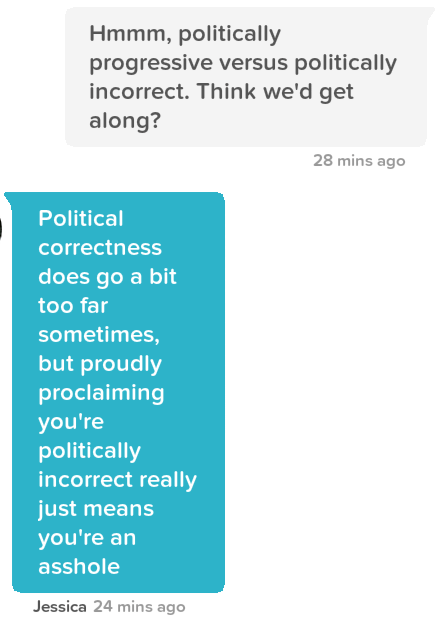
BOOM! No fun or games with this one. Did I “proudly proclaim” that I am politically incorrect? Reread my bio, and let me know. I think I’m just straightforward about what I want out of my Tinder experience. She could have easily swiped me left if my intentions didn’t line up with hers. Looking back, though, maybe I should have ended my first message with a winky face. 😉
2017-05-22 12.26.28

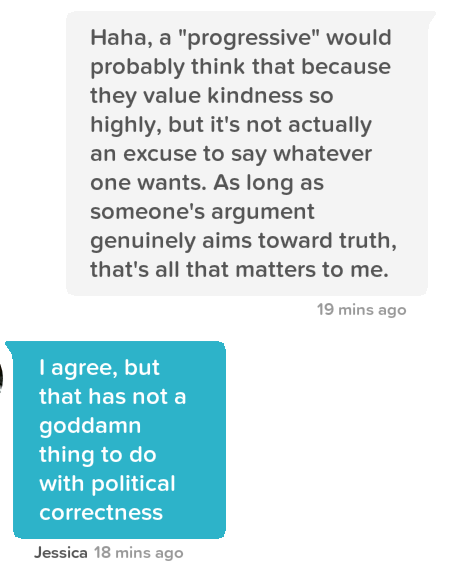
Do you value truth, Jessica? DO YOU? We’ll find out. Also, Jessica, I’ll be addressing you directly from here on. Wait, is it ok that I call you by your name, or would you prefer something else? I don’t want to be too incorrect and risk “invalidating your existence“.
2017-05-22 14.12.41

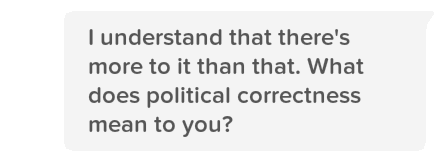
Yeah, let’s define a term together! That sounds like a fun philosophical exercise. Maybe you’ll even return the favor by asking me how I would define the term, and then we’ll find some common ground, bettering both of our conceptions of the world. Learning stuff is fun! You read philosophy, so you agree, right?
2017-05-22 12.29.22

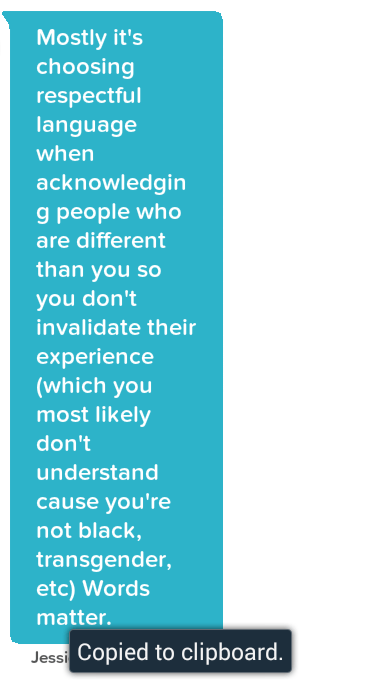
Annnnnd there it is. You pretty much nailed it, Jessica. I’m guilty of whiteness, so there’s no need to ask me what I think ‘political correctness’ means. Your understanding of how language works, on the other hand, seems a bit strange, and the philosophy you read may be of questionable quality. My validity on that topic comes from my education in linguistics and philosophy of language. But, you’re attempting to “invalidate” me because I’m… white? Hmmm.

I don’t think that speech is an activity so consciously aimed toward respect, nor do I think it’s a good idea to blindly respect people at all. In fact, it’s dangerous. I’ll spare you the technical linguistic part of the argument because I’m starting to sense that you have a screw or two loose, but I still must address the respect-issue.

Also, how are you so sure that I’m not black or transgender? If you respected me, then you would have asked about my preferred identity because race and gender are determined whimsically and have no biological basis, correct? No, you should have simply requested a dick pic, Jessica. Truth requires evidence, and I have plenty of it.
2017-05-22 12.31.40

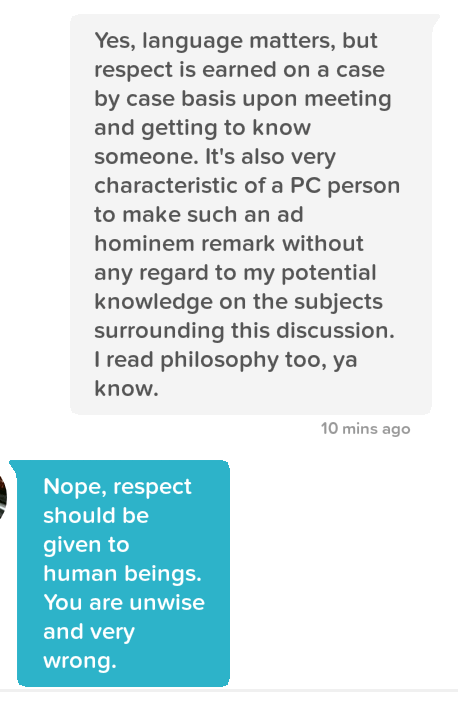
So, maybe there’s more to political correctness than your definition, Jessica, and maybe I know some stuff that you don’t. Maybe you’d be interested in hearing it. Maybe if you weren’t so keen on blindly respecting others, then you wouldn’t be so liable to get mugged and raped in a dark alley in New Orleans. Or, maybe you’d like that because you’d become a martyr for your ideology. At this point, you’re not giving me any reason at all to respect you, but I do fear for your safety. After all, you’re right that the world isn’t a very kind place.

2017-05-22 14.39.072017-05-22 14.40.34

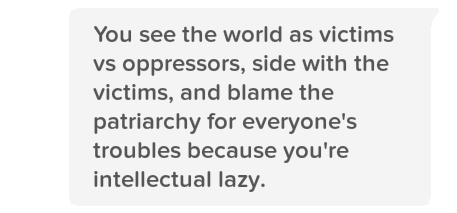
I figured I’d play the “patriarchy” card since you already accused me of being part of it by virtue of my straightness, whiteness, and maleness. What did you expect? Why did you swipe me right if you hate me by default, unless you wanted to hate-fuck me (shit, I may have missed my shot)? I mean, you’ve seen my pictures. Chances are that I’m not black under my clothes. In fact, I’m even WHITER there. Well, actually, there is a very small part of me that is kind of tan.

2017-05-22 12.35.42

2017-05-22 15.00.48

*ignores grammatical errors and moves on*

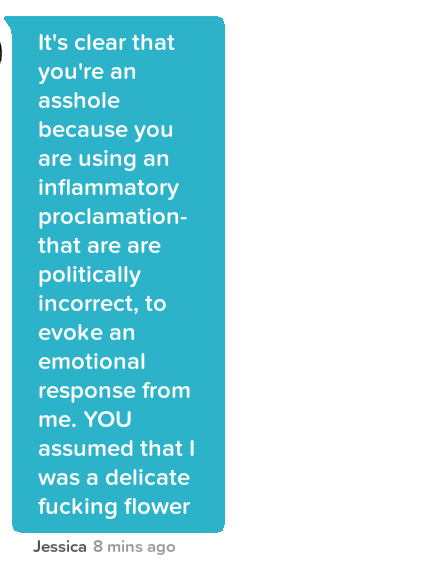
I know I’m an asshole, Jessica. There is no need to repeat yourself. But, does being an asshole make me wrong? No, Jessica, you’re the meanie who committed ad hominem. I also didn’t appeal to emotion to argue my point. You just took it that way. Taking offense and giving it are NOT the same thing. That’s Philosophy 101.

But…do save me! Please save me from my problematic ways so I can be more compassionate like you and make the world a more progressive place! Or, do I need a degree in women’s studies to be infected with your profound wisdom? If it’s LSU that infected you, then you’re right that there is no hope for me because I dropped out of that poor excuse for a higher-education institution after just one semester of grad school.

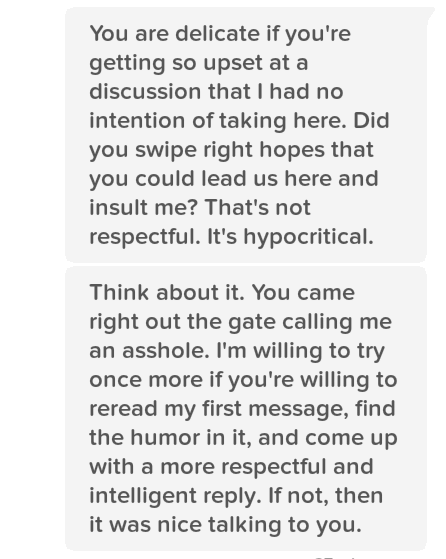
On the other hand, I could help you by revealing your greatest contradiction, and maybe even give you one more chance to get laid by me, knowing well that so few men would have gotten even this far with you. I mean, this is Tinder. Why else would you be here? Yeah, that’s what I’ll do because I want some too. I’ve learned to accept that liking sex makes women delicate flowers and men oppressive misogynists. It’s cool, really, I don’t need to be reeducated. I’ll even let you play the role of misogynist, and I’ll be the victim, and you can oppress deez nuts all you want.
2017-05-22 15.11.27

That’s where it ended. So…

What the hell is going on here?

I don’t think that I need to go into detail about what is going on here. There are plenty people who have done that very well already. For example, Dr. Jordan B. Peterson in this brilliant snippet from the most popular podcast in the world. The general point I want to make is that we are in a strange place where people like Jessica are multiplying exponentially by the semester, thanks to politically correct ideology infecting universities, business administrations, legislature, and now even Tinder (as if Tinder doesn’t already have enough spam)! This is the time for talented and capable people, mostly men, to stop ceding power to the people who live in those boxes; they’re wrong, and they’ve snuck their way into power without truly earning it. To stand up for truth is to stand up for yourself. However painful that may be now, it is absolutely necessary for the survival of our species. After all, if we were all angry, 35-year-old feminist virgins, of course humanity would end.

Since we aren’t all like Jessica, one day we will be without these people completely. Let’s give them what they want: spare their feelings, thus depriving them of the open, truth-seeking dialogue that would mold them into stronger moral beings and free them from the narrow and suffocating constraints of the feminist ideology. Since they aren’t open to that sort of thing, they will eventually self-extinguish under their childless philosophy and rot in the miserable hell that they’ve created for themselves.

The Slate, the Chalk, and the Eraser

Prerequisite reading: “WARNING: Your Kid is Smarter Than You!”

A mark of good critical thinking, let’s say, as it applies to science, is that it is always attempting to prove itself wrong. It challenges its most fundamental assumptions when unexpected results arise. We can do this in our everyday lives when we make decisions and formulate our own views. We are only truly challenging ourselves by trying to find flaws in our own reasoning rather than trying to confirm our views. It is easy to confirm our beliefs.

Let’s take astrology as a personal-scientific example. Sparing you the details, based on what little research has been done to refute it, astrology is seen as invalid, and therefore, a pseudoscience, by the standards of modern mechanistic science. However, that does not preclude one from believing in it – in confirming it or any of its insights to themselves. Now, one is not thinking critically by simply believing that astrology is a pseudoscience (or that it is legitimate science). That would be to put too much trust in other people’s thinking. What reasons can you give to support your own belief, and what does it mean?

One can wake up every morning, read their daily horoscope, and upon very little reflection, come up with a reason or two for how that horoscope applies to his or her life. On one hand, those reasons might be good ones, founded on an abundance of personal experience. The horoscope’s insights might serve as something to keep in mind as one goes about his or her day, and that can be a very helpful thing. On the other hand, however, the reasons might be mere, self-confirming opinions. They might be the result of the person’s ideological belief in astrology in general. That can be harmful if the person attempts to apply astrological insights to contexts which it is inapplicable. This is an example of how the confirmation of a specific belief, not the belief in itself, can be good or bad, helpful or harmful, depending on how one thinks about it and the reasons he or she gives for it. The question of whether it is right or wrong, correct or incorrect, is neither important nor provable.

In order to formulate views that are not mere opinions, we must expose ourselves to views that oppose the ones we already hold dear to our hearts. This is difficult for adults. Most of us have been clinging to the same beliefs since we were children or young adults. This is where children have a huge advantage. They don’t yet have views of their own. The sky is the limit to how they can think and what they might believe. Their handicap, though, is that they do not control what they are exposed to. They cannot (or perhaps, should not) search the internet alone, drive themselves to the library, proficiently read, or precisely express themselves through writing or speech. They are clean slates, and that ignorance not only gives them huge potential, but it also leaves them extremely vulnerable.

The Analogy

You may have heard this analogy before, but I will attempt to add a bit of depth to it.

A child’s mind is a slate, as are those of adults (though, arguably, much less so). It is a surface on which we can take notes, write and solve equations, draw pictures, and even play games. We can create a private world with our imaginations. For all intents and purposes, there are no innate limits to how we can use our slates. Maximizing our potential, and that of children, is up to the tools we use.

First, we need something to write with, but we shouldn’t use just any writing tool. Chalk is meant to be used on slate because it is temporary. It can be erased and replaced. If one were to write on a slate with a sharpie marker, that would be permanent. One could not simply erase those markings to make room for others. A slate has a limited amount of space.

Though our minds may not have a limited amount of space in general (there is not sufficient evidence that they do), there is a limit to how much information we can express at any given moment. That, not our mind in general, is our slate – that plane of instant access. The writing tool is our voice – our tool of expression. If we write with a sharpie, it cannot be erased. We leave no room to change our minds in the face of better evidence to the contrary. If we write with chalk, we can just as clearly express our ideas, but we also leave our ideas open to be challenged, and if necessary, erased and changed. It is also easier, for in the process of formulating our ideas with chalk, we need not be so algorithmic. We can adjust our system accordingly as we learn and experience new things.

The smaller the writing on the slate is, the more one can fit, but the more difficult it is to read. Think of a philosopher who has a complexly structured system of views. One detail leads into the next, and they all add up to a bigger-picture philosophy. It might take one’s reading all of it to understand any of it. That can be difficult and time-consuming, and not everyone has the patience for it. The larger the words on the slate, however, the easier it is to read, but the less there will be, so it risks lacking depth. Think of a manager-type personality who is a stickler for rules. He is easy to understand because he is concise, but he may lack the ability to explain the rules. People are irritated by him when he repetitively makes commands and gives no reasons for them. Likewise, children are annoyed when their parents and teachers make commands with no reasons to support them, or at least, no good ones (e.g. “because I said so”).

So, the slate represents the plane of instant access and expression of information, and the writing tool, whether it be chalk or a sharpie, represents our voice – our tool for expressing information and ideas. What does the eraser represent? The eraser represents our willingness to eliminate an idea or bit of information. It represents our willingness to refute our own beliefs and move forward. It represents the ability to make more space on our slate for better, or at least more situation-relevant, information. It represents reason. If one writes with chalk, the eraser – reason – holds the power. If we write with a sharpie, the eraser becomes becomes useless.

The Analogy for Children

I explained in my last post “WARNING: Your Kid is Smarter Than You” that it is important for parents and teachers to teach their kids how to think – not what to think – but I did not offer much advice on how to actually do that. I will not tell anyone, in detail, how to raise or educate their children. Each has a different personality and needs to be catered to through different means. I will, however, offer a bit of general advice based on the analogy above.

The way to teach children how to think (after already having done it for yourself, of course, which is arguably much more difficult) is NOT to hand the kids sharpies, for they will never learn to use an eraser. Their statements and beliefs will be rigid and lack depth of understanding. Granted, this might make them a lot of money in the short-term, but it will also significantly reduce their flexibility when they encounter real-life situations (outside of the institutions of school and work) that require them to think for themselves. This will inevitably limit their happiness from young adulthood to beyond.

Instead, simply hand them a piece of chalk. It is not even important to hand them an eraser, initially. Kids will figure out, after much trial and error, their own way to erase their slates. Eventually, they will find on their own that the eraser is a very efficient method to do so. Literally-speaking, they will express themselves and reason through their problems until they find the most efficient methods – by thinking for themselves, but only as long as they have the right tool.