A Morning Meditation

“I really only love God as much as the person I love the least.”

-Dorothy Day

Your love for God, your understanding of the world, your connection to nature and the universe, your pursuit of Truth — however you view the metaphysical source and governing body of all things — exists in all, and in it are all contained. Every part is necessary for the functioning and flourishing of everything else in it, and therefore, your willful coherence with all else is necessary for your functioning and flourishing as well.

Of course, people can act in a way that you will perceive to be out of line, but that should be just fine as far as you are concerned. This raises the distinction between acceptance and tolerance, for an individual possesses the capacity — which each also has a duty toward themselves and others to cultivate — to accept everything and tolerate nothing. That is to intuit, without interference from emotion or sense, what is true and good for one and for all and not to tolerate, to the extent that one can be locally effective, anything that is not.

This process is not about you. You may need to focus on yourself for some time — to build a boundary between yourself and others for some time — to get to know certain aspects of yourself to the point where intuitive reflection is at all possible. But, that is not the goal. You are not the goal. Total coherence is the goal, and you have a vital duty to play your role. The separation you create between yourself and others is merely so that you may discover what that role is. However, others will play a role in determining how it is that you will provide value to all (of which they are a part), so your engagement with them is ultimately necessary. It may not be what you expect or desire, but that is why one must tame the ego fire.

To cohere with all does not mean you must work with just anyone, but rather that you must accept them for where they are and what role from which they are capable of serving, depending on where they are on their path of spiritual development, whether that be to feed the poor and heal the sick or to delve into self-destructive hedonism before hitting rock bottom to merely realize they exist. Regardless, they are in need of your love, from near or far, and that implies full acceptance. Without that, there is incoherence, and thus, incompleteness. Your love for God, nature, truth, others, and yourself is only as good as your love for the one who you love the least, for they too play a role that is necessary for you.

Though, again, that is not the goal…

American Impressionism: Representing the Western Ideal

On the 10th of July, 2017, I had the pleasure of attending a talk on American Impressionism at the American Museum of Western Art in Denver, Colorado, and to view their impressive (pun intended) Anschutz Collection of works. The experience gave me much to think about, including but not limited to the differences between American and French Impressionism, both in terms of style and purpose, and how impressionism uniquely fulfills the purpose of art more generally. As a philosophizer with an interest in aesthetics, rather than as an artist, I naturally am more inclined to discuss purpose than I am style and technique, though those things are not mutually exclusive.

fffe1e42c2bf6c51c589541cca7f1303

On the Critique of Art

It is an interesting thing that philosophers do in discussing meaning and purpose of art. One symptom of this activity is that we often take for granted the technical skill of the artist in favor of a work’s meaning or lack thereof. We take for granted that the artist is satisfied with the degree to which he has shown what he intended to. We take art as a top-down process, while for the artist, it is a bottom-up process. For this reason, we hold art to a very high standard, and that puts pressure on the artist to show us something true, assuming, often falsely, that they are trying to show anything at all. Perhaps we should show more gratitude to the artist in this regard, for the technique is the necessary tool, usually cultivated over many a year, through which the artist expresses what is dear to us or, at the very least, to them. That is the disclaimer I would like to preface with before I go on philosophizing. I am not a visual artist myself, and I do admire those who are proficient in that medium, even if they do so with no or poor intention.

Anyway, and on that note, whether the artist says what he attempts to sufficiently is its own matter, so we should approach our critique gingerly, as to see through any such shortcomings. We simply want to understand the message that lies beneath. It is the same in music, where if one really listens, the technical quality of the recording doesn’t matter. The content’s form is what matters, for it inspires the function, and intentional functions merely serve the form, as Roger Scruton shows in his BBC documentary. Very often the artist is not able to communicate his ideas in any way other than through his brush or instrument. Clearly, though, he somehow understands what he is doing. He is like a scientist of meaning in this regard, as science is a bottom-up process for the scientist who hopes (naively) that truth will emerge from the compilation of facts, but it is also a top-down object of criticism for the philosopher.

Is this not fair, however? Does the purpose not precede the style of the work? I think any informed critic should agree that it does. To agree, one must understand what art does, generally speaking. That is to reveal something true about reality or human nature which is normally hidden, suppressed, or taken for granted. It shows us something that we as individuals or as a society need to pay more attention to. Even if that message is to show that beauty can exist in isolation and complexity, I think this point still stands.

There is also the purpose of much contemporary work which is to “be the best it can be for the sake of itself”. This purpose may, though not always, neglect the objective standard by which we might judge art (insofar as we might consider symbolic truths about reality and human nature to be objective), and it rather qualifies art according to the power of human creativity, even if the product of that creativity lacks an organized structure toward a higher purpose.

This approach to judging art is a postmodern one: here are no universal standards for anything, quality is merely relative, and meaning may be interpreted in an unlimited number of different, subjective ways with no one way being more accurate than any other. We take the human creation to be larger than the reality that gave birth to it and that permanently contains it. This is a mistake of the ego-mind. Postmodern pseudo-intellectuals (e.g. most French philosophers of the 20th century, the scientismists of today, such as Richard Dawkins and Sam Harris) make with human rationality. They worship rationality as their God and fall in love with its creations no matter how disorganized they may be, all at the expense of what the work might be trying to tell us. What postmodern art, literature, philosophy, and even science are trying to tell us, in the rare occasion that they are trying to tell us anything at all, is in fact false. Even when it does land on something true, it is by coincidence because truth was never the intention to begin with.

Does Impressionism Fulfill the Purpose of Art?

What I like about impressionism, whether French, American, or otherwise, is how subjectively true it is. One could say, in other words, that it is authentic. A good impressionist painter is skilled enough to get their message across, and it is one which only that particular artist can convey. Nevertheless, it tends to be digestible to anyone while maintaining its individuality.

Is this not the dream of the west? In its high form, western ideals, particularly in America, allow one to be one’s own authority for what is good. This can, of course, be taken too far — as to put the search for “my truth” ahead of what is the truth, but this is not the overall intention of genuine liberty. It is more a matter of not letting the how deter one from the what one decides will fulfill one — and more deeply, that the what is founded on a why that we all agree is for the good in a just society. We all have different stylistic expressions of doing what we do, but there is an underlying law of reason that maintains that our individual efforts have some universal truth and benefit.

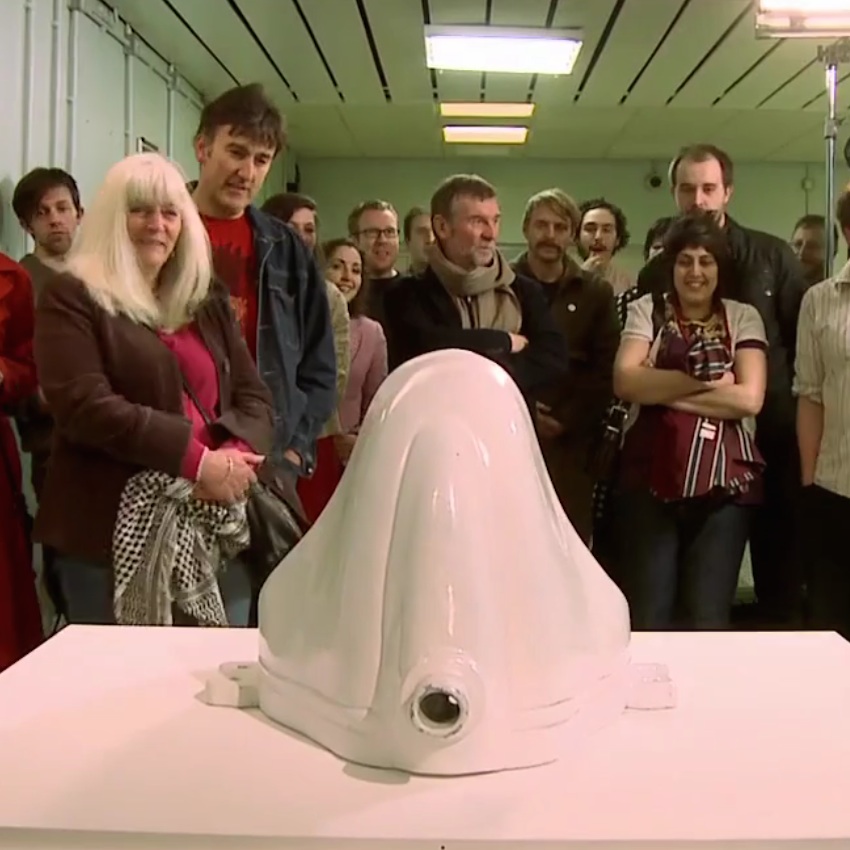
Contemporary, abstract art has no distinct subject matter, and it therefore leaves us to question whether the overall viewpoint which represents it is valid. It is, rather, an abstract perspective on an equally or more abstract subject. If the picture which the art represents is not real, then what is the representation (the art itself) worth? This probably-not-real-and-definitely-not-meaningful style of art is the perfect accompaniment to the aforementioned political and cultural climate in the west, which opposes the ideals of free expression of ancient truth on which the United States Constitution is founded, for example (supporters of this type of art, unsurprisingly, claim that beauty is subjective and are actively trying to destroy traditional values in education and politics). It values “my truth” over the truth, and in convincing the collective ego that “my truth” is a worthwhile pursuit, it tears people further away from meaning, leaving them as weak, powerless, and confused as an otherwise perfectly rational person observing Duchamp’s “Fountain” (it’s just a urinal) would be. Contemporary art is a movement representing the fear of and disregard for beauty, ancient wisdom, and one’s own individual authority. Both nature per se and

1-fountain-feature

life-sustaining expressions of sexuality, as countless specific examples would show in the style’s erotic manifestations, are portrayed as unimportant or nonexistent. In this movement, nothing is sacred.

Impressionism, more gracefully, is the style of visual art, painting in particular, which contains infinitely variable impressions of things which we all know are of value beyond our selfish ends. The subject matter — nature and our relationship to it, from landscapes to lovers — maintains its sacredness and is

mtn

conveyed in a style that is especially unique. It is an abstract perspective on a concrete picture of reality, we could say. American impressionism, overall, is an easily-perceived yet highly creative expression of the many great, natural wonders of the American countryside and ways of life — i.e. the foundation on which freedom of expression itself is held as the paramount liberty, and where “trust in God (or truth itself)” is the default principle. In my travels outside of the United States, for example I have been complimented on my strong sense of self and belief that things will unfold as they should, which those people have attributed to my “American-ness”, rightly or wrongly.

Lovers

Conclusion: Is American Impressionism Superior?

…to other contemporary styles of art? It seems so. By a classical measure, American Impressionism is good because of its return to classical subjects such as nature and love, and its attempt to convey awe for their beauty, rather than to bastardize it. It holds weight by creative measures as well for its uniquely subjective approach in doing so. However, if you enjoy chaos for its own sake, you are well within your rights to prefer contemporary abstract and absurdist art forms (I’m not talking down on Eric Andre — comedy is a unique case. See my MA thesis). The difference between preference and goodness is another issue. In general, it is permitted in the west that we can have disagreements about these kinds of topics and still function, yet that the cream will still rise to the surface, and that in extreme cases, it is worth fighting for. I wouldn’t consider one impressionist seeing a landscape one way and another seeing it another way as a pressing disagreement, but rather that some people can accept what is true and good for one and for all in their own way, and others are free to reject it at their own peril, also in their own way (have fun with that).

All art movements represent something about the values of the culture from which they emerge, and it does seem that there are at least two art movements going on right now, corresponding to the two general views on life. There is the ilk of culture that glorifies what opposes traditional conceptions of beauty and, therefore, sustainable ways of life — both through art and by flaunting their mutilated bodies in the street — and these are the “progressive” folk who align their aesthetic preferences with the shock and hedonism of contemporary abstractism. Then there are those who see that we have indeed inherited some values and structures that are worth holding onto, and that true power of both individual and collective thriving requires that we agree on some foundation of abstract-yet-observable conceptions of what is true, good, and beautiful. American Impressionism, insofar as I can tell, is making a real effort to acknowledge this foundation while leaving more than enough room for individual expression. American Impressionism: universal good, subjectively understood — just like the us.

Tolerance vs. Acceptance

The difference between tolerance and acceptance is essentially a difference between being morally negligent and spiritually connected.

Tolerance, as promoted by progressive political circles and cultural movements such as body positivity and pride, masks its negligence for what is true, good, and beautiful as false compassion, seeking to covertly destroy all standards and traditions, cultural and governmental, built and conserved in the name of God since the beginning of civilized culture. This does not result in the utopian clean slate that they dream of, not that they have the wisdom or manpower to build something better in its place anyway, but delves us back to the tribal, Arian hell that was the only form of conflict resolution between humans thousands of years ago.

What one tolerates, therefore, is directly rooted in ones own view of oneself. Tolerate falsehood of the misinterpretation of information, you devalue your own intellect. Tolerate incompetence by supporting diversity quotas, and you devalue the well-being of the structures enforcing them. Tolerate anything evil, including the proposition that morality per se is relative and therefore that there is not intrinsic order or goodness to the universe, and you devalue your own soul by replacing it with your ego and outsourcing your true inner authority, making it impossible to improve and live a fulfilling life.

Acceptance, on the other hand, shows that you can detach and at least desire to understand that things are as they are, and that you don’t have control over those externals, but only over how you respond to them. Acceptance is the first step for living a true life because it exemplifies mastery over the things that one doesn’t allow to possess them. Whereas tolerance is born out of guilt, shame, anger, or pride, acceptance is a prerequisite, though merely a prerequisite, of truth, goodness, and love.

The False Dichotomy of Sex & Go-karts

I recently conducted a poll which turned out to be the largest in Instagram history with 26 million participants. The results, astonishingly, were split in dead-ass half at 13 million a piece!

The question? Only the deepest and longest-standing debate among the most serious philosophers since the beginning of speculative thought…

“Which is the funnest activity of human beings: sex or go-karts?”

They are, indeed, two sides of the same coin, for “pole position” is crucial in both activities. However, they serve reverse roles of what convention would have us believe. They also represent two different and crucial ways of thinking about how we connect to our vulnerable, inner-child selves. Before I get into that, however, I need to define these terms.

By ‘go-kart’, I don’t mean your two-seat, 10mph, Celebration Station woo-woo garbage karts. I mean real race karts at a real race track – the kind that make you shit the seat when you lose control. I mean the kind with no seat belts because if you get in an accident, it’s actually safer to be ejected. I mean the kind that, if you get it wrong, you’re fucking dead.

By ‘sex’, I don’t mean your mindless, drunken, incompetent college hookup that has you ending the night in the ER because a condom got stuck in the wrong hole. I mean the kind in which vulnerability is required and desired. I mean an intimate connection between two conscious and spiritual, sober adults who know what they want and know what they’re doing. I mean the kind where you can hold eye contact, feel things, and actually like it. I mean the kind that, if you get it wrong, you’re fucking dead.

Now, I’ll ask you again. What’s the funnest thing ever? Sex or go-karts?

No, not sex IN a go-kart. That doesn’t work. I’ve actually tried it.

I’m not favoring one over the other here (although go-karts is usually better), but they’re both crucial to our development as social individuals. Allow me to explain.

On one hand, there is go-karting. This is a child’s game, one might think, but it requires an adult’s disposition to do right. Any childish idiot can go out and play bumper cars, but the most successful professional racing drivers all got their start in karting and still do it for fun and conditioning throughout their career. It pushes the limits of the connection between their mind and machine more and more with every lap, even more so than their race cars do. Go-karting represents the solitary nature of man at his best, “running his own race” without concern for how others are running theirs, improving by milliseconds at a time, corner by corner, so that it adds up to victory in the end.

Go-karting reminds us that healthy competition is not overt – it is not the goal in itself, but rather the consequence of doing one’s best and achieving individual potential over time. Improvement happens incrementally such as in braking a bit later and accelerating a bit earlier through each corner over the course of a session. A good kart racer sees the others on track not as competitors, but as obstacles.

One’s ability to maintain control of a go-kart indicates good masculine qualities like patience, precision, and consistency. A man who steps into a go-kart and proceeds to play bumper cars and cause carnage is – make no mistake – a toxic human being. The connection between man and go-kart represents the masculine in us to focus on one thing while maintaining awareness of everything else, and to make that craft an art form which we express with our own unique style.

Go-karting is the ultimate test of solitary focus, spatial awareness, and consistency of mind-body connection. It is no wonder that Finland, one of the most introverted and happy countries in the world, has produced the most world champions per capita in all top-tier autosport categories. Their culture centers around a unique concept called “Sisu”. Sisu has no direct translation in English, but it has to do with stoic determination, cool-headedness, courage, and resilience. This concept is present in their personal mindsets and enhances individual and collective performance in any task. The Finns are hot because they’re so cool. They have those traits that make and keep panties soaking wet.

On the other hand, appropriately, there is sex. This is an adult’s game, but it requires a child’s disposition. It calls us to leave behind all responsibility just as children effortlessly do when they’re at play. Like go-karting, it does require some degree of technical skill, but it takes (at least) two, and improvement, also incremental, happens more deeply through connecting with your partner over time. To do sex well, one must let go of the ego and expectation that often traps us in a masturbatory frame of mind. Letting go of control during sex, regardless of the role, marks more feminine qualities like submission, sensuality, and presence.

Sex is supposed to be fun – and funny! A woman who is in her head during sex has a lot of baggage to work through, and that’s no fun. When she has worked through all of that, develops confidence, and gets sex right, she brings an abundance of supportive love and curious energy to a connection with another. This also requires the right man. When a man is tuned in with his partner, knows how to touch her, is technically competent, and has a soy-free diet, he can allow his dominant sexual energy to flow in a natural way that is sure to please because he has put in the work to earn her submission.

Sexual chemistry means that the participants are accommodating of and enthusiastic about satisfying each other’s needs. An abundance of trauma that prevented one from experiencing their childhood in a free and open way will affect one in mature years and prevent them from being as curious and emotionally vulnerable as one must be in order to properly enjoy sex. It will also affect one’s ability to communicate respectfully and effectively, which is the only responsibility that we should carry into the bedroom. Having worked on themselves individually while staying open to more collectively is essential.

A child can look you in the eyes without fear, ask genuine questions, and connect. When it comes to sex, we adults are terrible at this. In seeking another we are often overcompensating for abandoning our own needs, desires, and potential. The thought of improving this is terrifying, but it is equally crucial for our social and psychological development. Sex calls us to communicate in ways that a 5-year-old would understand – e.g. “I like this/don’t like that!” This is a strength. Talk more outside of the bedroom about what you like and want, and more inside it to spice it up!

Whether you prefer sex or go-karting, that may tell you something about what you need to work on or are consciously working on, depending on where you are in your journey of self-discovery. A large part of that journey involves integrating one’s optimal masculine and feminine potential. Likewise, our attitude toward children in general can reveal our attitudes about ourselves. The progressive, feminist social philosophy fashionable today lacks value for childbearing and/or for nurturing children in a healthy way that integrates the masculine and draws firm boundaries around the feminine (drawing boundaries is a masculine activity, by the way). This delusion is based on, and intended to spread, mass fear surrounding the deep spiritual value of raising children. Without facing that fear, a parent is certain to inflict their own damage onto their child, especially if single.

Remember, it is our inner-child that is triggered when we mirror each other. We are mostly turned off by others who mirror our own weaknesses and insecurities. This is exaggerated when we are mirrored by children, for they question our deepest assumptions with the utmost innocence. That simple word ‘why’ is not to be shrugged off, but should rather be taken as an opportunity to look inward as much as to inform. Regardless of what you have to work on, sex and go-karts are clearly the two funnest activities known to man when done right, so why not enjoy both? They are also deeply meditative and therapeutic, for they reveal some of our deepest weaknesses in real time.

It’s not about what you want, but about what you need. Are you slow on track? Get out there, work on your focus and discipline, and improve your craft little by little. Do you suck in bed (in a bad way)? Work on tuning in and connecting with people better, and deal with those things that their presence triggers in you. Mastering sex and go-karting is beautifully impossible, but together, they afford us unlimited opportunity for balance between our masculine and feminine and to improve giving our full attention to what is truly important, namely sex and go-karts.

Writegenstein #7: Disagreement as Misunderstanding

“611. Where two principles really do meet which cannot be reconciled with one another, then each man declares the other a fool and heretic.”

-Ludwig Wittgenstein (On Certainty)

Disagreements don’t exist — only misunderstandings do — if we take truth to exist. For a relativist, there is no difference between the two.

Furthermore for the relativist, definitions don’t exist at all.

Nor does anything exist for the relativist. To follow relativism through to its conclusion, one must be nihilistic and solipsistic, which are also unsustainable because it would follow that identity itself is impossible.

For one who accepts truth (in conscious thought, that is — for we all do in action), however, understanding is a prerequisite to opinion. An opinion is a sort of judgement. To understand is to have thought critically, and to think critically is to have observed impartially. Few who practice this method would consider their views to be mere opinions, worth just as much consideration as that of one who has no conscious basis.

Have well-reasoned perspectives, not opinions. Some “opinions” have a basis, and some do not, so we should not consider them to be of the same category. When they do, it is by coincidence. What serves as the intentional value determines which is which.

An opinion is never put forth with the intention of being true. It is either a nonsensical impulse or an attempt to be right. It will be fought for by way of rhetoric rather than reasoning. Any tools of reasoning that it employs will be inverted. For example, one might commit the appeal-to-pity fallacy in order to win the argument rather than avoid it as to not be fallacious in one’s reasoning. All well-reasoned perspectives have, at the very least, the intention of truth. Otherwise, the end is chosen at random by man, all means are justified, and logic is inverted to serve that end if it is used at all.

In summary: rhetoric is the art of debate — i.e. inverting logic to persuade someone to your side, for your ends.

Rhetoric, indeed, has a solipsistic aura to it. It is not motivated by what is good for one and for all, but rather for oneself alone. The gain can be of finances, power, status, or the appearance of virtue, all of which are superficial and, in the end, not good for oneself either. It leaves one alone, imprisoned, on one’s own island.

To reason well, by contrast, one’s only concern should be that which is true is revealed. One must be indifferent to the specifics of the outcome. To be virtuous in one’s faith is to believe that what is true is also good — to not allow one’s own motivations to intervene with that inquiry. To be naive in one’s faith is to put one’s trust in the motivations of man.

One should not even trust one’s own motivations if one cannot first observe them.

To be made in the image and likeness of God means that we have all the power we need within us — to discern deception and to speak and act in favor of what is good for good’s sake. To have the power of God within us is to have the power of Truth within us.

God, goodness, and Truth are the same concepts, dressed differently.

Logic itself is not good or true. It is a tool that we have been given with which we can choose good or evil, true or false. The human will is the only entity that possesses the power of good and evil. We have the conscious ability to use our tools for either at any point. To lack this ability is to be imprisoned.

It should be regarded as good that logic does allow us to follow a perspective or opinion through to its conclusion. In a disagreement between two people, no more than one participant is doing this. Disagreement happens when one person has a more tightly knitted sifter for information than the other, so he can see what is relevant and irrelevant more clearly, thus formulating a more solid basis for a perspective. The one who has not tightened the knitting of his filter jumps to conclusions, perhaps not from sifting at all, but from constructing a viewpoint on the basis of his data. This is the composition fallacy.

As we know, a philosophical argument has three parts: assumption, evidence, conclusion. For a reasonable discussion to occur, it treats the assumption(s) as a foundation for the evidence, and so all participants agree on that foundation. If this is not the case, then the discussion should be about that basis itself before moving forward with evidence. Otherwise, the participants will have different ideas about what constitutes evidence to begin with. This will leave the discussion at a stalemate.

It is that which is not being questioned in the argument that should first be understood.

A spiritual being is a truth-centered being. To be spiritual is to value truth and goodness above all and to have intended it even if one falls short of it in action.

To mull over a disagreement is to expect that the other understands what you understand. This is a mistake.

Even if you have put forth your position in clear, logical terms, it may not be the case that your message has been received as you intended. Do not expect anyone to understand. Speak simply and authentically, as if to allow your message to flow through you.

If your message is true, then it is not yours to begin with. You are merely the vessel for truth, so take no offense to how it is received. Anticipate that it will be met with great resistance. Surprise about this will cause you much unnecessary anguish, as will anything that you seek to control but cannot.

Understanding human perception more broadly will afford you forgiveness in particular cases.

Understanding that what is true is good will afford you the willingness to investigate assumptions before the evidence.

It is not your job to convert someone’s assumptive basis, for that might entail a deeper spiritual journey that they are yet to embark upon. One can only pursue that journey from their own will. They may have to experience hell before they enter into that darkness.

To disagree with someone may spark a volatile response. He will, as Wittgenstein implies in the quotation above, commit argumentum ad hominem. This is proof enough that there is something deeper that they misunderstand. They are frustrated neither with you nor your argument, but with themselves. If you engage them, you are showing the same incompetency in your own way, whether it be regarding your assumptions, evidence, or the reasons for their disagreeing and an inability to forgive them for that.

To show indifference toward what they say but concern for why they say it is to love them.

Similarly, to lack the ability to release yourself of their struggle reveals a struggle of your own that you must address. To simply present what you have concluded as true, and step away, is to love yourself.

The paths to both heaven and hell are dark. The latter is guided by one’s own senses, which is to say that one abandons oneself and others in an attempt to serve oneself. The former is guided by intuition — i.e. faith that the light at the end is already self-contained, is also something greater of which one is a part, and is therefore also best for all others involved.

Tinder Fun With a Feminist

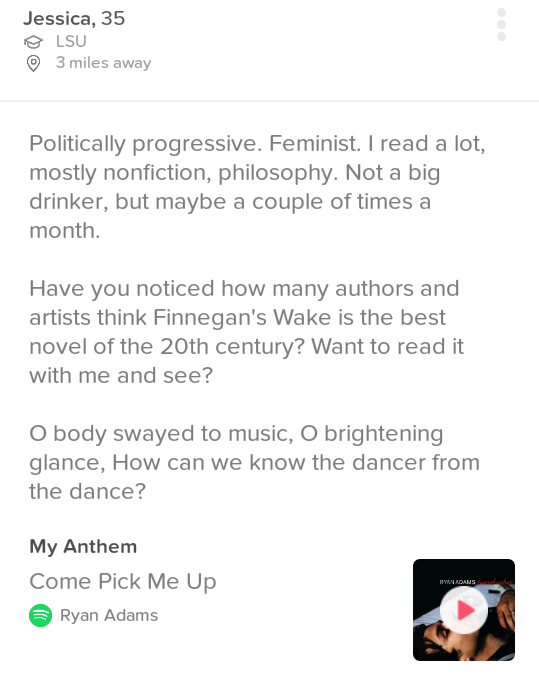
I’m Britton, as you should know, and below you’ll find the bio I wrote for my Tinder profile. If you don’t know what Tinder is, then get your head out of the sand, and read about it here.

2017-05-22 16.49.15

I was in New Orleans the other day, getting my swipe on, and then I came across this fine, older lady.

2017-05-22 12.40.00

The first things, ‘politically progressive’ and “the f-word”, I admit, probably should have raised red flags before even her shitty taste in music did. Those terms on their own hint at far-left political views, but the two of them together scream ‘SJW‘. However, she was hot, and that’s very rare of feminists, so I read into her words and saw deeper possibilities. I was hoping that maybe we could talk some philosophy, giving her the benefit of the doubt that her knowledge on that subject wasn’t confined to new-wave feminist crap. Hey, maybe she was even a feminist of the second-wave, non-radical kind, and ‘progressive’ just meant that she was kind of liberal and open to reasonable and necessary change. Maybe she’d even have a cat named Elvira. With this optimistic attitude, I swiped right and immediately tested her humor to see how “open” she really was.

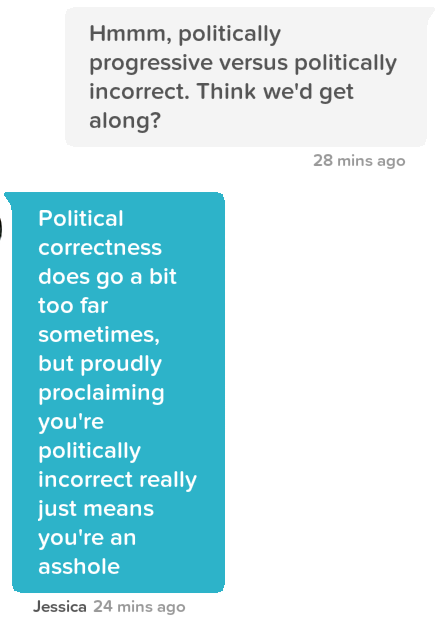
2017-05-22 12.24.23

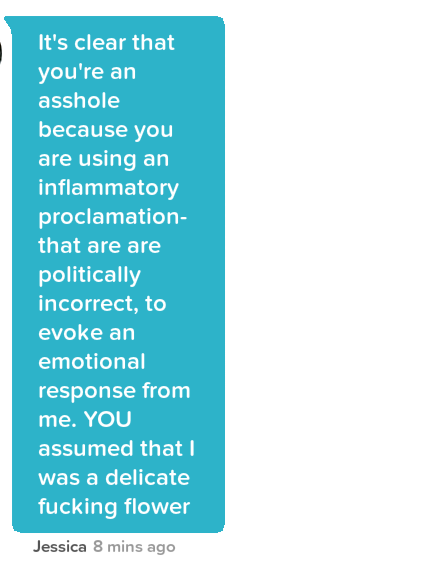
BOOM! No fun or games with this one. Did I “proudly proclaim” that I am politically incorrect? Reread my bio, and let me know. I think I’m just straightforward about what I want out of my Tinder experience. She could have easily swiped me left if my intentions didn’t line up with hers. Looking back, though, maybe I should have ended my first message with a winky face. 😉

2017-05-22 12.26.28

Do you value truth, Jessica? DO YOU? We’ll find out. Also, Jessica, I’ll be addressing you directly from here on. Wait, is it ok that I call you by your name, or would you prefer something else? I don’t want to be too incorrect and risk “invalidating your existence“.

2017-05-22 14.12.41

Yeah, let’s define a term together! That sounds like a fun philosophical exercise. Maybe you’ll even return the favor by asking me how I would define the term, and then we’ll find some common ground, bettering both of our conceptions of the world. Learning stuff is fun! You read philosophy, so you agree, right?

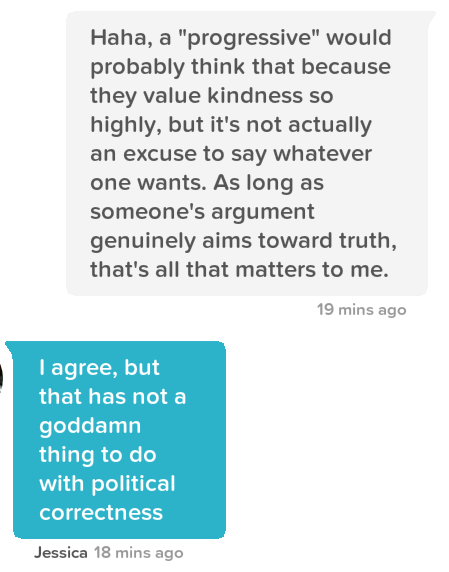
2017-05-22 12.29.22

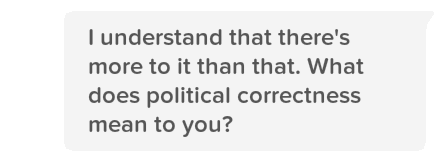
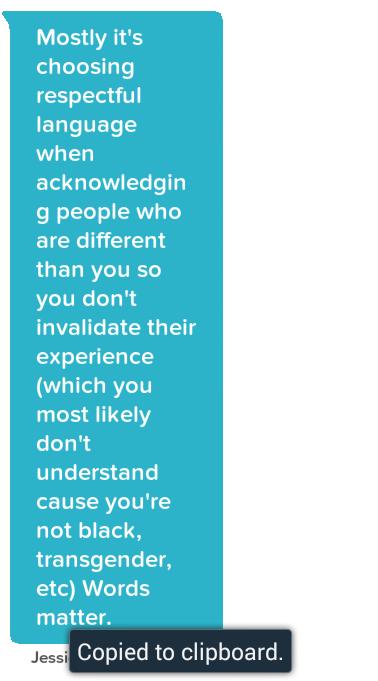
Annnnnd there it is. You pretty much nailed it, Jessica. I’m guilty of whiteness, so there’s no need to ask me what I think ‘political correctness’ means. Your understanding of how language works, on the other hand, seems a bit strange, and the philosophy you read may be of questionable quality. My validity on that topic comes from my education in linguistics and philosophy of language. But, you’re attempting to “invalidate” me because I’m… white? Hmmm.

I don’t think that speech is an activity so consciously aimed toward respect, nor do I think it’s a good idea to blindly respect people at all. In fact, it’s dangerous. I’ll spare you the technical linguistic part of the argument because I’m starting to sense that you have a screw or two loose, but I still must address the respect-issue.

Also, how are you so sure that I’m not black or transgender? If you respected me, then you would have asked about my preferred identity because race and gender are determined whimsically and have no biological basis, correct? No, you should have simply requested a dick pic, Jessica. Truth requires evidence, and I have plenty of it.

2017-05-22 12.31.40

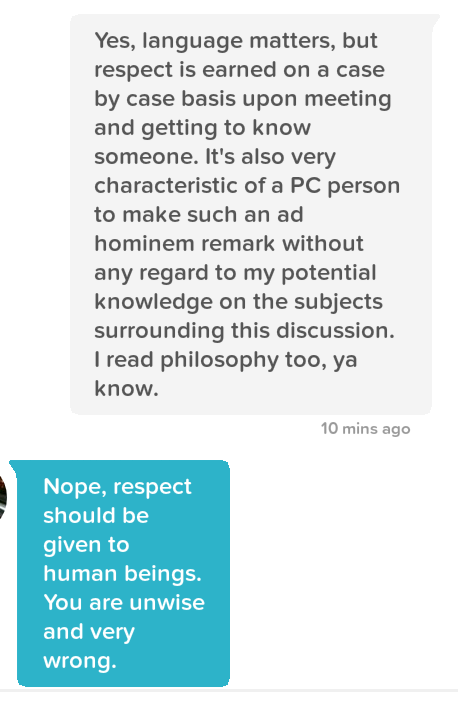
So, maybe there’s more to political correctness than your definition, Jessica, and maybe I know some stuff that you don’t. Maybe you’d be interested in hearing it. Maybe if you weren’t so keen on blindly respecting others, then you wouldn’t be so liable to get mugged and raped in a dark alley in New Orleans. Or, maybe you’d like that because you’d become a martyr for your ideology. At this point, you’re not giving me any reason at all to respect you, but I do fear for your safety. After all, you’re right that the world isn’t a very kind place.

2017-05-22 14.39.072017-05-22 14.40.34

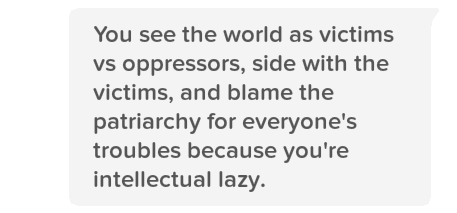
I figured I’d play the “patriarchy” card since you already accused me of being part of it by virtue of my straightness, whiteness, and maleness. What did you expect? Why did you swipe me right if you hate me by default, unless you wanted to hate-fuck me (shit, I may have missed my shot)? I mean, you’ve seen my pictures. Chances are that I’m not black under my clothes. In fact, I’m even WHITER there. Well, actually, there is a very small part of me that is kind of tan.

2017-05-22 12.35.42

2017-05-22 15.00.48

*ignores grammatical errors and moves on*

I know I’m an asshole, Jessica. There is no need to repeat yourself. But, does being an asshole make me wrong? No, Jessica, you’re the meanie who committed ad hominem. I also didn’t appeal to emotion to argue my point. You just took it that way. Taking offense and giving it are NOT the same thing. That’s Philosophy 101.

But…do save me! Please save me from my problematic ways so I can be more compassionate like you and make the world a more progressive place! Or, do I need a degree in women’s studies to be infected with your profound wisdom? If it’s LSU that infected you, then you’re right that there is no hope for me because I dropped out of that poor excuse for a higher-education institution after just one semester of grad school.

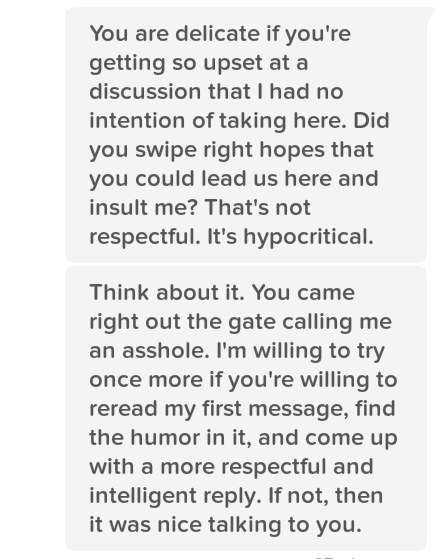
On the other hand, I could help you by revealing your greatest contradiction, and maybe even give you one more chance to get laid by me, knowing well that so few men would have gotten even this far with you. I mean, this is Tinder. Why else would you be here? Yeah, that’s what I’ll do because I want some too. I’ve learned to accept that liking sex makes women delicate flowers and men oppressive misogynists. It’s cool, really, I don’t need to be reeducated. I’ll even let you play the role of misogynist, and I’ll be the victim, and you can oppress deez nuts all you want.

2017-05-22 15.11.27

That’s where it ended. So…

What the hell is going on here?

I don’t think that I need to go into detail about what is going on here. There are plenty people who have done that very well already. For example, Dr. Jordan B. Peterson in this brilliant snippet from the most popular podcast in the world. The general point I want to make is that we are in a strange place where people like Jessica are multiplying exponentially by the semester, thanks to politically correct ideology infecting universities, business administrations, legislature, and now even Tinder (as if Tinder doesn’t already have enough spam)! This is the time for talented and capable people, mostly men, to stop ceding power to the people who live in those boxes; they’re wrong, and they’ve snuck their way into power without truly earning it. To stand up for truth is to stand up for yourself. However painful that may be now, it is absolutely necessary for the survival of our species. After all, if we were all angry, 35-year-old feminist virgins, of course humanity would end.

Since we aren’t all like Jessica, one day we will be without these people completely. Let’s give them what they want: spare their feelings, thus depriving them of the open, truth-seeking dialogue that would mold them into stronger moral beings and free them from the narrow and suffocating constraints of the feminist ideology. Since they aren’t open to that sort of thing, they will eventually self-extinguish under their childless philosophy and rot in the miserable hell that they’ve created for themselves.

“Ideology and the Third Realm” – What is Philosophy?

In Dr. Alva Noë’s book Varieties of Presence, many important aspects of perception are discussed. He makes a convincing case that we achieve contact with the world through skill-based action. Our understanding of a new experience is a collective recurrence, both conscious and unconscious, of past experiences. It is a dense work that deserves the attention of other contemporaries who concern themselves with matters in cognitive science and philosophy of mind. Perhaps I will do a full review of this book at a later date, but for now I would like to focus on a matter addressed in the final chapter entitled “Ideology and the Third Realm” which takes an important departure from the philosophy of consciousness and neuroscience.

What this chapter does is something that every philosopher should do periodically: broadly revisits the fundamental importance of philosophy as it relates to the context of his work. I will be a bit more general than that since I am not  “professional” philosopher. The role that philosophy plays in the world seems to constantly be changing. But is it? Perhaps it is only the popular understanding of what philosophy is that changes. I think that is, in part, the case, but it has more to do with the uses of philosophy. Some of those uses have remained constant since the beginning of recorded thought while others change by the minute. For this reason, it is impossible to pin down. But one need not pin it down. Philosophy exists to be used, and it is set of skills that will hopefully never become extinct. There is no dictionary definition that can sufficiently explain it, much less emphasize the field’s vital presence. I will give a general overview of the chapter but mainly share my thoughts about what philosophy is and why it is not only relevant, but necessary. Before I continue, I should define an important term which will be mentioned several times in this piece.

Q.E.D. (Latin) quod erat demonstrandum –  meaning “which had to be proven”

Many people, in and out of academia, naively think that philosophy deals with questions that warrant a Q.E.D. response. When you take a philosophy course, you often have to write at least one argumentative essay where you choose a position of a philosopher who you have read, you attempt to prove him wrong, and then you attempt to formulate a complete view of your own by supporting evidence. This way of “doing philosophy” is popular in undergraduate, base-level courses. It helps you to develop reasoning skills that can be applied anywhere. This is important, no doubt, but this is not where philosophy ends. Why? First, writing is not even necessary for “doing philosophy”. The only thing that is necessary, I would argue, is thinking. Thinking must be assisted by reasoning, but this is only the start.

This does not imply that we should identify the philosopher as one who locks himself up in his ivory tower and speculates of a deluded, idealized world. To philosophize well, one must also be able to communicate his ideas in some way, and that will involve language, whether spoken or written. This is one reason philosophy courses are difficult: one must already have a certain level of reading, writing, and speaking proficiency to succeed. The full title of the final chapter of Noë’s book is “Ideology and the Third Realm (Or, a Short Essay on Knowing How to Philosophize)”. Since language is such a crucial part of this issue, I will begin by taking a language-based example from that chapter:

‘The King’s carriage is drawn by four horses’ is a statement about what?

a) the carriage;  b) the horses;  c) the concept it asserts;  d) other

Immediately, one might think that the answer is ‘a) the carriage’. This seems completely logical, given how most of us understand language. ‘Carriage’ is the subject of the sentence, so any terms that follow should (theoretically) describe it. It is certainly not ‘b) the horses’ because that is the object receiving the action, and nor can the answer be ‘c) the concept it asserts’ because nine out of ten people in the room don’t know what the hell that means. Right? Good. It’s settled.

Gottlob Frege had other ideas. He thought that a statement about numbers is a statement about a concept. When we attempt to answer the question about the subject matter of the “king’s carriage” statement, we are speaking in conceptual terms. We are not using the statement to assert anything. So, the answer must be ‘c’. He gives more reasons for this, of course, and he makes us realize that there is a sense in which we become confused about what we mean when we say ‘The king’s carriage is drawn by four horses’. However, despite the piercing quality of Frege’s argument, we have a much stronger sense that we are unconvinced by his theory of language.

The problem with Frege’s claim, for most of us, seems to be that he had a preconception of the meaning of the statement ‘the king’s carriage is drawn by four horses’ before he was even asked the question. He had already established that any statement about a number, without exception, is a statement about a concept, so he was able to answer the question without thinking. The problem with our rejection of his claim is that we are doing exactly the same thing. We also answered without thinking. We held the preconception that every sentence is about its subject. This preconception is guided by the larger logical construction by which we understand language, and it is certainly no more correct than Frege’s view simply because nine out of ten people in the room agree that it is (that would be to commit ad populum). We take our theory of language for granted, and perhaps Frege takes his for granted too. There seems to be no Q.E.D. conclusion here. What we are all doing, if we become inflexible, if we stick to our answer to the question without sufficient evidence to support it, is committing what I call the ideological fallacy.

However, subscribing to ideologies is not always a fallacious thing. It is only when the ideology is applied in a dogmatic way that it becomes wrong. When an evangelical christian lives by Jesus’ principle, “love your enemies”, that can have very positive effects. It may minimize conflict in the person’s life. It may allow them to stand strong in the face of racial adversity. It may allow them to accept people more openly, and very often the favor will be returned. However, the favor is not always returned if the christian is careless and thoughtless. Despite his belief that he loves his enemies, participating in radical evangelical activism would invade on others and create more conflict, leaving his conception of “love” to be questioned. It takes Christianity out of context and misapplies it to the world in a negatively ideological way. There is nothing about the beliefs in themselves that are illogical, destructive, or even wrong. It is in how they are used will determine that. I will use another example. Evolutionary biology can study preserved skeletons of million-year-old homo erectus figures and learn about how we sapiens evolved three stages of evolution later. This could contribute to our understanding of how humans will continue to evolve (or devolve). However, evolutionary biology can only contribute a small piece to the puzzle of predicting the future of humankind. It needs influence from many other fields to even begin to solve any of its own problems. So, when Richard Dawkins uses the broad concept of evolution to attempt to disprove creationism in any one of its countless forms, he is taking his work out of context and applying it in a radical, dogmatic, negatively ideological way. There is nothing about evolutionary biology, as a field, that is wrong. It is a highly-useful method of inquiry. But there is still plenty we do not know about how humans have evolved. We generally just accept that they did with the minimal evidence that we have just as the evangelical accepts his own conception of loving his enemies based solely on Jesus’ teachings. In this case, both parties look equally silly.

Of course, the example above presents two extreme cases. Although we answer this “king’s carriage” question one way, Frege answers it in another, and we seem to have to agree to disagree, there is still a sense in which both sides think the issue is objective in nature and that it deserves further discussion. In order to have this discussion in a logical, respectful, open manner, we must become philosophers, and one may not need to go school to achieve this. Alva Noë wonders how we might categorize our dealing with the “king’s carriage” question. It is not in the realm of the material (e.g. biology), nor is it in the realm of belief (e.g. religion). It seems to be within some third realm. Noë begins to explain with this quote:

The point is not that Frege or we are entitled to be indifferent to what people say or would say in answer to such a questionnaire. The point is that whatever people say could be at most the beginning of our conversation, not its end; it would be the opportunity for philosophy, not the determination of the solution of a philosophical problem. (Noë, 173)

at most…“, Noë says “(what other people say is) the beginning of our conversation… the opportunity for philosophy…” This is another reason philosophy is so difficult! At the very most, when our view stands in opposition to another, we may only have the opportunity to do philosophy. We rarely get there. When we do get there, two or more people are concerning themselves with the third realm of a problem. What is the third realm? It is the realm of possibilities with minimal influence from ideologies. It is abstractly objective yet, as I will explain later, not in the realm of matters Q.E.D.

Where is this third realm? Well, ‘where’ is the wrong question. Bertrand Russell once said of philosophy that it is “in the no-man’s land between science and religion” because it always seems to be under scrutiny from both sides. Perhaps, in some cases, this is correct. It can serve as a mediator between two extremes, but, on the surface, this only explains one of unlimited applications of philosophy.

Upon first reading or hearing Russell’s quote, one might be inclined to place philosophy in between science and religion because it deals with reason over belief (like science) and thought without quantifiable experimentation (like religion). This would be a shallow interpretation that lacks crucial insight. Russell was perhaps a bit too concise for the average interpreter. He did not mean, as I understand him, that philosophy is inside the space between science and religion. It has deeper implications which resonate with those of Noë (despite the fact that Russell was a logical positivist, and Noë is a phenomenologist, so they would probably have a duel for other reasons). Explaining philosophy has nothing to do with where we should fit it in relation to other fields. It has to do with how we can apply its skills, and in that way it is most unique. Those skills are skills of thought. Developing those skills first requires one to look inward, rid himself of bias, and then turn outward to consider all possibilities. This is still only the beginning. Once we achieve this skill of thought, what do we do with it? We continue to practice and improve it. How? The answer is simple, but the application seems, in some cases, impossible. We communicate.

We share our ideas with others who have, to some degree, developed the skill of clear thinking. Of course, communication, whether written, oral, or otherwise, is a practical skill in itself that will be developed naturally, mostly prior to but also simultaneously, alongside the skill of thinking. We tend to adapt our ability to communicate only to the situational extents that we need them, and that can be limiting. When doing philosophy, anyone can participate, but only to the extent that they can think clearly. Philosophy tests those limits, which is why both science and religion so often scrutinize it. Though they deal with subject matter that seems contradictory, (mechanistic) science and religion do have one general thing in common: dogmatic ideology. Philosophy, on the other hand, is perhaps the only field that dedicates the elimination of dogmatism as one of its primary goals.

Doing philosophy is not only about increasing the degree to which people can think, but about being open to different forms of thought as well. What is fortunate in this regard is that each person in the conversation, if one is to find himself in such a conversation, has probably achieved their skill of thought through different means. For example:

There may be one who developed his thinking through philosophy itself, who rigorously studied informal logic to learn how not to commit errors in reasoning. He also may be able to contribute history of thought to the conversation and explain why certain schools of thought are obsolete in academic philosophy. There might also be a more scientifically-minded person who, in a graduate school lab, performed the same experiment under the same conditions hundreds of times, but got variable results. He questioned why this was happening (if the laws of physics are supposed to be constant), so he turned his research to the inconsistencies and realized that uncertainty transcends mathematical equations. He is now able to think more broadly about his work. There might also be a Buddhist in the group who practices intensive meditation. He can turn off influence from his sensory world and walk on hot coals without getting burned, or he can submerge himself into freezing-cold water without catching hypothermia. He is able to clear his mind from all unnecessary matter. Each person achieves the same thing – to think clearly, skeptically, critically – through different means. They each learn from one another and gain a broad range of insights.

Also, and perhaps most importantly, each person in the conversation should be genuinely interested in learning new perspectives in order to improve their own points of view. There is a sense in which someone may have achieved access to the third realm of conversation to a lesser degree than the others, and at a deeper point in the discussion, he gets flustered and has to back out. This is perfectly fine as long as he does back out, at least until his temper cools (if he does not back out, he will disrupt the conversation). He has pushed his boundaries of clear thinking to a level that the others have not, and that can be a very constructive or destructive thing, depending on his mindset. But it is vital that all parties directly involved maintain self-preservation throughout the conversation. If there are any unsettled nerves, it is almost certain that at least one participant is not being genuine, but rather, is too outwardly focused and is perhaps ultimately trying too hard to prove himself right or the others wrong. Although they might seem to contribute insight to the conversation, they will inevitably expose themselves as operating from within an ideology, thereby rendering themselves a nuisance. Philosophy is no activity for the pretentious or egocentric, contrary to popular belief. In fact, the absolute contrary is the case.

Do any philosophical questions warrant a Q.E.D. response? (Does philosophy ever prove anything?)

No. In case this is not already clear, there are, in a sense, no “philosophical questions”. There are only philosophical approaches to questions. Approaching the third realm of a problem requires one to be, as stated earlier, abstractly objective (or perhaps objectively abstract). There are limits to how objective one can be, no doubt, but the aim of advancing thought is to learn more and more about the world and how those in it think, so we can improve on that, both individually and collectively. It exposes dogmatism and reveals the sheer grey-ness in any concrete matter. Need I give examples as to when this might be useful? I challenge anyone to give an example of when it is not, and thereby present an opportunity for doing philosophy! This is why philosophy is so widely-applicable.

To draw an analogy – toward the end of Noë’s final chapter, he mentions Immanuel Kant’s aesthetic view that the reality of one’s response to a work of art is based in feeling – it is not contingent on his ability to explain it. Similarly, Clive Bell described a “peculiar aesthetic emotion” that must (first) be present in something for it to be considered art. It is that feeling you get when you listen to a beautiful composition, watch a film that evokes tears, or look at Picasso’s Guernica after you have heard the gruesome story behind the painting. I had experienced this aesthetic emotion many times, but it was my former professor at the University of New Orleans, Rob Stufflebeam, who, whether he intended to or not, led me to realize that all of those experiences involved the same exact emotional response. Perhaps only for those who have experienced it, it is certainly something that need not, and often cannot be explained.

Likewise, a philosophical approach to a problem is, instead of an emotional experience as with art, at its very best, an all-encompassing intellectual experience. It is not a heated argument, nor is it even a controlled debate. It is a respectful, open-ended discussion about ideas between two or more people in an intimate setting. It raises the awareness of each involved to a broad level of skepticism that, perhaps very strangely, brings with it an aura of contentment. It is obviously not the same feeling one gets with the peculiar aesthetic emotion, but it is parallel in the sense that when you are part of it, you really know. That reality seems to transcend explanation.

Final Thoughts

Alva Noë has developed this idea about perception: “The world shows up for us, but not for free. We achieve access to it through skill-based action.” It is a combination of developing our conceptual and practical skills that allows us to understand the world and live in it. Achieving access to the third realm of a question, as I would consider it, is one of those countless skills. It comes more easily for some than for others. Just as one person might naturally have ideal physiological makeup for learning how to swim (lean, broad shoulders, webbed feet, etc.), another person’s brain might seem to be better wired for clear thinking. Everyone, to some degree, with the proper amount of training, can swim. Likewise, everyone can, with practice, think clearly. The more one practices by looking inward, ridding himself of bias, and working up the courage to subject himself to critique, the more he can contribute to the conversation in his own unique way. How much one wants to participate is solely up to him, but to not participate at all is to miss out on a hugely important (and my personal favorite) part of the human experience.