Debunking the “Free Will Illusion”

The other day, I read this PsyBlog article that attempts to explain a psychological study which, according to the author, seems to imply that humans are mechanical robots merely controlled by neuronal impulses in our brains, and that free will is an illusory conception that humans have constructed to cope with death. There have been numerous studies, including the one described in that article, which show that neurons in the brain begin to fire before the person can report being conscious of their decision to pick up a pencil or before they can predict exactly which one of five circles on a computer screen changes color, for examples (the latter example is the experiment referred to in the article). The article also mentions the term ‘unconscious’ several times, and the usages imply that ‘unconscious’ should be defined merely as ‘the mechanical workings of the brain’. My aims in this post are to explain why that is an oversimplified and unsophisticated definition of ‘unconscious’, and also to suggest, partly on that basis, why these studies not only do not imply that free will is an illusion, but that they have virtually no bearing on what constitutes free will to begin with.

A Less Trivial Definition of ‘Unconscious’

There is one thing that the article (and anyone who would agree with it) gets right: we are not in total control of what we see, understand, and believe. However, this truth cannot be maintained to every degree of analysis imaginable (the highest degree being the ontology of free will and morals, arguably). This raises a semantic problem. Everyone has their own definition of what constitutes “unconscious” and even “free will”. The level of analysis that the article attempts to operate on is one of moral ontology, but it fails. Instead, it maintains the assumption that all that exists in us are mechanistic processes, and those processes are “unconscious”. We are our brains, and our brains are computer processors that take in data and organize that data for output, and when we are faced with stimuli relevant to our experiences, we merely react in accordance with our pre-organized data. Eh, well, partially correct! We are more nature than nurture after all. But, how does this imply that we don’t have free will? Let’s step back first. What can we infer from this article’s usage of ‘unconscious’?

“Neural activity is unconscious”, materialists will hold. Yes, we know that to the same extent that we know that digestion in the intestines is unconscious, and it need not be overstated. It is merely a biological process per se. However, biological processes tell us very little about our conscious world — the reality that we actually experience. They presuppose that the origins of our behaviors and decisions are pre-programmed inside our brains, and the neuronal activity is the first step in activating those programs (which we call decisions). This is an assumption, albeit a rather interesting one. Those who believe that this process is the causal origin of our behavior commit the most basic fallacy in science: correlation without causation. Why do they assume that the brain is the beginning when the brain requires the world to gather information to begin with, and why would anyone assume that we are disconnected from objective reality to the extent that we are separate and not intimately connected to it in a way that our actions most likely have ancient origins. What is left over when we commit to this materialist view of perception?

A lot, I would say. In fact, one can control some aspects of even these biological processes. If I am lactose-intolerant, I can consciously avoid dairy so my digestion maintains a regular track. In the same way, I can somewhat control what my brain “processes”. If I am at a music festival, for example, and I have to decide whether I want to attend the concert of a band I have already seen or that of a new band I haven’t yet seen, my decision will affect what my brain processes. If I choose the familiar option, I will go into the show having certain expectations based on what I have already processed from previous shows of theirs. If I choose the unfamiliar band, (which is statistically less likely), then I am choosing a new path. My experience will not be dictated by any biases, and, in a way, the show will present a challenge — a challenge to what I already know and expect in music generally. It is not only those biological processes that are necessarily unconscious, but so are some of the decisions we make which come prior to those processes. We can, however, take control of those decisions if we think about learning and decision-making in the right way. So, let’s think about it like this: perhaps the origins of our behavior and decisions are in the world, but not in the minute-by-minute, stimuli-centric world that neuro-materialists would like to believe. If it were that way, then we would not even be able to inquire about how our minds work as we’re doing now (which requires temporarily stepping outside of them), much less to overcome social pressure to leave our friend group at a music festival to see the band we want to see, alone.

What I am dancing around now is the more nuanced meaning of ‘unconscious’ that we find in fringe psychology and spiritual circles.

“To know oneself is to make the unconscious conscious.” — C.G. Jung

We can observe, in my field of birth chart astrology, that people live out their charts until they seek knowledge about them. The birth chart represents one’s innate set of perceptions and predispositions for responding to different aspects of reality. Someone is likely even living out their transits when they come to me for consultation — i.e. there is something external compelling them to learn about themselves at a particular time — but free will is clearly expressed in how they make use of the information I give them. The better one knows oneself, the more opportunities they will have to express their free will. There is still no guarantee, however, that they will. As I always say, I don’t tell people what to do; I help them own what they choose to do.

There is a strong case that it is not when someone is acting from their proclivities, but rather only when someone acts against what is normal and comfortable for them, that they are expressing free will. This “opposition to the self” kind of behavior must be founded on moral principles, boundaries, or in the very least, external rules. These represent three different degrees of self-governance and the spectrum of our human relationship to that concept, and only one fully shows that free will can be expressed in any case. In the next post, I will describe these three levels and show the connection from free will to that one of them, perhaps revealing something about the origins of autonomous decision-making that evaded us in the beginning of this article.

Tinder Fun With a Feminist

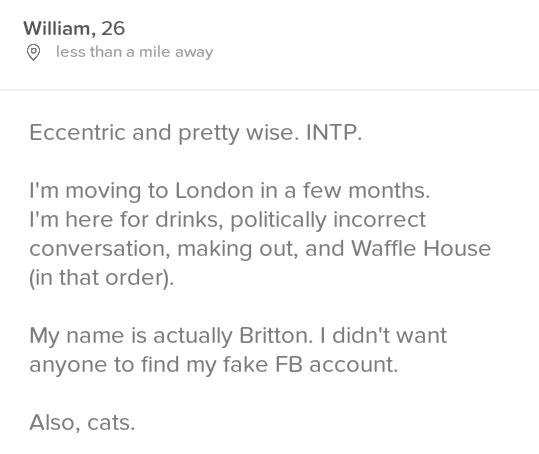
I’m Britton, as you should know, and below you’ll find the bio I wrote for my Tinder profile. If you don’t know what Tinder is, then get your head out of the sand, and read about it here.

2017-05-22 16.49.15

I was in New Orleans the other day, getting my swipe on, and then I came across this fine, older lady.

2017-05-22 12.40.00

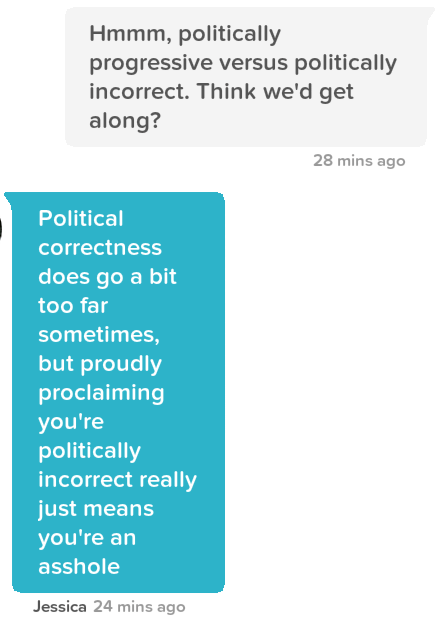
The first things, ‘politically progressive’ and “the f-word”, I admit, probably should have raised red flags before even her shitty taste in music did. Those terms on their own hint at far-left political views, but the two of them together scream ‘SJW‘. However, she was hot, and that’s very rare of feminists, so I read into her words and saw deeper possibilities. I was hoping that maybe we could talk some philosophy, giving her the benefit of the doubt that her knowledge on that subject wasn’t confined to new-wave feminist crap. Hey, maybe she was even a feminist of the second-wave, non-radical kind, and ‘progressive’ just meant that she was kind of liberal and open to reasonable and necessary change. Maybe she’d even have a cat named Elvira. With this optimistic attitude, I swiped right and immediately tested her humor to see how “open” she really was.

2017-05-22 12.24.23

BOOM! No fun or games with this one. Did I “proudly proclaim” that I am politically incorrect? Reread my bio, and let me know. I think I’m just straightforward about what I want out of my Tinder experience. She could have easily swiped me left if my intentions didn’t line up with hers. Looking back, though, maybe I should have ended my first message with a winky face. 😉

2017-05-22 12.26.28

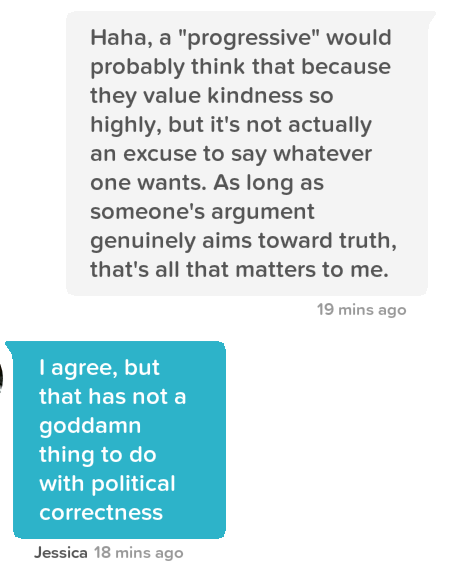
Do you value truth, Jessica? DO YOU? We’ll find out. Also, Jessica, I’ll be addressing you directly from here on. Wait, is it ok that I call you by your name, or would you prefer something else? I don’t want to be too incorrect and risk “invalidating your existence“.

2017-05-22 14.12.41

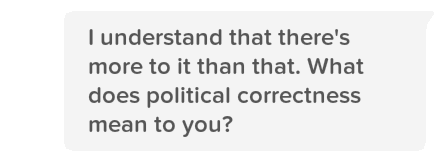
Yeah, let’s define a term together! That sounds like a fun philosophical exercise. Maybe you’ll even return the favor by asking me how I would define the term, and then we’ll find some common ground, bettering both of our conceptions of the world. Learning stuff is fun! You read philosophy, so you agree, right?

2017-05-22 12.29.22

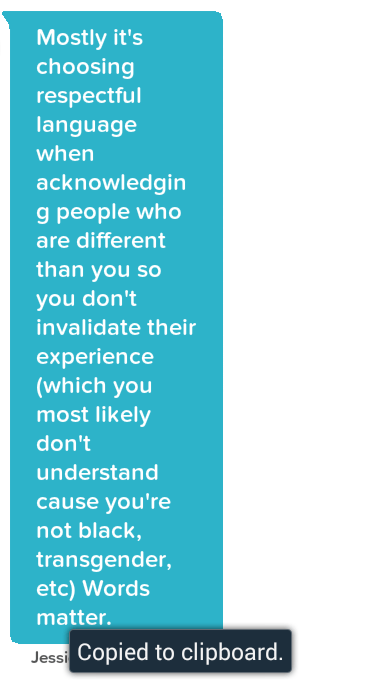
Annnnnd there it is. You pretty much nailed it, Jessica. I’m guilty of whiteness, so there’s no need to ask me what I think ‘political correctness’ means. Your understanding of how language works, on the other hand, seems a bit strange, and the philosophy you read may be of questionable quality. My validity on that topic comes from my education in linguistics and philosophy of language. But, you’re attempting to “invalidate” me because I’m… white? Hmmm.

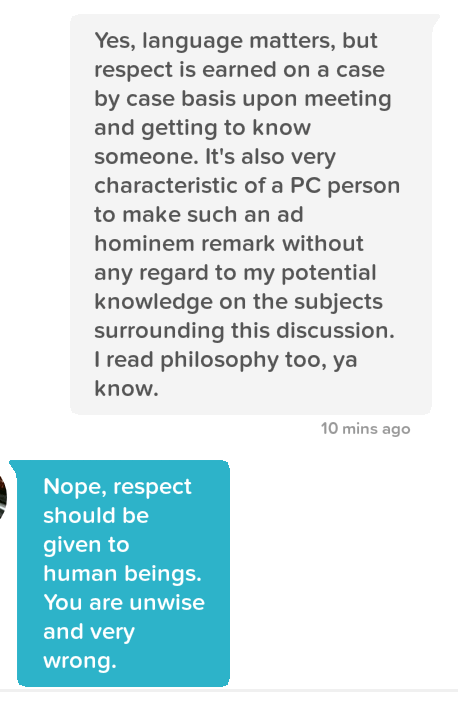
I don’t think that speech is an activity so consciously aimed toward respect, nor do I think it’s a good idea to blindly respect people at all. In fact, it’s dangerous. I’ll spare you the technical linguistic part of the argument because I’m starting to sense that you have a screw or two loose, but I still must address the respect-issue.

Also, how are you so sure that I’m not black or transgender? If you respected me, then you would have asked about my preferred identity because race and gender are determined whimsically and have no biological basis, correct? No, you should have simply requested a dick pic, Jessica. Truth requires evidence, and I have plenty of it.

2017-05-22 12.31.40

So, maybe there’s more to political correctness than your definition, Jessica, and maybe I know some stuff that you don’t. Maybe you’d be interested in hearing it. Maybe if you weren’t so keen on blindly respecting others, then you wouldn’t be so liable to get mugged and raped in a dark alley in New Orleans. Or, maybe you’d like that because you’d become a martyr for your ideology. At this point, you’re not giving me any reason at all to respect you, but I do fear for your safety. After all, you’re right that the world isn’t a very kind place.

2017-05-22 14.39.072017-05-22 14.40.34

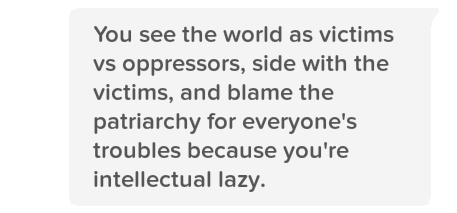
I figured I’d play the “patriarchy” card since you already accused me of being part of it by virtue of my straightness, whiteness, and maleness. What did you expect? Why did you swipe me right if you hate me by default, unless you wanted to hate-fuck me (shit, I may have missed my shot)? I mean, you’ve seen my pictures. Chances are that I’m not black under my clothes. In fact, I’m even WHITER there. Well, actually, there is a very small part of me that is kind of tan.

2017-05-22 12.35.42

2017-05-22 15.00.48

*ignores grammatical errors and moves on*

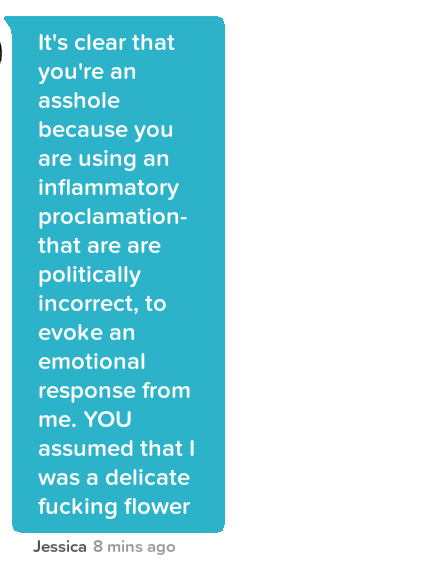
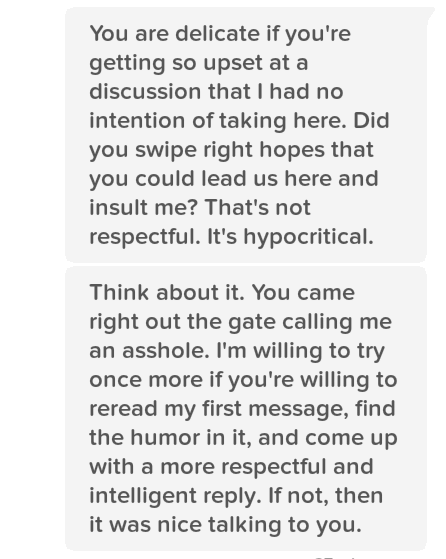
I know I’m an asshole, Jessica. There is no need to repeat yourself. But, does being an asshole make me wrong? No, Jessica, you’re the meanie who committed ad hominem. I also didn’t appeal to emotion to argue my point. You just took it that way. Taking offense and giving it are NOT the same thing. That’s Philosophy 101.

But…do save me! Please save me from my problematic ways so I can be more compassionate like you and make the world a more progressive place! Or, do I need a degree in women’s studies to be infected with your profound wisdom? If it’s LSU that infected you, then you’re right that there is no hope for me because I dropped out of that poor excuse for a higher-education institution after just one semester of grad school.

On the other hand, I could help you by revealing your greatest contradiction, and maybe even give you one more chance to get laid by me, knowing well that so few men would have gotten even this far with you. I mean, this is Tinder. Why else would you be here? Yeah, that’s what I’ll do because I want some too. I’ve learned to accept that liking sex makes women delicate flowers and men oppressive misogynists. It’s cool, really, I don’t need to be reeducated. I’ll even let you play the role of misogynist, and I’ll be the victim, and you can oppress deez nuts all you want.

2017-05-22 15.11.27

That’s where it ended. So…

What the hell is going on here?

I don’t think that I need to go into detail about what is going on here. There are plenty people who have done that very well already. For example, Dr. Jordan B. Peterson in this brilliant snippet from the most popular podcast in the world. The general point I want to make is that we are in a strange place where people like Jessica are multiplying exponentially by the semester, thanks to politically correct ideology infecting universities, business administrations, legislature, and now even Tinder (as if Tinder doesn’t already have enough spam)! This is the time for talented and capable people, mostly men, to stop ceding power to the people who live in those boxes; they’re wrong, and they’ve snuck their way into power without truly earning it. To stand up for truth is to stand up for yourself. However painful that may be now, it is absolutely necessary for the survival of our species. After all, if we were all angry, 35-year-old feminist virgins, of course humanity would end.

Since we aren’t all like Jessica, one day we will be without these people completely. Let’s give them what they want: spare their feelings, thus depriving them of the open, truth-seeking dialogue that would mold them into stronger moral beings and free them from the narrow and suffocating constraints of the feminist ideology. Since they aren’t open to that sort of thing, they will eventually self-extinguish under their childless philosophy and rot in the miserable hell that they’ve created for themselves.

Collective Subjectivity = Reality :: The Utility of Phenomenological Thought

In my last post, I explained the differences between and the proper uses of the terms ‘subjective’ and ‘objective’. To recap, these terms do not describe the positions from which one perceives. Of course, everyone perceives subjectively, and objects don’t perceive at all. Therefore, the subject/object spectrum is not a spectrum on which one may judge a matter’s truth-value. The spectrum simply describes the nature of the matter at hand — subjective means “of a subject” and objective means “of an object”. Having said that, how can we define truth more broadly? What determines it?

I think that we can, in many conceivable instances, equate truth with reality. This is based on one of two popular definitions of reality. The first, more popular definition in which we cannot equate truth and reality, and the one I reject, is that of objective, Newtonian-scientific reality. This holds that there are mathematical laws and principles out there in the universe, already discovered or waiting to be discovered, which the forces of nature can be reduced to. Proponents of this view hold “rationality”, in all of its vagueness, as the singular Platonic ideal which dictates what is true, real, and meaningful. It follows from this that mechanistic science holds the key to all knowledge. The problem here is that mechanistic science (not all science) is founded in the metaphysical belief in materialism. Materialism suggests that all reality is comprised of quantifiable matter and energy. Humans, and all living things, are “lumbering robots”, as Richard Dawkins claims. Consciousness, ethics, morality, spirituality, and anything else without a known material basis is subjective in nature and thus superstitious, irrational, and not real. As I have already explained, this worldview rests on a straw-man distinction between what constitutes subjective and objective, for it assumes that this distinction creates a spectrum on which to judge a matter’s truth-value (the more objective, the more true).

Remaining consistent with how I have distinguished subjective and objective is the second, less popular, and in my view, much more useful way of defining truth and reality: what is real is what affords us action and drives us toward a goal. The definition is as simple as that, but its implications have a tremendous amount of depth rooted in the unknown. Instead of holding one Platonic ideal (like rationality) as the key to all truth, there are an infinite number of ideals that humans conceptualize, both individually and collectively, in order to achieve their ends. Therefore, this view affords relevance to a wide range of perspectives even if the nature of the objects being perceived is unknown. The rationalist view, by contrast, is limited to the assumption that the nature of everything has already been determined to fit into one of two metaphysical categories: objective reality or subjective delusion. (This Newtonian theory of reality I have just explained, by the way, is a long-winded way of defining ‘scientism’, a term I often use in my posts.)

Nature doesn’t obey laws; humans do, so we tend to compartmentalize everything else in that way because that makes it easier for us to explain what we want to know and explain-away anything we don’t want to know. What we don’t want to know is what we are afraid of, and as it turns out, what we are afraid of is the unknown. So, when anomalies, whether personal or scientific, that don’t fit the already-established laws arise, a Newtonian thinker will categorize it as illusory in order to explain it away. This doesn’t work because even we humans have a propensity to break the laws that we create for ourselves, and this can be a very productive thing. The degrees to which this is the case depends on our individual psychological makeups. People who are high in the Big-5 personality trait conscientiousness, for example, tend to obey rules because of their innate need for outward structure and order. Those who are low in that trait are more likely to break rules, especially if they are also low in agreeableness which measures one’s tendency to compromise and achieve harmony in social situations. Openness, on the other hand, the trait correlated with intellect and creativity, allows one to see beyond the rules and break them for the right reasons — when they are holding one back from progress, for example. These are just three of five broad personality traits that have an abundance of scientific research to potentially confirm their realness and usefulness, even as a rationalist/Newtonian might perceive them. However, the tendency of someone to break rules as a result of their psychological makeup does not only apply to political laws. We also create collective social rules among groups of friends and unconscious conceptual rules for ourselves in order to more easily understand our environment, and those systems satisfy the same basic human needs and take the same hierarchical forms as political order does, and they serve purposes that contrast only in terms of their widespread-ness.

Regardless of our individual psychologies, there are commonalities that all humans share in terms of which types of goals we have and which types of things drive us toward or away from action. Those things are, therefore, collectively subjective across humanity and are what I would like to propose the most universally real and true things (insofar as anything can be universally real or true at all). This leads me to elaborate further on this goal-oriented view of reality.

Since I used Newton as a scientific lens through which to understand the rationalist theory of reality, I will do the same thing to explain the goal-based theory that I am proposing, but this time using Darwin. Philosophically speaking, Darwin did not commit himself to his theories in the same law-sense that Newton did his. In fact, many of Darwin’s ideas have recently been found to be rooted in psychology rather than in hard mechanistic biology. His main principle can be summed up with this: nature selects, and we make choices, based on what we judge to be most likely to allow us to survive and reproduce. That is all. Everything else is just detailed justification which may or may not be true or relevant. In fact, Darwin left open the possibility that the details of his evolutionary theory not only could be wrong, but that they probably were, and he was very serious about that. To take all of those details literally leads one into the same logical trap that the “skeptics/ new atheists” fall into when they obsess over the details of the Bible — they oversimplify and misrepresent its meaning, and therefore overlook the broader, most important points that exist. These are straw-man arguments, and they demonstrate a persistent, juvenile lack and rejection of intellect.

The reason Darwin’s main evolutionary principle is psychological is because it is consistent with Carl Jung’s idea of the archetype. An archetype is any ancient, unconscious pattern of behavior common among groups or the entirety of the human population and their ancestors. The need for all living beings, not only humans, to survive and reproduce, is undoubtedly real. It is something we understand so little, yet it drives an inconceivably wide range of behaviors, most of which are taken for granted to the extent that they are unconscious (e.g. sex-drive is causally related to the desire to reproduce). It is not only in the natural world that humans would have to desperately fight for their life against other species, but even among ourselves in the civilized world have there been instances of radical attempts to wipe out masses of people because one group saw another group’s ideologies as threatening to their own survival and prosperity (e.g. both Hitler and Stalin led such endeavors in the 20th century).

Perhaps, instead, if we equate truth with this archetypal, goal-oriented conception of reality, then we can come to a reasonable conclusion about what constitutes truth: that which affords and drives us to action. That is to say that (capital-T) Truth, in the idealistic, rationalist sense, probably does not exist, and if it does, our five senses will never have the capacity to understand it. The best we can achieve and conceive is that which is true-enough. For what? For us to achieve our goals: survive, reproduce, and make ends meet, and if we are very sophisticated and open, to also introspect, to be honest with ourselves and others, and to live a moral and just life.

Who Has Midlife Crises and Why

Psychologist Carl Jung spoke of a process called ‘individuation’ whereby one gains an elevated degree of self-awareness and is therefore able to take crucial steps toward cultivating his ideal personality (i.e. ‘self actualization’ in Maslownian terms). In layman’s terms, this process is called a ‘midlife crisis’. My proposal is that this is a period of growth that everyone experiences, and the sooner it happens, the easier it is to overcome.

According to social convention and many professional circles of psychology, a midlife crisis is considered a bad thing. For example, a psychiatrist named Sue may claim to have seen this instance many times before. Sue describes it empirically as stress at work and in the family that has accumulated over time, and then it was suddenly unleashed in different forms. This places the blame on the individual for not communicating his inner thoughts and feelings as they arose, so Sue will offer her therapy services to fix the problem by teaching better communication.

A neurotherapist named Ben might also claim to have seen this many times before, but he will take a more materialist approach. Ben will confine the problem to the brain by assuming that something simply went wrong with his neural functioning, and that the matter is beyond his control. He might suggest that the only solution is to undergo neurotherapy in his clinic to realign normal neural pathways in the frontal lobe of the brain.

Both the Sue and Ben, as well as most people in general, see this crisis as a problem that needs to be fixed, and that the only way to do that is via the specific methods in which they have been trained. “I understand. Let me handle it. You can trust me.” is what they will tell their potential patient. Given their wall of shiny degrees in there cozy, inviting office, it is difficult to turn down their offer no matter the cost, as long as they can convince you that you need it.

More likely than not, both Sue and Ben are acting in their own self interests first. They are business people as well as medical professionals. Indeed, the term ‘crisis’ itself carries a derogatory tone, and the professionals have learned to capitalize on that. Their outward warmth, their technical language, their comfortable offices, their alleged understanding the situation, etc. are tactics that they use to keep their business running. That is not to say that their practices are completely useless, but rather, that either service will likely have more or less the same effect for the very same condition because neither comes close to attacking the root of the issue. In fact, they unknowingly focus on fixing the same exact thing (outward communication of inward feelings) since language expressions are actually channeled through the frontal lobe of the brain!

Meet my friend Jay. Jay is 38 years old, and he is an officer in the military. To this point, Jay has led a respectable life of service and duty. He is a devout Christian, goes to church every Sunday, and does community service with his church. He worked hard in high school and in Boy Scouts; he graduated and became an Eagle Scout; he went to college, worked hard, graduated, joined the military as a lieutenant, worked hard, got married, worked hard, had two kids, and then he continued to work hard to maintain that for the years following. Jay is a doer: Make a decision, work hard at it, and you will lead a successful life.

Jay never really questioned the position he was in, and things seemed to be going great, but then, seemingly out of nowhere, he began to have what is commonly known as a midlife crisis. He became a bit depressed and self-conflicted. His temper shortened, and he frequently had emotional outbursts at his wife and kids. With some reluctance, he finally agreed to grant his wife’s request and seek help. He began going to Sue, the psychiatrist, both alone and with his wife. Things seemed to improve for one or two days following each session, but then he would revert back to his ordinary behavior. Sue’s methods weren’t really working for Jay. He got impatient and started to believe that the process was being prolonged, and that he was spending more money than he needed to.

Jay began to seek other forms of help, and then he discovered Ben’s neurotherapy practice. Upon first meeting Ben, he felt a bit more confident moving forward. Ben explained, using much technical jargon, how important the brain is in processing information and making decisions. Though the claim that the brain is important is true, indeed it is necessary, he went on to convince Jay further that his methods were “more scientific” than traditional therapy because they are “backed by modern neuroscientific research”. Jay became convinced that neurotherapy was the answer, and he began treatment. After a few months, however, as Jay’s optimism wore off, so did his patience; his behavior took the same turn that it did before and after psychiatric therapy. He began to feel misled into thinking that these therapists were offering a sure-fire, algorithmic solution that was actually, in some sense, a scam. It turns out that he was right.

The absolute root of a “crisis” is unknown to Sue and Ben because it is, in the conventional sense, unknowable. A crucial part of it deals with knowledge that does not likely have its foundations in the material world, nor is it solvable by simply making a few practical, sure-fire adjustments in one’s everyday life. Therefore, it should come as no surprise that most people like Jay have so much trouble wrapping their minds around something that is different in nature from their materialism-based work and education and their practical, habit-based personal lives, especially when the people who they put their trust and money in are misleading them. It is difficult for them to realize that there is more to themselves than their brains, bodies, and the feedback they gather from the external social and material world. This was exactly Jay’s predicament. He wanted to put his trust into a system to manage his life from the outside-in, but nothing was working. He was forced to turn inward and deal with it himself.

There is a continuous process of personality development in everyone, and without its sufficient maturation, one simply cannot optimally handle the stresses of life. Understanding a midlife crisis, or any crisis for that matter, and taking steps to solve it is a personal journey. It requires one to discover, embrace, and cultivate the auxiliary side of the personality in conjunction with the continuing development of the dominant side. What I am alluding to is certainly not to have solved this puzzle for everyone, necessarily, but rather that it is each person’s job to solve their own puzzle for themselves. There is indeed a highly-effective model one can keep in mind to better understand the self and its place in the world: the cognitive functions as described by Carl Jung.

Immediately, one might question this method. Good. You should, but don’t question it without knowing anything about it, or at least in a way that presupposes bias. It is a continuously developing theory outside of institutional psychology. The reason for this is simply that it does not seem to fit the existing ideology of institutional science on a broader scale: materialism – all reality in the universe is founded on and comprised of quantifiable matter and energy. I have explained in several previous posts, just as well as several professional scientists and philosophers have explained in recent years, why science must move past the materialist worldview in order to progress, no matter the cost. That is not up for debate, so I will prevent any further discussion on the matter by saying this: To dismiss Jungian psychology on the basis of their being “no evidence” for it presupposes that the only evidence is the type that materialism relies on. This is circular reasoning. There in fact has been no materialist attempt to disprove it to begin with. In other words, to stick to such an unsupported principle is to assume it is “guilty until proven innocent”, as in wrong-until-proven-by-materialism. The premise for my proposal here is about people. All people are unique, but there are baseline psychological tendencies by which we operate. This is, as we should all agree, indeed obvious upon any amount of close observation of one’s social environment. That, I will submit, is in itself a form of evidence worthy of a discussion. Having said that…

Each person’s dominant cognitive function, according to Jung, is either introverted or extroverted, and either a mode of judgment or perception. There are two ways of making judgments (thinking and feeling) and two modes of perception (sensing and intuiting). If one’s dominant function is inwardly perceptive, say, introverted intuiting (Ni), then his auxiliary (secondary) function will be an outward mode of judgment, either extroverted thinking or feeling (Te/Fe), to balance out the dominant function.

Of course, everyone necessarily has the capacity to both perceive and make judgments, to extrovert output and introvert input, to think and feel, to sense and intuit; we otherwise would not be able to survive in any social or professional setting. We all do all of those things to varying degrees, indeed. One of those functions, however, is naturally dominant. It is our own personal “standard operating procedure” under normal conditions. When we are confronted with a crisis, we are forced to operate with more depth; i.e. we must work harder do deal with the death of a loved-one than to decide what to wear to go to church, obviously. This does not mean we abide by our SOP more closely than usual. In fact, it implies the opposite: that we must be more flexible about our dominant function. We need balance between our most dominant modes of perception and judgment in order optimally deal with stressful situations. The auxiliary function is what we all struggle with cultivating at some point in our young adulthood to middle-aged lives. It is the one that is more repressed, but it is necessary to use in support of our dominant function if we are to deal with crises healthily.

Whether one is introverted or extroverted in general depends on whether his dominant function is introverted or extroverted. An introvert will likely develop his extroverted auxiliary function earlier in life than an extrovert will develop his introverted auxiliary function because, especially in extroverted-dominated western societies like the United States, functioning in an extroverted fashion is forced upon introverts. Extroverts more easily fit in right from the start, but they have personal crises later in life.

Jay, for example, is Te (extroverted thinking) dominant, which means he is an extrovert with left-brained thinking tendencies. He is outgoing, decisive, and abides by cold, hard, logical systems (e.g. mathematics, law, protocol, etc.) to make judgments about reality. This is very useful in his military environment which values this type of rule-based reasoning very highly. He has a wide circle of social and professional connections and makes a good living. From the outside-looking-in, he is viewed as a success by his peers; the American dream is very Te-focused, and Te-dominants (and Fe) are the most likely to buy into it. However, on a more personal level, as he is learning in his midlife, he is only outwardly, not inwardly, organized. An introverted thinking-dominant (Ti) personality, by contrast, will have a well-structured, internal set of logical rules and principles, but to other people, he may seem outwardly messy and disorganized because he dismisses conventional rules.

For his entire life to this point, Jay has identified himself based on the rules that he followed (by his commanding officer at work, by the Bible in his moral decisions, and by his wife at home). He lived the first half of his life constantly focused on planning for the future and managing himself in an outward fashion. He was accustomed to getting things done – acting now and thinking later. Now that things have settled down, there is no more planning to be done. What is he to do?

The answer is: Don’t do anything. Think. Process. Reflect. Jay’s most obvious problem is that he was not able to turn inward and think independently, apart from the rules set before him. He had been so busy living up to standards external to himself, he had never even considered himself to be a conscious, independent, introspective being. In fact, he was afraid to because he naively associated introspection with feelings, and feelings with weakness. That, after all, is the popular opinion in American culture.

Jay’s midlife crisis is common among all left-brained judging (Te or Fe dominant) personalities, who encompass about half of the American population according to psychologist David Keirsey who was a leader in modernizing Jung’s principles in the 70s and 80s. This process manifests itself in different ways and at different times.

First thing’s first: we need to change our terminology. This crisis is not really a “crisis” at all, in fact; it is a period of growth whereby the extrovert discovers the introverted side of his or her personality, or the introvert attempts to align his internal rules with outer reality. Jay’s dominant function, as I have mentioned, is called extroverted thinking. It is a way of making judgments: being quickly decisive and taking impartial action based on established rules. What he lacks is a cultivated ability to inwardly process the information that he is acting on. That function is a mode of perception. Jay’s perceiving function, once cultivated, will act as the support for his decision-making, and will improve that process to a huge degree. The perceiving function specific for Jay is called introverted sensing (Si). This function collects data based on personal experience, traditions, and principles for the sake of themselves. His personality suits the military and other managerial positions perfectly. When his auxiliary Si is underdeveloped, he follows the rules and doesn’t question them, while almost entirely neglecting his own interests.

What it means for Jay to develop his auxiliary Si function is to improve the way he collects and interprets data and flexibly adapts his existing principles to the constantly-changing environment. This is an internal process. It will improve the way he perceives himself in relation to the data as well as the way he perceives the data itself. He will use this introverted Si perception in conjunction with his dominant Te judgment to make well-rounded decisions.

I used Jay as an example because he possesses the most common type of Jungian personality construction among men in the United States (ESTJ according to Myers-Briggs). The most common type for females (ESFJ) is very similar (Fe/Si dominant/auxiliary instead of Te/Si). If you don’t relate to Jay or his Fe counterpart, that is fine. There are 14 other forms of cognitive functioning, according to Jung. And that is not to take anything away from the individuals within each of those categories. As with anything, there is an immeasurably wider variety of uniqueness among individuals within each group than there are generalized differences among the groups themselves. Having said that, Jungian cognitive typology is not more than a guideline, albeit a very effective one, to keep in mind as one deals with the struggles of life. At the same time, however, don’t blame anyone other than yourself if you reject the system out of principle alone amid a personal crisis.

Cheers!