Writegenstein #2: Philosophy of Psychology 205 (Seeing-As)

How does one play the game: “It could also be this”?

[…] “I see (a) as (b)” might still mean very different things.

Here is a game played by children: they say of a chest, for example, that it is now a house; and thereupon it is interpreted as a house in every detail. A piece of fancy is woven around it.

— aphorism 205 of Ludwig Wittgenstein’s “Philosophy of Psychology” from Philosophical Investigations

It could be this and I see (a) as (b) point to different ways in which one could interpret a material object. That object alone has limited value, if any at all. In a sense, the material aspects of the object are arbitrary compared to the conceptualization of the object on the whole. What is conceptualized of it, i.e. how it is understood, depends on its place in its environment – what use it is to its environment. When children are playing house, they are playing a game. They see a chest as something to use in a game which mimics the game the child sees its parents playing daily and of which they are a part. They do not see it as something with material, mechanical parts as the builder might see it (that is what it would mean simply to see, though the builder may see the bigger picture as well.) They ask “What can we do with this?” and understand the chest to be a house, having already established, and taken for granted, the rules for what constitutes a house.

It does not end there. Playing the game of house is itself a very sophisticated perceptual process. Our ability to formulate and make use of abstraction is perhaps what separates human perception from the perception of other animals – not in terms of form, importantly, but in terms of degree. A cat, for example, will definitely see the chest as something other than a bundle of wood and nails assembled in a particular way. It will almost certainly see it as a scratching post or a place on which or in which to sit or sleep (depending on whether the chest is open or closed and on how tired the cat is), but the cat lacks the ability to conceptualize the chest as anything more than that with which it is afforded these very basic “cativities”, if you will. The reason for this, from an evolutionary standpoint, is that these cativities are all the cat needs to achieve its potential. So, the cat’s abstraction is of the same sort but of a much lower degree than that of the child. The cat’s abstraction is more like that of an infant’s than the young child’s, for an infant, like the cat, only seeks in objects the fulfillment of very basic needs. The only difference between the cat and the infant is the potential of growth and development.

One still might ask “what objective or quantifiable relation is there between a chest and a house?” One should see now, unless one is blinded by a materialist view of reality, that this question now becomes arbitrary because one cannot speak of perception in this example without qualifying the individual subjects’ understanding of it. Perception as we experience it does not seem to be a mere material process. One does not need to understand anything about brain matter to understand something. In fact, it is that understanding that is indeed the goal. One could say that in the cat’s mind there is very little understanding taking place at all, while in the child’s mind there is no limit, especially since the child’s capability for abstract thought will continue to develop. The child understands much more than the cat does. To understand an object, I should say, is to make an abstraction of it – an abstraction that has utility in the greater context of its environment – to allow one to be successful at a game. To see-as, then, is to understand, and vise versa.

Don’t Use Sarahah; Own Your Words!

The problem with the new anonymous messaging app Sarahah isn’t that it creates a platform for cyberbullying (just walk away from your computer screen, jackass); it’s that it is playing a role in the leftist movement against free speech by ridding people of the responsibility of owning their words.

I don’t need to have used the app to know this. It’s obvious. In this time when social media is allowing for people to communicate less and less directly, making them more and more thin-skinned, careless with their speech, and, quite frankly, stupid, this app deals with the free speech problem by cleverly working around it. While most leftist social media platforms attempt to censor content or to simply suspend accounts when people say things that don’t conform to their collective beliefs, Sarahah allows the content to flow freely because no one in particular can claim responsibility for it. It is an anonymous free speech safe space, if you will.

Of course, the app knows who said what, so it allows you the option to anonymously block users if you get an undesirable message, so content can still be managed in that way.

Fair enough.

If someone messages you through the app telling you point-blank “you’re a dumb fuck”, you might not want to hear from that person again since they are lacking the tact and constructive criticism that the app would like of its users, and the same would be the case in real life, you can be sure.

The point I’d like to make in this post is that the Sarahah concept can seem all well and good on its own, but when you put it into a real world context, as with any new product, the users will determine its true identity. (this is through no clear fault of the creator; not every app developer knows enough about human nature to think through every scenario in which someone might use the app differently than he intended… this is why user feedback is so crucial). This post is my prophesy about why Sarahah’s identity will turn out more bad than good and why I would generally advise against using it.

Why Sarahah is Bad for Business

A good business provides a valuable service to the community. In order to ensure that the service continues to grow and improve, it is necessary that the employees work in an environment conducive to the free-exchange of ideas. That might make Sarahah seem like the perfect app, right? Actually, the contrary is true because of what the idea leaves out.

What is just as important as the idea itself is the employee’s taking credit for it. Sarahah doesn’t allow for this, neutralizing the dominance hierarchy within the company. The employer can reap the benefits of having the idea, but he does not have to give credit where it is due. This is convenient for the individuals at the top whose jobs won’t be threatened, and for the human resources department because they will have fewer cases to deal with, but it could hurt the company in the long run when their employees’ intellects are suppressed and promotions are given to the wrong people. This is bad news for female employees who, if they thought they were disadvantaged in the workplace before, will be even more so now, perhaps without their even realizing it. It is also bad for male employees who will inevitably lack the motivation to give any criticism at all.

Here are the differences between how women and men will be affected by Sarahah in the workplace.

Sarahah sneekily caters to the female temperament.

From a personality perspective, women tend on average to be higher than men in Big5 trait agreeableness. This means they are more compassionate, less assertive, tend to underestimate their abilities, and they don’t as often take credit for their achievements. They are also higher in trait neuroticism, which is sensitivity to negative emotion. This makes Sarahah the perfect place for women to speak their minds. They don’t have to give criticism directly, and they don’t have to claim fault if that criticism hurts someone’s feelings.

This might sound appealing to women, but I see it as taking advantage of the woman’s common workplace weaknesses. Though (probably) not intended, the inevitable consequence of this will be that even fewer women will stand out among their coworkers and be considered for promotions. They’ll be comforted now more than ever that simply sitting there and doing their jobs is enough, instead of taking the risks necessary to advance. (Of course, personality studies show that this is a good thing if they want to maximize their mate options, as women prefer mates who are at least as smart and successful as they are) All of this is true for some men as well, but I suspect men in general will encounter a different set of problems.

Sarahah Suppresses the Male Intellect

Since men are more assertive and aggressive, they will still be more likely than women to give criticism face-to-face, and there’s bad news for men who do. If a company begins to rely on Sarahah as the primary means by which to take criticism, then direct dialogue between people will be constricted, not enforced. Any man who does not use the app to speak his mind is taking a dangerous and unnecessary risk. He may get into trouble and risk losing his job if his speech is in violation of company policy. He won’t be able to play the traditional, competitive, risk-reward game that is crucial to his potential to climb the company ladder.

Challenging the status quo is an important way in which men typically show their ability to think critically, articulate, and negotiate – skills that are necessary for managing a good business at all levels. Sarahah suppresses these skills. This will allow HR to keep the hiring process neutralized, so they do not have to promote people within the company based on merit, but rather by whichever absurd and counterproductive standards they choose (e.g. to meet notoriously anglophobic ethnic diversity quotas).

Why Sarahah is Bad for Personal Relations (to point out the obvious)

It might sound appealing to find out what your friends and acquaintances really think of you, but I suspect that the anxiety that will result from not knowing who exactly said those things will far outweigh any positive effect that the criticism may have on you. Imagine walking around at a party where all of your closest friends are present, knowing that half, maybe even all of them have only been able to honestly open up to you anonymously.

A good friendship or relationship should not only be conducive to, but founded on open, honest communication. I know it sounds cliché, but this cannot be overstated given that Sarahah exists to deny that. In fact, we identify who our friends are based on how open our communication is with them, do we not?

Consider this… your primary or best friends are those few who you can be absolutely open with. You know who they are. Your secondary friends encompass a wider circle. They are people you may call on regularly, but the subject matter of your communication with them is limited, whether to specific topics or to a level of depth in general. Your acquaintances are everyone else you know – people you could (and often should) do without.

Which friend group do you suspect is the most likely to send you overly-critical messages on Sarahah? Acquaintances? The people who know you the least?

Hmm, maybe not.

Acquaintances might be the most likely to send you the occasional “you’re a dumb fuck” sort of message. But, since they know you the least, they think of you the least. They care for you the least. They’re the least likely to try to help you. So, I’d guess not.

What about those best friends who use the app? They very well may use it to give you some much-needed advice, but who are they? Though the advice is sound, are they really your friends if they can’t sit you down and talk to you?

You might be disappointed (or even relieved, if you’re a particularly strong person) to find out that some people who you thought were your best friends are really secondary friends, or mere acquaintances, or just snakes and not your friends at all. In fact, any “best friend” who might use the app out of fear of being honest with you, no matter the content of their message, is doing you a huge disservice. They’re simply acting cowardly.

Conclusion: Don’t Be a Pussy

Don’t use Sarahah. Own your words. Be an open, honest, and responsible human, for your sake and the sake of your friends and coworkers. If your company tries to adopt Sarahah in order to take criticism, explain to them the problems that would cause for you and for them. If they insist, then give criticism directly anyway. Get into a fight with those dumb cunts in HR. Get fired. Chances are that it’s not your dream job anyway.

If your friends announce on social media that they just started a Sarahah account, they’re reaching out for help. Take them out for a drink and ask them what’s up. It may require a bit of persistence, but if they’re really your friend, then it will be worth it.

Despite the difficulties in the short-term, the long-term benefits of having straightforward, critical discussions with people will be worth it. You’ll show them that you are worth it, and they will reward you for it. But, of course, don’t do it for the reward; as with anything, do it simply because it’s right.
Tinder Fun With a Feminist

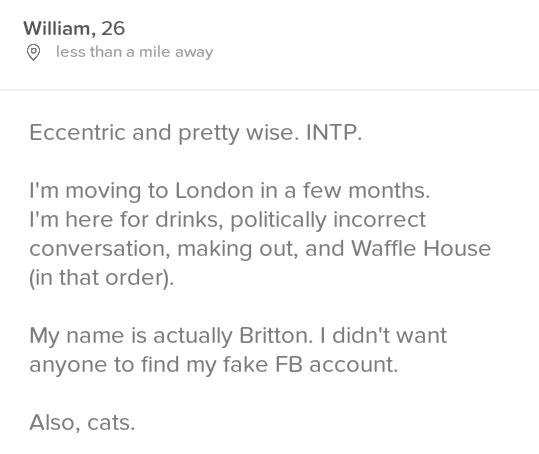
I’m Britton, as you should know, and below you’ll find the bio I wrote for my Tinder profile. If you don’t know what Tinder is, then get your head out of the sand, and read about it here.

2017-05-22 16.49.15

I was in New Orleans the other day, getting my swipe on, and then I came across this fine, older lady.

2017-05-22 12.40.00

The first things, ‘politically progressive’ and “the f-word”, I admit, probably should have raised red flags before even her shitty taste in music did. Those terms on their own hint at far-left political views, but the two of them together scream ‘SJW‘. However, she was hot, and that’s very rare of feminists, so I read into her words and saw deeper possibilities. I was hoping that maybe we could talk some philosophy, giving her the benefit of the doubt that her knowledge on that subject wasn’t confined to new-wave feminist crap. Hey, maybe she was even a feminist of the second-wave, non-radical kind, and ‘progressive’ just meant that she was kind of liberal and open to reasonable and necessary change. Maybe she’d even have a cat named Elvira. With this optimistic attitude, I swiped right and immediately tested her humor to see how “open” she really was.

2017-05-22 12.24.23

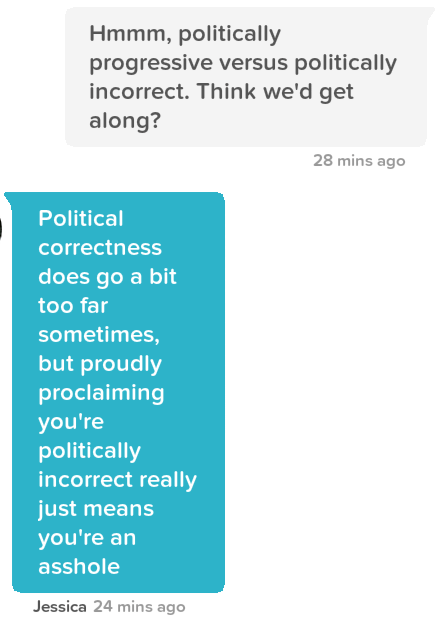
BOOM! No fun or games with this one. Did I “proudly proclaim” that I am politically incorrect? Reread my bio, and let me know. I think I’m just straightforward about what I want out of my Tinder experience. She could have easily swiped me left if my intentions didn’t line up with hers. Looking back, though, maybe I should have ended my first message with a winky face. 😉

2017-05-22 12.26.28

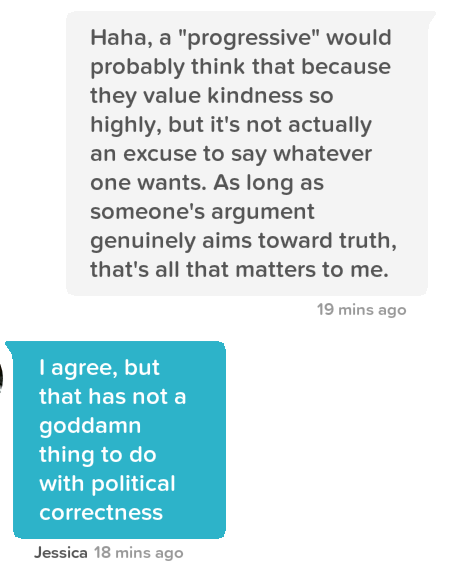
Do you value truth, Jessica? DO YOU? We’ll find out. Also, Jessica, I’ll be addressing you directly from here on. Wait, is it ok that I call you by your name, or would you prefer something else? I don’t want to be too incorrect and risk “invalidating your existence“.

2017-05-22 14.12.41

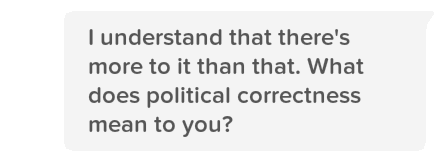
Yeah, let’s define a term together! That sounds like a fun philosophical exercise. Maybe you’ll even return the favor by asking me how I would define the term, and then we’ll find some common ground, bettering both of our conceptions of the world. Learning stuff is fun! You read philosophy, so you agree, right?

2017-05-22 12.29.22

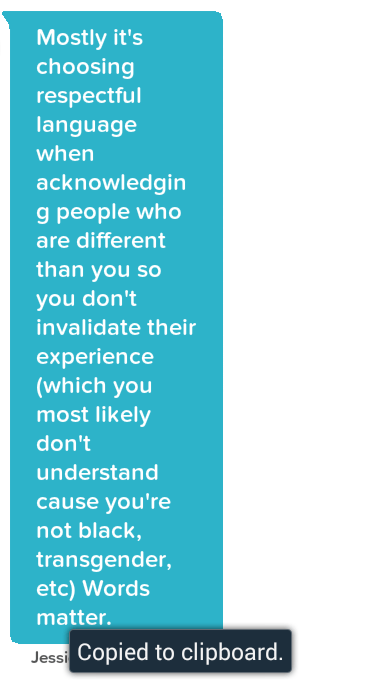
Annnnnd there it is. You pretty much nailed it, Jessica. I’m guilty of whiteness, so there’s no need to ask me what I think ‘political correctness’ means. Your understanding of how language works, on the other hand, seems a bit strange, and the philosophy you read may be of questionable quality. My validity on that topic comes from my education in linguistics and philosophy of language. But, you’re attempting to “invalidate” me because I’m… white? Hmmm.

I don’t think that speech is an activity so consciously aimed toward respect, nor do I think it’s a good idea to blindly respect people at all. In fact, it’s dangerous. I’ll spare you the technical linguistic part of the argument because I’m starting to sense that you have a screw or two loose, but I still must address the respect-issue.

Also, how are you so sure that I’m not black or transgender? If you respected me, then you would have asked about my preferred identity because race and gender are determined whimsically and have no biological basis, correct? No, you should have simply requested a dick pic, Jessica. Truth requires evidence, and I have plenty of it.

2017-05-22 12.31.40

So, maybe there’s more to political correctness than your definition, Jessica, and maybe I know some stuff that you don’t. Maybe you’d be interested in hearing it. Maybe if you weren’t so keen on blindly respecting others, then you wouldn’t be so liable to get mugged and raped in a dark alley in New Orleans. Or, maybe you’d like that because you’d become a martyr for your ideology. At this point, you’re not giving me any reason at all to respect you, but I do fear for your safety. After all, you’re right that the world isn’t a very kind place.

2017-05-22 14.39.072017-05-22 14.40.34

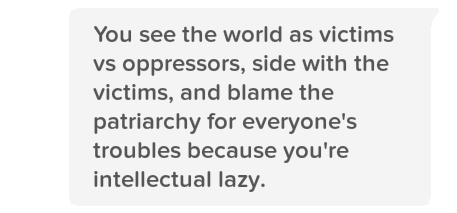
I figured I’d play the “patriarchy” card since you already accused me of being part of it by virtue of my straightness, whiteness, and maleness. What did you expect? Why did you swipe me right if you hate me by default, unless you wanted to hate-fuck me (shit, I may have missed my shot)? I mean, you’ve seen my pictures. Chances are that I’m not black under my clothes. In fact, I’m even WHITER there. Well, actually, there is a very small part of me that is kind of tan.

2017-05-22 12.35.42

2017-05-22 15.00.48

*ignores grammatical errors and moves on*

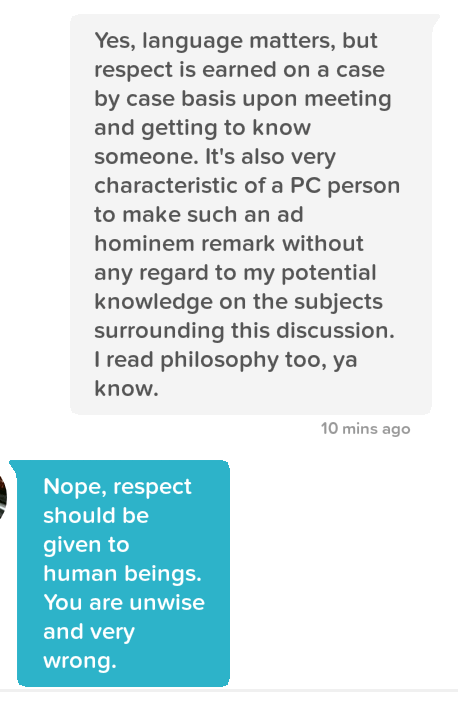
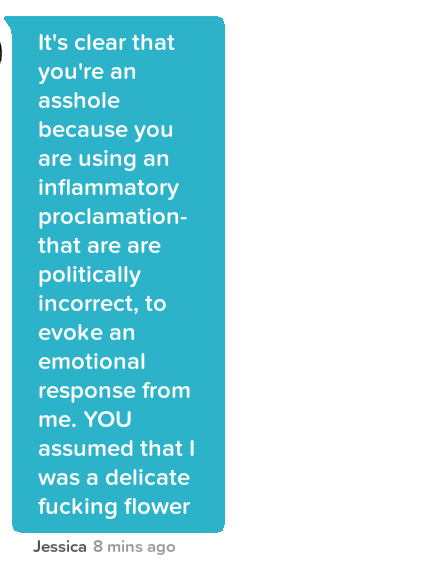
I know I’m an asshole, Jessica. There is no need to repeat yourself. But, does being an asshole make me wrong? No, Jessica, you’re the meanie who committed ad hominem. I also didn’t appeal to emotion to argue my point. You just took it that way. Taking offense and giving it are NOT the same thing. That’s Philosophy 101.

But…do save me! Please save me from my problematic ways so I can be more compassionate like you and make the world a more progressive place! Or, do I need a degree in women’s studies to be infected with your profound wisdom? If it’s LSU that infected you, then you’re right that there is no hope for me because I dropped out of that poor excuse for a higher-education institution after just one semester of grad school.

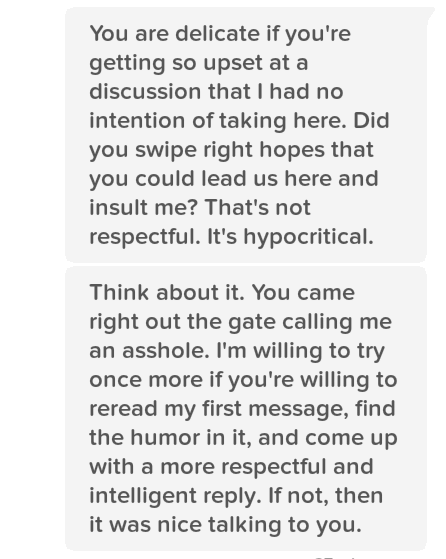
On the other hand, I could help you by revealing your greatest contradiction, and maybe even give you one more chance to get laid by me, knowing well that so few men would have gotten even this far with you. I mean, this is Tinder. Why else would you be here? Yeah, that’s what I’ll do because I want some too. I’ve learned to accept that liking sex makes women delicate flowers and men oppressive misogynists. It’s cool, really, I don’t need to be reeducated. I’ll even let you play the role of misogynist, and I’ll be the victim, and you can oppress deez nuts all you want.

2017-05-22 15.11.27

That’s where it ended. So…

What the hell is going on here?

I don’t think that I need to go into detail about what is going on here. There are plenty people who have done that very well already. For example, Dr. Jordan B. Peterson in this brilliant snippet from the most popular podcast in the world. The general point I want to make is that we are in a strange place where people like Jessica are multiplying exponentially by the semester, thanks to politically correct ideology infecting universities, business administrations, legislature, and now even Tinder (as if Tinder doesn’t already have enough spam)! This is the time for talented and capable people, mostly men, to stop ceding power to the people who live in those boxes; they’re wrong, and they’ve snuck their way into power without truly earning it. To stand up for truth is to stand up for yourself. However painful that may be now, it is absolutely necessary for the survival of our species. After all, if we were all angry, 35-year-old feminist virgins, of course humanity would end.

Since we aren’t all like Jessica, one day we will be without these people completely. Let’s give them what they want: spare their feelings, thus depriving them of the open, truth-seeking dialogue that would mold them into stronger moral beings and free them from the narrow and suffocating constraints of the feminist ideology. Since they aren’t open to that sort of thing, they will eventually self-extinguish under their childless philosophy and rot in the miserable hell that they’ve created for themselves.

WARNING: Your Kid is Smarter Than You!

Everyone is born with some capacity for critical thinking, but most people lose the skill over time. Children, specifically those aged 3-5, happen to be the best at it. This can be proven by a single word: ‘why’.

When someone asks a ‘why’-question, they are asking a question of reason, which is to say they are thinking critically to some degree. Children do this much more openly than adults, which is why most adults think children are simply being pests when they do. That is incorrect. The root of their questioning is philosophical. Children challenge assumptions, premises, and claims more openly than anyone. They are learning as much as they can about the world, and they demand reason to back up that knowledge. They are not lazy in the way that they tend to develop beliefs. Unfortunately, most parents do not share such genuine, open curiosity, nor are they readily able to cater to it. This is most obvious in grandparents, as the saying goes, “you can’t teach an old dog new tricks”. Elderly people tend to be the most firmly set in their ways and resistant to new ideas. Who can blame them? Thinking is calorie-intensive. Quite frankly, old people just don’t have the energy for it. Parents and teachers, however, have an important job to do. They have no excuse.

Though a child’s tendency to ask these types of questions will persist for some time, his continuance to do so will depend greatly on how open and able his parents and teachers are to dealing with it. In a perfect world, adults would take this as an opportunity to think critically about those questions themselves. Instead, they get frustrated or annoyed, make up a poor answer (e.g. “because I said so”), and send their kid straight to the TV or to bed; whatever it takes to keep them occupied and out from under the their skin. This is an uninspired and very resistant approach to parenting. The child’s curiosity is repressed, and they gradually stop asking questions and start submitting more and more to an ideology. The more naive children give in more quickly to the rules set before them. Others might become rebellious. Those rule-followers are certainly no smarter than the rebels, despite what social convention will tell you. Either way, their guardians’ repression has a lasting, negative effect on how they think.

I would like to now disclose that I do not have any children of my own, and I do not plan to have children in the foreseeable future. On that basis, someone who is guilty of the above might already feel offended and accuse me of having an incredible opinion on the matter. I would like to think that the contrary is true for two main reasons. First, I am a good planner. I am fully aware of the challenges of raising a child, and that is precisely why I am responsible enough to take the necessary precautions to prevent having one. Secondly, experience isn’t everything. I can observe the effects of bad parenting with a high level of objectivity because my thoughts about the matter are not distorted by the feelings caused by having a child of my own – feelings which unavoidably inhibit one’s ability to reason well.

Having said that, as you are a rational, autonomous agent, let me tell you a story.

I have a friend who has a four-year-old daughter. Immediately, there is a problem: He did not intend to. No, the fact that so many other people accidentally have children does not excuse him. That would be to commit the bandwagon fallacy. Nor does the fact that he is married and is financially able to support his daughter excuse him. In fact, he and his wife planned on holding out for five to seven years after their marriage to have a child, as they were aware of their not being ready. Instead, they ended up getting pregnant within only one year of their marriage. She was not planned, and my friend was not ready for the challenge of raising her. This is obvious upon close observation.

What does it mean for one to “be ready” to raise a child? That seems like a personal, descriptive question that everyone has their own unique answer to. That is true in a sense, but there is also a very normative aspect to this question. What “readiness” should mean here is that one is willing to accept the intellectual challenge of teaching a little person how to think – not what to think. That involves, not shrugging every time the child asks ‘why’, but, also, more crucially, asking ‘why’ for oneself. There is a modern saying that goes, “grade school teaches one what to think whereas college teaches one how to think”. My argument is that by the time someone gets to college age, they have already become a person to a degree, with their own thoughts, feelings, and system of beliefs. Therefore, it is almost certainly too late to teach one how to think. Small children ask the most critical questions. Parents should help them improve that ability at that point, before they have subscribed to an ideology that will most likely be founded in poor reasoning. The obstacle here is that the parents have previously adopted certain beliefs and have therefore surrendered their own ability to think well, much less will they be able to teach that ability to a child. Leading by example is vital, as kids learn by copying.

My friend is no exception. He holds some rather radical beliefs – mainly those of scientism and atheism, which normally go hand-in-hand. Therefore, he is not the type, no matter the subject, to be truly open to the question ‘why’. His beliefs dictate specific answers to those questions. i.e. All knowledge in the universe, including that of supernatural entities (such as God), has been or will be confirmed or falsified on the basis of physical, quantifiable matter.

The other day, my friend’s daughter was at preschool when some of her classmates were talking about a discussion they had in Sunday School the weekend before. When she got home that afternoon, she began to ask her father questions about God. She wasn’t doing so in a way that presupposed God’s existence, nor was she making any such claims. She was simply asking out of genuine curiosity, as children do with everything. To this point in her life, she had never even heard of God because my friend, being a serious atheist, had kept all sources of religion from her access at home. So, as you might imagine, he was quite disturbed that she was asking these questions. He felt he had done all he could do at home to keep religion out of her life, and now she was confronting him, backing him into a corner. His quick-fix decision was to, first, reject her questioning, and second, become more militant in forcing scientism upon her. He went out and bought children’s books about Darwinian evolution to fill the gap of there being no religion (e.g. bible story books). His hope was that she would believe in science (actually, scientism) instead of religion.

My friend, on an elusive, yet vital note, is trapped in a very conflicted way of thinking. He wants his daughter to “think according to reason”, as he says, but he also wants her to believe in some very specific ideologies. The two, at least in principle, cannot coexist. As I have clearly explained in earlier posts, reason and ideology are nearly polar opposite mindsets. If one is to reason well, he should find that no general ideology, is worth submitting to. There are only specific, situational exceptions to that fact. For example, when one takes a math test, he tunes into the deductive, mathematical way of thinking. When he takes a history test, he tunes into the material he studied for that test. Each way of thinking is useful in its own contexts. If he tries to apply math to the history test, or vise versa, he will fail the test.

On a more obvious note, my friend’s attempt to relentlessly control what is exposed to his daughter is a hopeless endeavor. She is going to get out of the house and away from her parents, as she already has to a degree. She is going to experience the world. She is going to have conversations with people who have views that conflict with her own. Most of all, she is going to be challenged. If she is taught what to think (whether evangelical Christianity, scientism, atheism, democratic or republican ideologies, etc.) she will be defenseless in such encounters. She will only be able to think and express herself according to those strict systems of thought, and that will be very limiting.

This approach to parenting, in some form or another, is widespread in the western world, and it is wrong. It is like trying to understand how the brain of a rat works by killing the rat, taking the brain out, and observing the brain in a non-working state, independent of the body. When one attempts to control all variables from happening, such conditions fail to represent those in the real world, for the real world is that which contains all the variables uncontrolled! Anything learned via such a method cannot be meaningfully applied in the real world. In fact, such methods will produce literally no meaningful results whatsoever.

How these analogies and examples can help us improve things, I will soon explain. There are constructive methods and solutions. The details of those methods will be for the individual parents and teachers to determine. All I will do is offer insights. You know your children the best, so adapt the concepts in your own way toward the one common goal: development of flexible thinking and viewpoints. There is a route for everyone. It is up to you to carve it for your children and for yourself.

There is not one generalized system of government, education, and economy that will satisfy all individuals. The ways individuals see things can change instantaneously. Creating a better world starts with better-thinking individuals. We can only hope that future systems will adapt accordingly.

To be continued…