Debunking the “Free Will Illusion” Part 2: Three Levels of Self-Governance

To continue from my previous post, self-governance is not as common as we’d like to think, but I intend to hold that it is still possible for everyone in certain cases and following a degree of conscious effort to understand the self. That said, it seems plausible that it is not a function of most of us, most of the time.

Although there are many, I want to focus on three sources of self-governance from which we can draw principles for living, as I mentioned at the end of the last section. They can be from morality (truth), from self-enforced boundaries (the self), or from external authority (others).

Appealing to external authority for the formulation of principles, regardless of how true they are or how good the results they produce, is a logical fallacy — i.e. an error in reasoning. Whether they are copy and pasted from your father, mentor, religion, or boss, nothing is true or good because of the person’s position of authority, and you give up your own inner authority by blindly following that of another. People have varying degrees of just authority, and such a degree may represent their ability to guide someone toward the truth if it is indeed the truth for which they live — this means that they have good intentions. Good intention is unconditional and does not seek money or control, and it is only from those with good intention that we can truly learn anything. Still, lead us they need not. Their wisdom should merely help us to guide ourselves. It could, on the other hand, be that the authority is merely self-serving (as is the case for leaders for whom pride is the driving force of their reign), and one’s ability or inability to distinguish between others’ true or ill intentions means that one is vulnerable to selling their soul’s autonomy to the ones who seek it. External authority is never the answer for principle-setting.

Self-enforced boundaries come merely from the self. They are often overcorrective, flight response limits to external stimuli and events. So, although one is the sole, conscious arbiter of these rules, they are at the willing hand of the world, and so boundaries are not set with clear consciousness. They draw a line in the sand and say “I will do that and not do this”, regardless of the circumstances, thereby, paradoxically, letting circumstances control their rigid minds. They shortcut the work one must do in order to adapt to external circumstances as to “do right” under any conditions, which requires cultivating a filter for what one will allow oneself to be influenced by. Boundaries, rather, build a wall against facing circumstances as they are. They mistake defensiveness for genuine protection, and they only delay the cultivation of character.

The human mind, much like the body, is anti-fragile. The more one is exposed to and observant of something, the more one understands its patterns, and the less one fears it. Boundaries do not seek to understand things in themselves, but rather, avoid those things from fear. However, this type of self-governance is a step in the right direction for someone who was previously guided more directly by external authority.

Genuine moral principles, in contrast, constantly, voluntarily take on the challenge of being tested. It is as if one’s belief system is in a constant state of exposure therapy. With every test, a principle gets stronger because it is both being exposed to its foe and making use of the wisdom gained from facing all of the tests from the past. Expose yourself to nothing, and you will go weak. Principle must come from self-awareness, but not arrogance, and understand that the external world is not within one’s control. Therefore, minor improvements occur in one’s principles over time. A principle-forming person knows that the only thing he can control is his responses to externals, based on his patterned understanding of those externals and how he is both a keen observer and a dutiful participant in all of reality. This type of person is a spiritual person who has gratitude for life and all of its struggles and joys, and they relish the duties of observation and self-improvement. This path implies a belief in some universal conception of truth and goodness, and self-improvement equates to the process of sharpening one’s perception as to orient them closer to that universal state with every thought, word, and action.

Self-governance from the cultivation of moral principles is a path rooted in unconditional acceptance — unlike boundaries which are seen as good under the condition that they don’t cause one pain, or external authority which has no intrinsic right to speak on others’ behalves to begin with — and they are the only governance pattern whose origin really is in truth and goodness for one and for all. “Truth and goodness for one and for all” is perhaps the core value from which any sustainable principles originate, for it is universal and non-polar in nature, which relinquishes the ego’s need to believe and prove things…

As it turns out, the ego rules most, and those people would rather take the easy path of outsourcing their own moral authority anyway.
Don’t Use Sarahah; Own Your Words!

The problem with the new anonymous messaging app Sarahah isn’t that it creates a platform for cyberbullying (just walk away from your computer screen, jackass); it’s that it is playing a role in the leftist movement against free speech by ridding people of the responsibility of owning their words.

I don’t need to have used the app to know this. It’s obvious. In this time when social media is allowing for people to communicate less and less directly, making them more and more thin-skinned, careless with their speech, and, quite frankly, stupid, this app deals with the free speech problem by cleverly working around it. While most leftist social media platforms attempt to censor content or to simply suspend accounts when people say things that don’t conform to their collective beliefs, Sarahah allows the content to flow freely because no one in particular can claim responsibility for it. It is an anonymous free speech safe space, if you will.

Of course, the app knows who said what, so it allows you the option to anonymously block users if you get an undesirable message, so content can still be managed in that way.

Fair enough.

If someone messages you through the app telling you point-blank “you’re a dumb fuck”, you might not want to hear from that person again since they are lacking the tact and constructive criticism that the app would like of its users, and the same would be the case in real life, you can be sure.

The point I’d like to make in this post is that the Sarahah concept can seem all well and good on its own, but when you put it into a real world context, as with any new product, the users will determine its true identity. (this is through no clear fault of the creator; not every app developer knows enough about human nature to think through every scenario in which someone might use the app differently than he intended… this is why user feedback is so crucial). This post is my prophesy about why Sarahah’s identity will turn out more bad than good and why I would generally advise against using it.

Why Sarahah is Bad for Business

A good business provides a valuable service to the community. In order to ensure that the service continues to grow and improve, it is necessary that the employees work in an environment conducive to the free-exchange of ideas. That might make Sarahah seem like the perfect app, right? Actually, the contrary is true because of what the idea leaves out.

What is just as important as the idea itself is the employee’s taking credit for it. Sarahah doesn’t allow for this, neutralizing the dominance hierarchy within the company. The employer can reap the benefits of having the idea, but he does not have to give credit where it is due. This is convenient for the individuals at the top whose jobs won’t be threatened, and for the human resources department because they will have fewer cases to deal with, but it could hurt the company in the long run when their employees’ intellects are suppressed and promotions are given to the wrong people. This is bad news for female employees who, if they thought they were disadvantaged in the workplace before, will be even more so now, perhaps without their even realizing it. It is also bad for male employees who will inevitably lack the motivation to give any criticism at all.

Here are the differences between how women and men will be affected by Sarahah in the workplace.

Sarahah sneekily caters to the female temperament.

From a personality perspective, women tend on average to be higher than men in Big5 trait agreeableness. This means they are more compassionate, less assertive, tend to underestimate their abilities, and they don’t as often take credit for their achievements. They are also higher in trait neuroticism, which is sensitivity to negative emotion. This makes Sarahah the perfect place for women to speak their minds. They don’t have to give criticism directly, and they don’t have to claim fault if that criticism hurts someone’s feelings.

This might sound appealing to women, but I see it as taking advantage of the woman’s common workplace weaknesses. Though (probably) not intended, the inevitable consequence of this will be that even fewer women will stand out among their coworkers and be considered for promotions. They’ll be comforted now more than ever that simply sitting there and doing their jobs is enough, instead of taking the risks necessary to advance. (Of course, personality studies show that this is a good thing if they want to maximize their mate options, as women prefer mates who are at least as smart and successful as they are) All of this is true for some men as well, but I suspect men in general will encounter a different set of problems.

Sarahah Suppresses the Male Intellect

Since men are more assertive and aggressive, they will still be more likely than women to give criticism face-to-face, and there’s bad news for men who do. If a company begins to rely on Sarahah as the primary means by which to take criticism, then direct dialogue between people will be constricted, not enforced. Any man who does not use the app to speak his mind is taking a dangerous and unnecessary risk. He may get into trouble and risk losing his job if his speech is in violation of company policy. He won’t be able to play the traditional, competitive, risk-reward game that is crucial to his potential to climb the company ladder.

Challenging the status quo is an important way in which men typically show their ability to think critically, articulate, and negotiate – skills that are necessary for managing a good business at all levels. Sarahah suppresses these skills. This will allow HR to keep the hiring process neutralized, so they do not have to promote people within the company based on merit, but rather by whichever absurd and counterproductive standards they choose (e.g. to meet notoriously anglophobic ethnic diversity quotas).

Why Sarahah is Bad for Personal Relations (to point out the obvious)

It might sound appealing to find out what your friends and acquaintances really think of you, but I suspect that the anxiety that will result from not knowing who exactly said those things will far outweigh any positive effect that the criticism may have on you. Imagine walking around at a party where all of your closest friends are present, knowing that half, maybe even all of them have only been able to honestly open up to you anonymously.

A good friendship or relationship should not only be conducive to, but founded on open, honest communication. I know it sounds cliché, but this cannot be overstated given that Sarahah exists to deny that. In fact, we identify who our friends are based on how open our communication is with them, do we not?

Consider this… your primary or best friends are those few who you can be absolutely open with. You know who they are. Your secondary friends encompass a wider circle. They are people you may call on regularly, but the subject matter of your communication with them is limited, whether to specific topics or to a level of depth in general. Your acquaintances are everyone else you know – people you could (and often should) do without.

Which friend group do you suspect is the most likely to send you overly-critical messages on Sarahah? Acquaintances? The people who know you the least?

Hmm, maybe not.

Acquaintances might be the most likely to send you the occasional “you’re a dumb fuck” sort of message. But, since they know you the least, they think of you the least. They care for you the least. They’re the least likely to try to help you. So, I’d guess not.

What about those best friends who use the app? They very well may use it to give you some much-needed advice, but who are they? Though the advice is sound, are they really your friends if they can’t sit you down and talk to you?

You might be disappointed (or even relieved, if you’re a particularly strong person) to find out that some people who you thought were your best friends are really secondary friends, or mere acquaintances, or just snakes and not your friends at all. In fact, any “best friend” who might use the app out of fear of being honest with you, no matter the content of their message, is doing you a huge disservice. They’re simply acting cowardly.

Conclusion: Don’t Be a Pussy

Don’t use Sarahah. Own your words. Be an open, honest, and responsible human, for your sake and the sake of your friends and coworkers. If your company tries to adopt Sarahah in order to take criticism, explain to them the problems that would cause for you and for them. If they insist, then give criticism directly anyway. Get into a fight with those dumb cunts in HR. Get fired. Chances are that it’s not your dream job anyway.

If your friends announce on social media that they just started a Sarahah account, they’re reaching out for help. Take them out for a drink and ask them what’s up. It may require a bit of persistence, but if they’re really your friend, then it will be worth it.

Despite the difficulties in the short-term, the long-term benefits of having straightforward, critical discussions with people will be worth it. You’ll show them that you are worth it, and they will reward you for it. But, of course, don’t do it for the reward; as with anything, do it simply because it’s right.

Tinder Fun With a Feminist

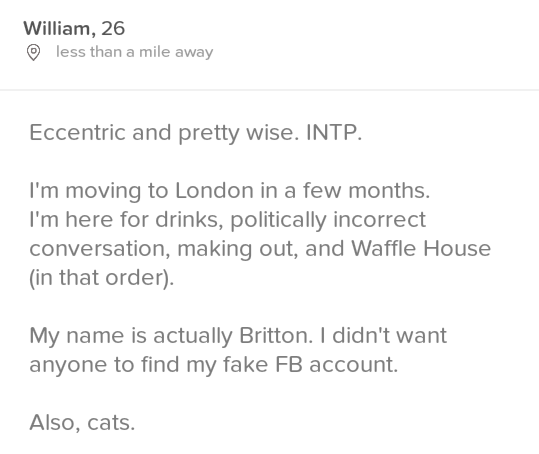
I’m Britton, as you should know, and below you’ll find the bio I wrote for my Tinder profile. If you don’t know what Tinder is, then get your head out of the sand, and read about it here.

2017-05-22 16.49.15

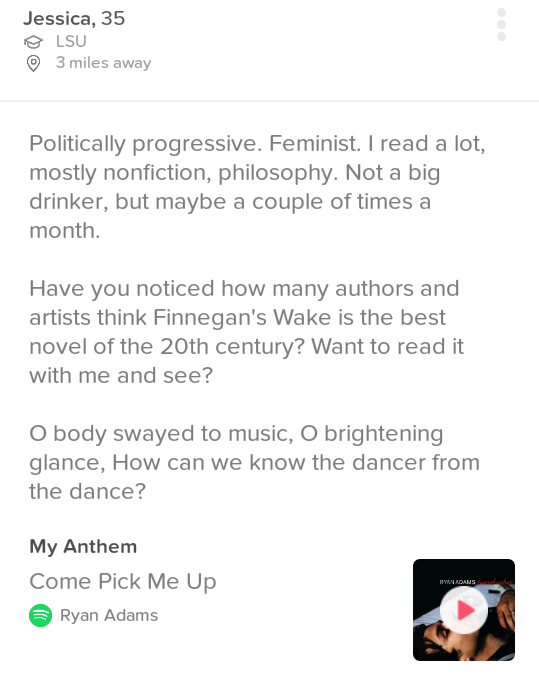
I was in New Orleans the other day, getting my swipe on, and then I came across this fine, older lady.

2017-05-22 12.40.00

The first things, ‘politically progressive’ and “the f-word”, I admit, probably should have raised red flags before even her shitty taste in music did. Those terms on their own hint at far-left political views, but the two of them together scream ‘SJW‘. However, she was hot, and that’s very rare of feminists, so I read into her words and saw deeper possibilities. I was hoping that maybe we could talk some philosophy, giving her the benefit of the doubt that her knowledge on that subject wasn’t confined to new-wave feminist crap. Hey, maybe she was even a feminist of the second-wave, non-radical kind, and ‘progressive’ just meant that she was kind of liberal and open to reasonable and necessary change. Maybe she’d even have a cat named Elvira. With this optimistic attitude, I swiped right and immediately tested her humor to see how “open” she really was.

2017-05-22 12.24.23

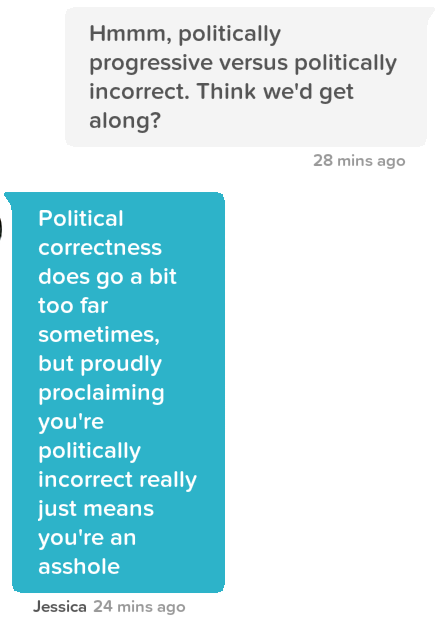
BOOM! No fun or games with this one. Did I “proudly proclaim” that I am politically incorrect? Reread my bio, and let me know. I think I’m just straightforward about what I want out of my Tinder experience. She could have easily swiped me left if my intentions didn’t line up with hers. Looking back, though, maybe I should have ended my first message with a winky face. 😉

2017-05-22 12.26.28

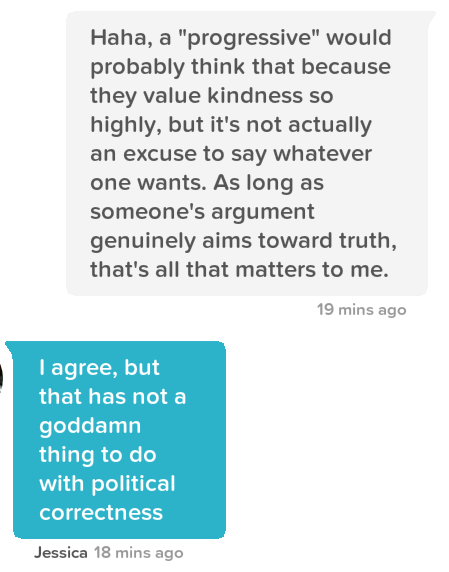
Do you value truth, Jessica? DO YOU? We’ll find out. Also, Jessica, I’ll be addressing you directly from here on. Wait, is it ok that I call you by your name, or would you prefer something else? I don’t want to be too incorrect and risk “invalidating your existence“.

2017-05-22 14.12.41

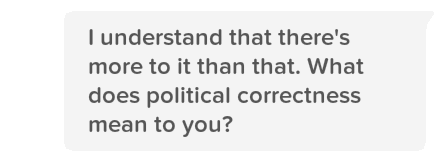
Yeah, let’s define a term together! That sounds like a fun philosophical exercise. Maybe you’ll even return the favor by asking me how I would define the term, and then we’ll find some common ground, bettering both of our conceptions of the world. Learning stuff is fun! You read philosophy, so you agree, right?

2017-05-22 12.29.22

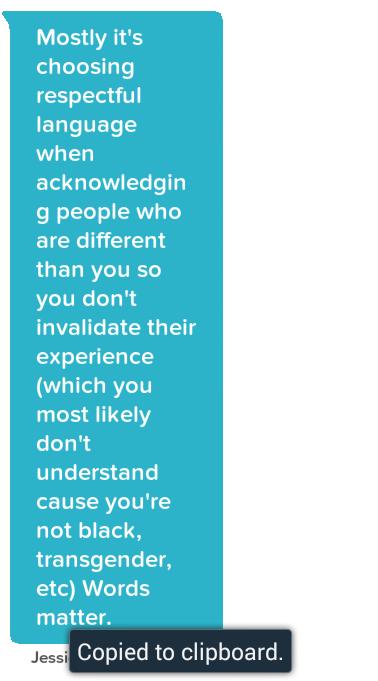
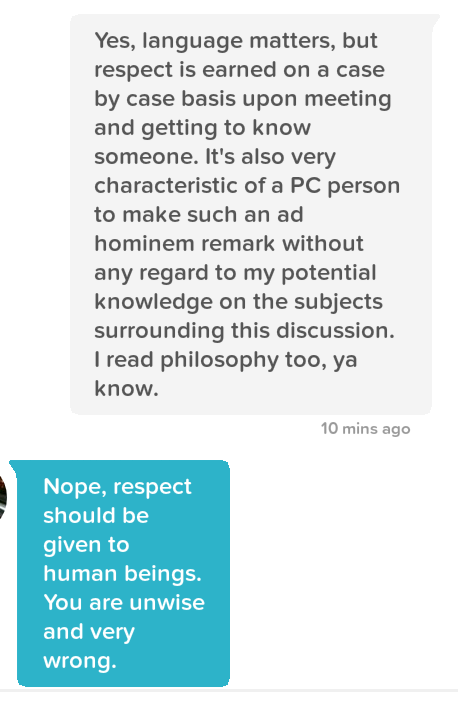
Annnnnd there it is. You pretty much nailed it, Jessica. I’m guilty of whiteness, so there’s no need to ask me what I think ‘political correctness’ means. Your understanding of how language works, on the other hand, seems a bit strange, and the philosophy you read may be of questionable quality. My validity on that topic comes from my education in linguistics and philosophy of language. But, you’re attempting to “invalidate” me because I’m… white? Hmmm.

I don’t think that speech is an activity so consciously aimed toward respect, nor do I think it’s a good idea to blindly respect people at all. In fact, it’s dangerous. I’ll spare you the technical linguistic part of the argument because I’m starting to sense that you have a screw or two loose, but I still must address the respect-issue.

Also, how are you so sure that I’m not black or transgender? If you respected me, then you would have asked about my preferred identity because race and gender are determined whimsically and have no biological basis, correct? No, you should have simply requested a dick pic, Jessica. Truth requires evidence, and I have plenty of it.

2017-05-22 12.31.40

So, maybe there’s more to political correctness than your definition, Jessica, and maybe I know some stuff that you don’t. Maybe you’d be interested in hearing it. Maybe if you weren’t so keen on blindly respecting others, then you wouldn’t be so liable to get mugged and raped in a dark alley in New Orleans. Or, maybe you’d like that because you’d become a martyr for your ideology. At this point, you’re not giving me any reason at all to respect you, but I do fear for your safety. After all, you’re right that the world isn’t a very kind place.

2017-05-22 14.39.072017-05-22 14.40.34

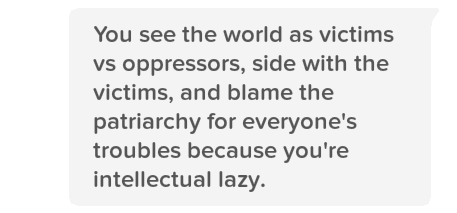
I figured I’d play the “patriarchy” card since you already accused me of being part of it by virtue of my straightness, whiteness, and maleness. What did you expect? Why did you swipe me right if you hate me by default, unless you wanted to hate-fuck me (shit, I may have missed my shot)? I mean, you’ve seen my pictures. Chances are that I’m not black under my clothes. In fact, I’m even WHITER there. Well, actually, there is a very small part of me that is kind of tan.

2017-05-22 12.35.42

2017-05-22 15.00.48

*ignores grammatical errors and moves on*

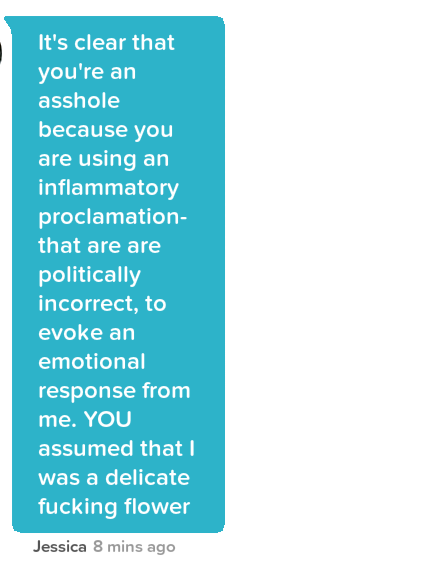
I know I’m an asshole, Jessica. There is no need to repeat yourself. But, does being an asshole make me wrong? No, Jessica, you’re the meanie who committed ad hominem. I also didn’t appeal to emotion to argue my point. You just took it that way. Taking offense and giving it are NOT the same thing. That’s Philosophy 101.

But…do save me! Please save me from my problematic ways so I can be more compassionate like you and make the world a more progressive place! Or, do I need a degree in women’s studies to be infected with your profound wisdom? If it’s LSU that infected you, then you’re right that there is no hope for me because I dropped out of that poor excuse for a higher-education institution after just one semester of grad school.

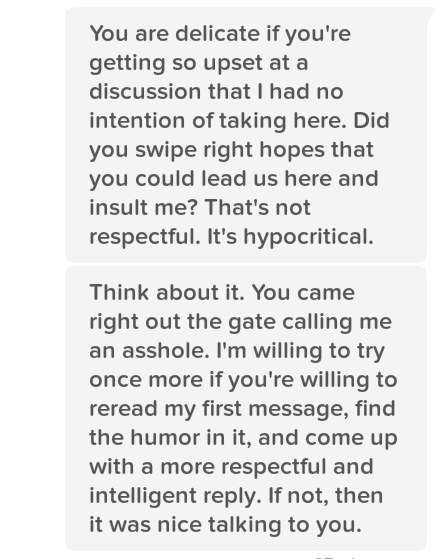
On the other hand, I could help you by revealing your greatest contradiction, and maybe even give you one more chance to get laid by me, knowing well that so few men would have gotten even this far with you. I mean, this is Tinder. Why else would you be here? Yeah, that’s what I’ll do because I want some too. I’ve learned to accept that liking sex makes women delicate flowers and men oppressive misogynists. It’s cool, really, I don’t need to be reeducated. I’ll even let you play the role of misogynist, and I’ll be the victim, and you can oppress deez nuts all you want.

2017-05-22 15.11.27

That’s where it ended. So…

What the hell is going on here?

I don’t think that I need to go into detail about what is going on here. There are plenty people who have done that very well already. For example, Dr. Jordan B. Peterson in this brilliant snippet from the most popular podcast in the world. The general point I want to make is that we are in a strange place where people like Jessica are multiplying exponentially by the semester, thanks to politically correct ideology infecting universities, business administrations, legislature, and now even Tinder (as if Tinder doesn’t already have enough spam)! This is the time for talented and capable people, mostly men, to stop ceding power to the people who live in those boxes; they’re wrong, and they’ve snuck their way into power without truly earning it. To stand up for truth is to stand up for yourself. However painful that may be now, it is absolutely necessary for the survival of our species. After all, if we were all angry, 35-year-old feminist virgins, of course humanity would end.

Since we aren’t all like Jessica, one day we will be without these people completely. Let’s give them what they want: spare their feelings, thus depriving them of the open, truth-seeking dialogue that would mold them into stronger moral beings and free them from the narrow and suffocating constraints of the feminist ideology. Since they aren’t open to that sort of thing, they will eventually self-extinguish under their childless philosophy and rot in the miserable hell that they’ve created for themselves.

The False-Dilemma of the Nature vs. Nurture Debate

Before I begin, allow me to explain what I mean by false dilemma. A false dilemma is an error in reasoning whereby one falsely assumes that the truth of a matter is limited to one of two (or a select few) explanations. For example, the American presidential election. For another example, have you ever been stumped by a question on multiple choice test because you saw more than one possible correct answer (or no correct answers all)? — perhaps you got frustrated because you felt that the test was unfairly trying to trick you? Well, you were probably right. This may have been an instance of your ability to recognize the false dilemma fallacy. Sometimes there are indeed any number of correct answers given any number of circumstances. There is often simply not enough information provided in the question for one choice to clearly stick out as correct. This might lead you to question the test in a broader sense. What is the purpose of this (presidential election, or) test? What is it trying to measure or prove? Without getting into that answer in too much detail (as this is not a post about the philosophical state of academic testing), I can say such tests aren’t really concerned with truth and meaning as they are about the specific program they support. That program may or may not have the best interests of the people in mind, and it may or may not be directly governed by the amount of money it can produce in a relatively short period of time. Anyway, that’s another discussion.

In a previous post entitled The Slate, the Chalk, and the Eraser, I compared a child’s mind to a slate, and I argued that as long as we write on it with chalk by teaching him how to think (rather than a permanent marker/what to think), then he will be able to erase those markings to make way for better and more situation-relevant ones in the future, once he develops the ability to make conscious judgments. This is an example that you may have heard before, and it can be useful, but by some interpretations, it may seem to rest on a false presupposition. Such an interpretation may raise the “nature-nurture” question that is so common in circles of science and philosophy. One might argue that if a child’s mind is truly analogous to a slate in the way I have put forth, then I should commit myself to the “nurture” side of that debate. That was not my intention. In fact, that debate, in its most common form, presents a false dilemma, so I can only commit to both or neither side depending on what is meant by ‘nature’ and ‘nurture’. The conventional definitions of these terms are limited in that they create a spectrum on which to make truth-value judgments about objects, experiences, phenomena, etc. We commit to one end of the spectrum or the other, and we take that position as true and the other as illusory. This is similar to the subject-object distinction I described in an earlier post. Perhaps comically, even the most radical (and supposedly-yet-not-so-contrary) ends of scientific and religious belief systems sometimes agree one which side to commit to, albeit for different reasons. That particular conflict, however, is usually caused by a semantic problem. The terms ‘nature’ and ‘nurture’ obviously mean very different things for radical mechanistic scientists and evangelical Christians.

Please keep in mind throughout that I am not criticizing science or religion in general, so I am not out to offend anyone. I am merely criticizing radical misinterpretations of each. Consequently, if you’re an idiot, you will probably misinterpret and get offended by this post as well.

Taking this description a step further, false dilemma can be committed to any number of degrees. The degree to which it is committed is determined by at least two factors: the number of possible options one is considering and the level of complexity at which one is analyzing the problem. Any matter we might deal with can be organized conceptually into a pyramid hierarchy where the theoretical categorical ideal is at the top, and the further one goes down the pyramid, the more manageable but trivial the matters become. As a rule of thumb, the fewest options (one or two) and the lowest level of analysis (bottom of the pyramid) should give rise to the highest probability of a logical error because the bottom level of analysis has the highest number of factors to consider, and those factors culminate up the pyramid toward the categorical ideal. Fortunately, committing an error at the lowest levels of analysis usually involves a harmless and easily-correctable confusion of facts. Committing the error at higher levels of analysis are more ontological in nature (as the categorical ideals are per se) and can have catastrophic consequences. All sciences and religions structure their methods and beliefs into such pyramid hierarchies, as do we individually. They start with a categorical ideal as their assumption (e.g. materialism for some science; the existence of God for some religion), and they work down from there. However, neither religion nor science are meant to be top-down processes like philosophy (which is likely the only top-down discipline that exists). They’re meant to be bottom-up processes. For science, everything starts with the data, and the more data that is compiled and organized, the more likely we are able to draw conclusions and make those conclusions useful (in order to help people, one would hope). For religion, everything starts with the individual. Live a moral and just life, act kindly toward others, and you will be rewarded through fulfillment (heaven for western religions, self-actualization for eastern religions). These can both be good things (and even reconcilable) if we go about them in the right way. What are the consequences, however, if we go about them radically (which is to say blindly)? In short, for radical belief in a self-righteous God, it is war, and therefore the loss of potentially millions of lives. In short, for radical materialism, it is corruption in politics, education, and the pharmaceutical industry, the elimination of health and economic equality, and the potential downfall of western civilization as we know it. That’s another discussion, though.

For the nature-nurture debate, the false dilemma is the consequence of (but is not limited to) confusion about what constitutes nature and nurture to begin with, and even most people who subscribe to the very same schools of thought have very different definitions of each. First, in the conventional form of this debate, what do people mean by ‘nature’? Biology, as far as I can tell, and nothing more. We each inherit an innate “code” of programmed genetic traits passed down from our parents, and they from theirs, and so on. This code determines our physiology and governs our behavior and interaction with the outside world. Our actions are reactive and governed by our brain-computer, and free will is consequently an illusion. What is meant by ‘nurture’ on the other hand? Our experienced environment, and nothing more. Regardless of our chemical makeup, how we are raised will determine our future. There is no variation in genetics that could make once person significantly different from another if raised in identical fashion by the same parents, in the same time and place. We have no control over the objective environment we experience, so free will still seems to be illusory.

These positions seem equally shortsighted, and therefore, this problem transcends semantics. Neither accounts for the gray in the matter — that reality, whatever that is, does not follow rules such as definitions and mathematical principles. These are conceptions of our own collectively-subjective realities which make it easier for us to explain phenomena which are otherwise unfathomable. On this note, we could potentially  consider both nature and nurture phenomenal. That is an objective point on the matter. The first subjective problem is that both positions imply that we don’t have free will. Sure, there are unconscious habits of ancient origins that drive our conscious behavior (e.g. consumption, survival, and reproduction), but there other more complex structures that these positions don’t account for (e.g. hierarchical structures of dominance, beliefs, and abstract behavior such as artistic production), and those are infinitely variable from person to person and from group to group. This comes back to the point I just made about phenomenal reality and the conceptions we follow in order to explain them as if they are somehow out there in the objective world that we are not part of.

Not to mention, we all take differently to the idea that free will might not exist. Religious people are often deeply offended by this idea whereas many scientists (theoretical physicists in particular) claim to be humbled by it. Both reactions, I would argue, are disgustingly self-righteous and are the direct consequence, not of truly understanding the concept of free will per se, but of whether or not free will simply fits into his or her preconstructed hierarchical structure of beliefs. One should see clearly, on that note, why a materialist must reject free will on principle alone, and a radical christian must accept it on principle alone. Regardless of the prospect that the religious person has a right to be offended in this case, and that it is contradictory of the scientist to commit to a subjective ontological opinion when that very opinion does not permit one to have an opinion to begin with (nor can it be supported with any sufficient amount of “scientific” evidence whatsoever), the point here transcends the matter of free will itself: that rejecting or accepting anything on principle alone is absurd. This calls into question matters of collective ideological influence. There is power in numbers, and that power is used for evil every bit as often as it is used for good. When individuals, however, break free from those ideologies, they realize how foolish it is to be sheep and to believe in anything to the extent that it harms anyone in any way (physiologically, financially, emotionally, etc.). The scary part about this is that literally any program might trap us in this way (ideologically), and blind us from the potentially-innate moral principles that underlie many of our actions. On that note, we are all collectively very much the same when we subscribe to a program, and we are all part of some program. We are individually very different, however, because we each have the potential to arrive at this realization through unique means. We each have a psychological structure that makes up our personality. It is undeniably innate to an extent, yet only partially biological. This reveals the immeasurable value in developing the one’s intrapersonal intelligence through introspection and careful evaluation of one’s own thoughts, feelings, perceptions, and desires.

Furthermore, conventional nature-nurture positions are polarities on a spectrum that doesn’t really exist. If we had clearer definitions of each, perhaps the debate would not present a false dilemma. We should reconstruct those definitions to be inclusive of phenomena — think of these terms as categories for ranges of processes rather than singular processes themselves. If we think of these terms as being on a spectrum, we are led to ask the impossible question of where the boundary is between them. If we think of them as categories, we are forced to embrace the reality that most, if not all, processes can fall into either category given a certain set of circumstances, and thus, those categories become virtually indistinguishable. E.g. in the case of inherited skills: practice makes perfect, yet natural talent seems so strongly to exist. If the truth-value-based spectrum between nature and nurture were a real thing, then neither position would be able to account for both nurtured ability and natural talent; it would simply be either/or. This is a consequence of the false dilemma. It leads us to believe that this gray matter is black and white. If we one is decent at learning anything, he/she knows that there is only gray in everything.

But is there? I hope I have explained to some conceivable extent why scientific and metaphysical matters should not be structured into a polar truth-spectrum, and why any attempt to do so would likely present a false dilemma. However, it seems more reasonable to apply spectrum structures to value theory matters such as aesthetics, ethics, and even other personal motivators such as love. This, I will explain further in a later post.


Collective Subjectivity = Reality :: The Utility of Phenomenological Thought

In my last post, I explained the differences between and the proper uses of the terms ‘subjective’ and ‘objective’. To recap, these terms do not describe the positions from which one perceives. Of course, everyone perceives subjectively, and objects don’t perceive at all. Therefore, the subject/object spectrum is not a spectrum on which one may judge a matter’s truth-value. The spectrum simply describes the nature of the matter at hand — subjective means “of a subject” and objective means “of an object”. Having said that, how can we define truth more broadly? What determines it?

I think that we can, in many conceivable instances, equate truth with reality. This is based on one of two popular definitions of reality. The first, more popular definition in which we cannot equate truth and reality, and the one I reject, is that of objective, Newtonian-scientific reality. This holds that there are mathematical laws and principles out there in the universe, already discovered or waiting to be discovered, which the forces of nature can be reduced to. Proponents of this view hold “rationality”, in all of its vagueness, as the singular Platonic ideal which dictates what is true, real, and meaningful. It follows from this that mechanistic science holds the key to all knowledge. The problem here is that mechanistic science (not all science) is founded in the metaphysical belief in materialism. Materialism suggests that all reality is comprised of quantifiable matter and energy. Humans, and all living things, are “lumbering robots”, as Richard Dawkins claims. Consciousness, ethics, morality, spirituality, and anything else without a known material basis is subjective in nature and thus superstitious, irrational, and not real. As I have already explained, this worldview rests on a straw-man distinction between what constitutes subjective and objective, for it assumes that this distinction creates a spectrum on which to judge a matter’s truth-value (the more objective, the more true).

Remaining consistent with how I have distinguished subjective and objective is the second, less popular, and in my view, much more useful way of defining truth and reality: what is real is what affords us action and drives us toward a goal. The definition is as simple as that, but its implications have a tremendous amount of depth rooted in the unknown. Instead of holding one Platonic ideal (like rationality) as the key to all truth, there are an infinite number of ideals that humans conceptualize, both individually and collectively, in order to achieve their ends. Therefore, this view affords relevance to a wide range of perspectives even if the nature of the objects being perceived is unknown. The rationalist view, by contrast, is limited to the assumption that the nature of everything has already been determined to fit into one of two metaphysical categories: objective reality or subjective delusion. (This Newtonian theory of reality I have just explained, by the way, is a long-winded way of defining ‘scientism’, a term I often use in my posts.)

Nature doesn’t obey laws; humans do, so we tend to compartmentalize everything else in that way because that makes it easier for us to explain what we want to know and explain-away anything we don’t want to know. What we don’t want to know is what we are afraid of, and as it turns out, what we are afraid of is the unknown. So, when anomalies, whether personal or scientific, that don’t fit the already-established laws arise, a Newtonian thinker will categorize it as illusory in order to explain it away. This doesn’t work because even we humans have a propensity to break the laws that we create for ourselves, and this can be a very productive thing. The degrees to which this is the case depends on our individual psychological makeups. People who are high in the Big-5 personality trait conscientiousness, for example, tend to obey rules because of their innate need for outward structure and order. Those who are low in that trait are more likely to break rules, especially if they are also low in agreeableness which measures one’s tendency to compromise and achieve harmony in social situations. Openness, on the other hand, the trait correlated with intellect and creativity, allows one to see beyond the rules and break them for the right reasons — when they are holding one back from progress, for example. These are just three of five broad personality traits that have an abundance of scientific research to potentially confirm their realness and usefulness, even as a rationalist/Newtonian might perceive them. However, the tendency of someone to break rules as a result of their psychological makeup does not only apply to political laws. We also create collective social rules among groups of friends and unconscious conceptual rules for ourselves in order to more easily understand our environment, and those systems satisfy the same basic human needs and take the same hierarchical forms as political order does, and they serve purposes that contrast only in terms of their widespread-ness.

Regardless of our individual psychologies, there are commonalities that all humans share in terms of which types of goals we have and which types of things drive us toward or away from action. Those things are, therefore, collectively subjective across humanity and are what I would like to propose the most universally real and true things (insofar as anything can be universally real or true at all). This leads me to elaborate further on this goal-oriented view of reality.

Since I used Newton as a scientific lens through which to understand the rationalist theory of reality, I will do the same thing to explain the goal-based theory that I am proposing, but this time using Darwin. Philosophically speaking, Darwin did not commit himself to his theories in the same law-sense that Newton did his. In fact, many of Darwin’s ideas have recently been found to be rooted in psychology rather than in hard mechanistic biology. His main principle can be summed up with this: nature selects, and we make choices, based on what we judge to be most likely to allow us to survive and reproduce. That is all. Everything else is just detailed justification which may or may not be true or relevant. In fact, Darwin left open the possibility that the details of his evolutionary theory not only could be wrong, but that they probably were, and he was very serious about that. To take all of those details literally leads one into the same logical trap that the “skeptics/ new atheists” fall into when they obsess over the details of the Bible — they oversimplify and misrepresent its meaning, and therefore overlook the broader, most important points that exist. These are straw-man arguments, and they demonstrate a persistent, juvenile lack and rejection of intellect.

The reason Darwin’s main evolutionary principle is psychological is because it is consistent with Carl Jung’s idea of the archetype. An archetype is any ancient, unconscious pattern of behavior common among groups or the entirety of the human population and their ancestors. The need for all living beings, not only humans, to survive and reproduce, is undoubtedly real. It is something we understand so little, yet it drives an inconceivably wide range of behaviors, most of which are taken for granted to the extent that they are unconscious (e.g. sex-drive is causally related to the desire to reproduce). It is not only in the natural world that humans would have to desperately fight for their life against other species, but even among ourselves in the civilized world have there been instances of radical attempts to wipe out masses of people because one group saw another group’s ideologies as threatening to their own survival and prosperity (e.g. both Hitler and Stalin led such endeavors in the 20th century).

Perhaps, instead, if we equate truth with this archetypal, goal-oriented conception of reality, then we can come to a reasonable conclusion about what constitutes truth: that which affords and drives us to action. That is to say that (capital-T) Truth, in the idealistic, rationalist sense, probably does not exist, and if it does, our five senses will never have the capacity to understand it. The best we can achieve and conceive is that which is true-enough. For what? For us to achieve our goals: survive, reproduce, and make ends meet, and if we are very sophisticated and open, to also introspect, to be honest with ourselves and others, and to live a moral and just life.

WARNING: Your Kid is Smarter Than You!

Everyone is born with some capacity for critical thinking, but most people lose the skill over time. Children, specifically those aged 3-5, happen to be the best at it. This can be proven by a single word: ‘why’.

When someone asks a ‘why’-question, they are asking a question of reason, which is to say they are thinking critically to some degree. Children do this much more openly than adults, which is why most adults think children are simply being pests when they do. That is incorrect. The root of their questioning is philosophical. Children challenge assumptions, premises, and claims more openly than anyone. They are learning as much as they can about the world, and they demand reason to back up that knowledge. They are not lazy in the way that they tend to develop beliefs. Unfortunately, most parents do not share such genuine, open curiosity, nor are they readily able to cater to it. This is most obvious in grandparents, as the saying goes, “you can’t teach an old dog new tricks”. Elderly people tend to be the most firmly set in their ways and resistant to new ideas. Who can blame them? Thinking is calorie-intensive. Quite frankly, old people just don’t have the energy for it. Parents and teachers, however, have an important job to do. They have no excuse.

Though a child’s tendency to ask these types of questions will persist for some time, his continuance to do so will depend greatly on how open and able his parents and teachers are to dealing with it. In a perfect world, adults would take this as an opportunity to think critically about those questions themselves. Instead, they get frustrated or annoyed, make up a poor answer (e.g. “because I said so”), and send their kid straight to the TV or to bed; whatever it takes to keep them occupied and out from under the their skin. This is an uninspired and very resistant approach to parenting. The child’s curiosity is repressed, and they gradually stop asking questions and start submitting more and more to an ideology. The more naive children give in more quickly to the rules set before them. Others might become rebellious. Those rule-followers are certainly no smarter than the rebels, despite what social convention will tell you. Either way, their guardians’ repression has a lasting, negative effect on how they think.

I would like to now disclose that I do not have any children of my own, and I do not plan to have children in the foreseeable future. On that basis, someone who is guilty of the above might already feel offended and accuse me of having an incredible opinion on the matter. I would like to think that the contrary is true for two main reasons. First, I am a good planner. I am fully aware of the challenges of raising a child, and that is precisely why I am responsible enough to take the necessary precautions to prevent having one. Secondly, experience isn’t everything. I can observe the effects of bad parenting with a high level of objectivity because my thoughts about the matter are not distorted by the feelings caused by having a child of my own – feelings which unavoidably inhibit one’s ability to reason well.

Having said that, as you are a rational, autonomous agent, let me tell you a story.

I have a friend who has a four-year-old daughter. Immediately, there is a problem: He did not intend to. No, the fact that so many other people accidentally have children does not excuse him. That would be to commit the bandwagon fallacy. Nor does the fact that he is married and is financially able to support his daughter excuse him. In fact, he and his wife planned on holding out for five to seven years after their marriage to have a child, as they were aware of their not being ready. Instead, they ended up getting pregnant within only one year of their marriage. She was not planned, and my friend was not ready for the challenge of raising her. This is obvious upon close observation.

What does it mean for one to “be ready” to raise a child? That seems like a personal, descriptive question that everyone has their own unique answer to. That is true in a sense, but there is also a very normative aspect to this question. What “readiness” should mean here is that one is willing to accept the intellectual challenge of teaching a little person how to think – not what to think. That involves, not shrugging every time the child asks ‘why’, but, also, more crucially, asking ‘why’ for oneself. There is a modern saying that goes, “grade school teaches one what to think whereas college teaches one how to think”. My argument is that by the time someone gets to college age, they have already become a person to a degree, with their own thoughts, feelings, and system of beliefs. Therefore, it is almost certainly too late to teach one how to think. Small children ask the most critical questions. Parents should help them improve that ability at that point, before they have subscribed to an ideology that will most likely be founded in poor reasoning. The obstacle here is that the parents have previously adopted certain beliefs and have therefore surrendered their own ability to think well, much less will they be able to teach that ability to a child. Leading by example is vital, as kids learn by copying.

My friend is no exception. He holds some rather radical beliefs – mainly those of scientism and atheism, which normally go hand-in-hand. Therefore, he is not the type, no matter the subject, to be truly open to the question ‘why’. His beliefs dictate specific answers to those questions. i.e. All knowledge in the universe, including that of supernatural entities (such as God), has been or will be confirmed or falsified on the basis of physical, quantifiable matter.

The other day, my friend’s daughter was at preschool when some of her classmates were talking about a discussion they had in Sunday School the weekend before. When she got home that afternoon, she began to ask her father questions about God. She wasn’t doing so in a way that presupposed God’s existence, nor was she making any such claims. She was simply asking out of genuine curiosity, as children do with everything. To this point in her life, she had never even heard of God because my friend, being a serious atheist, had kept all sources of religion from her access at home. So, as you might imagine, he was quite disturbed that she was asking these questions. He felt he had done all he could do at home to keep religion out of her life, and now she was confronting him, backing him into a corner. His quick-fix decision was to, first, reject her questioning, and second, become more militant in forcing scientism upon her. He went out and bought children’s books about Darwinian evolution to fill the gap of there being no religion (e.g. bible story books). His hope was that she would believe in science (actually, scientism) instead of religion.

My friend, on an elusive, yet vital note, is trapped in a very conflicted way of thinking. He wants his daughter to “think according to reason”, as he says, but he also wants her to believe in some very specific ideologies. The two, at least in principle, cannot coexist. As I have clearly explained in earlier posts, reason and ideology are nearly polar opposite mindsets. If one is to reason well, he should find that no general ideology, is worth submitting to. There are only specific, situational exceptions to that fact. For example, when one takes a math test, he tunes into the deductive, mathematical way of thinking. When he takes a history test, he tunes into the material he studied for that test. Each way of thinking is useful in its own contexts. If he tries to apply math to the history test, or vise versa, he will fail the test.

On a more obvious note, my friend’s attempt to relentlessly control what is exposed to his daughter is a hopeless endeavor. She is going to get out of the house and away from her parents, as she already has to a degree. She is going to experience the world. She is going to have conversations with people who have views that conflict with her own. Most of all, she is going to be challenged. If she is taught what to think (whether evangelical Christianity, scientism, atheism, democratic or republican ideologies, etc.) she will be defenseless in such encounters. She will only be able to think and express herself according to those strict systems of thought, and that will be very limiting.

This approach to parenting, in some form or another, is widespread in the western world, and it is wrong. It is like trying to understand how the brain of a rat works by killing the rat, taking the brain out, and observing the brain in a non-working state, independent of the body. When one attempts to control all variables from happening, such conditions fail to represent those in the real world, for the real world is that which contains all the variables uncontrolled! Anything learned via such a method cannot be meaningfully applied in the real world. In fact, such methods will produce literally no meaningful results whatsoever.

How these analogies and examples can help us improve things, I will soon explain. There are constructive methods and solutions. The details of those methods will be for the individual parents and teachers to determine. All I will do is offer insights. You know your children the best, so adapt the concepts in your own way toward the one common goal: development of flexible thinking and viewpoints. There is a route for everyone. It is up to you to carve it for your children and for yourself.

There is not one generalized system of government, education, and economy that will satisfy all individuals. The ways individuals see things can change instantaneously. Creating a better world starts with better-thinking individuals. We can only hope that future systems will adapt accordingly.

To be continued…


Typology as a Step Toward Critical Thinking

One of the key aims of philosophy, for the individual, is to simply become more open-minded. It is to broaden one’s understanding of what is logical and illogical, rational and irrational, not merely to himself, but actually. This is extremely difficult, so most philosophy course syllabi will include a disclaimer such as this one:

WARNING!
Doing philosophy requires a willingness to think critically. Critical thinking does not consist in merely making claims. Rather, it requires offering reasons/evidence in support of your claims. It also requires your willingness to entertain criticism from
others who do not share your assumptions. You will be required to do philosophy in this class. Doing philosophy can be hazardous to your cherished beliefs. Consequently, if you are unwilling to participate, to subject your views to critical analysis, to explore issues that cannot be resolved empirically, using computers, or watching Sci-Fi, then my course is not for you.
Rob Stufflebeam (University of New Orleans)

Harsh? For many, it is. After extensive, philosophical examination of our beliefs via criticism from others or otherwise, we should find that they are founded on many assumptions. Of course, one cannot make any argument without some preexisting assumption(s). Perhaps the challenge, for some, lies in choosing which assumptions to submit to and which to debate. For the philosopher, though, the challenge is much more broad and often more difficult. Philosophy isn’t about formulating beliefs from nothing, but rather, if not to develop beliefs which can be justified and maintained in a logically consistent way, to eliminate belief altogether.

It may seem ironic that the aim of the philosopher is precisely to not have “a philosophy” in the conventional sense of the term. I would argue, though, that this is not a conscious aim of philosophy (perhaps that is the conscious aim of art). After all, good philosophers are not grumpy, old, bigoted skeptics in the way some may think. Rather, this unbelief is merely a byproduct of having explored a subject in a philosophical way, i.e. impartially. As I explained in a previous post, There are no “philosophical problems” per se; there are only philosophical approaches to a problem, and one can approach any problem philosophically.

What do philosophical approaches to problems do for us? The short answer is “lots of stuff”. Let us consider this example: Let us suppose that a man named Scott stands at the foot of a deciduous forest in the winter long after all of the trees’ leaves have fallen off. In front of the forest, in Scott’s plain view, are two large, lush, and green coniferous firs. Scott’s wife, Cindy, asks him “how many trees do you see?”. He answers “two”, for the firs, so green and lush, are the clearest things in his immediate view that resemble what he conceives to be trees.

Cindy’s question initially seemed like a very straight-forward, mathematical question. But Scott jumped to the conclusion that firs, not trees in general, were the objects Cindy wanted him to count. Of course there are many deciduous trees directly behind the two firs. He could have very well replied ‘a bunch; too many to count’ if he had simply looked past the eye-catching firs to the vast-yet-barren, leafless forest. As we know, the deciduous trees are every bit as alive as the firs; they’re only dormant for the winter. Even if Cindy’s question specified the firs as the trees for Scott to count, answering in a straightforward way might pose more questions, leading to a philosophical discussion about, say, mathematics (e.g. what is meant by “two firs” when the trees literally have so little in common?).

This is just a metaphoric example, but the point is this: an aim of approaching questions in a philosophical (and similarly, an artistic) manner is to gain the ability to see past what is immediately present to us. After all, what is immediately present to us are often dubious assumptions formulated by culture, nurture, institutions, etc.

Immediately, one might see why this type of “critical thinking” can not only be difficult, but get us into trouble, and it often does. Not only are individual’s beliefs founded on assumptions which are very often irrational, but the same is the case for belief systems of businesses, institutions, and personal relationships. People in these contexts can be very sensitive to criticism. “Power-in-numbers” exists and is very often harmful in a philosophical sense, for collective bodies are generally more easily influenced by foolish belief systems than individuals are (cult mentality). Those who break from the group and question things in a fundamental way are only thinking for themselves. They become outcasts, albeit curious and honest ones. Just as an individual should strive for harmony between his outer world and inner self, so should a group be resistant to any type of dogmatism. How do we achieve this?

There is no sure-fire solution, for if there were, it would follow that all people innately think the same way, and this is obviously not the case. In fact, thinking for yourself, which is to say, thinking differently from everyone else, is absolutely vital if you want to thrive in any regard. Philosophy and critical thinking in general can help if one is up for the challenge, but it is not advisable for just anyone to dive right into philosophical reading and discussion (Philosophy is difficult, and few people have the natural tendency to think openly about sensitive subjects to the extent that one must to be successful in philosophical discussion – see the WARNING above). There are other ways.

Each person has a different mind which presents a new set of challenges – challenges for which they will find solutions only if they come to terms with themselves first. For an outwardly-focused extrovert, this generally means finding comfort in one’s own skin. For an inwardly-focused introvert, it means finding one’s place in the outer world. However, it is much more complicated than that. This has been one basis for why I think Jungian typology, personality psychology, and light aesthetics, for the general population, present more relatable ways to deal with questions that are normally of concern to ethics and moral philosophy. No one broad ethical theory will satisfy everyone, and I find it nearly impossible to adapt such a theory to a wide range of people in a conceptual sense, and even less so in a practical sense. Typology is an extremely effective method for understanding one’s self and others.

How can each individual maximize his or her ability to think, act, and thrive? First of all, we must acknowledge that every person has his or her own version of the “good life”, so it is his or her goal to figure out what that is and aspire to it by maximizing his or her cognitive potential, so ethics does not, at least initially, seem to be of much use. This sort of “self-actualization” can be vital, also, for maximizing one’s participation in philosophical discussion. However, before one subjects him or herself to harsh philosophical criticism, it is advisable for one to come to know him or herself. Jungian typology is a great method for taking that first step, and then, perhaps, philosophy can pave the rest of the path.

To be continued…