Writing As A Service — But For Whom?

In my previous post, I gave a rather technical description of some of the basic parts of astrology, but it isn’t quite what I wanted to write. I often feel that I cannot write what I want to, not because I am unable to write it, but because in order for anyone to understand it, they must have the background knowledge that I do about the topic.

What I really wanted to write about was the quincunx aspect in astrology, but I assume that most who will read it are not already interested in astrology, much less do they know what the hell a quincunx is. This is one of the most fundamental problems of writing non-fiction, at least for me: For whom am I writing?

Does this question even matter? I will only partially explore whether it matters here. For now, I will follow a line of reasoning that assumes that it does under the premise that the purpose of writing is to provide a valuable idea-based service to people.

I am constantly feeling the need to explain as much background as possible before writing what I want to write, and this requires dry, boring, technical bullshit that no one gives a fuck about. The only people who would be interested in my thoughts on the quincunx are those who either are specialists and already have the background knowledge (and although they could offer valuable insight, I have no inclination to reach out to them because that would mean joining a ghey-ass “community”; I prefer to be alone in my endeavors), or those who have potential to find interest in astrology but have not found it yet and therefore need that background. But, the problem with the latter case is that astrology is a personal journey. It just comes to you, and I cannot force someone to take interest in my technical descriptions if they have not discovered an interest in astrology more broadly on their own, so this further deems my dilemma seemingly useless.

Any time I find a new interest, I dive in deep very quickly. I surpass the basic level knowledge and immediately find myself in the no-man’s land between “somewhat knowledgeable hobbyist” and “nerdy technical professional”. One problem is that I prefer to stay at that level with pretty much everything I am interested in. I want to understand things in a holistic way and connect dots between new interests and the rest of what I know and deem important (often at the expense of the technical details), but I feel an incredible sense of guilt about the idea of marketing myself to make money from my skills and knowledge (not to mention I lack sales skills to begin with; I see that as someone else’s job). I cannot bring myself to care about or overtly pursue money. It seems deeply inauthentic. I end up doing jobs that offer me just enough money to survive and require no creative or intellectual engagement at all because their monotony affords my mind freedom to wander and “plan my escape.” At every job I have ever had, I have had wisdom and foresight that could have brought those businesses to incredible heights, but I have steered clear of correcting what was wrong with them because it “wasn’t my responsibility” to do so, it would involve career advancement that I simply do not desire, and it would involve endless meetings that would go nowhere because of the deaf ears who were in power to implement those changes. I need absolute freedom of thought, creativity, and responsibility, and I am very careful about where I apply my energy. This crippling guilt is about more than personality quirks, however. There is a general moral aspect about it.

I don’t ultimately care about the industries I have worked in (motorsports, film, coffee, etc). I chose them because they would be expendable in favor of more meaningful work down the road. More deeply, I don’t think that they provided value to human well-being, and therefore I felt guilt also about the idea of making those businesses better. Why make a business better if that industry in general does not make the world better? Working in any industry for long enough, I inevitably come to see it as a superficial luxury of life and not worthy of my time or effort at all because I have no place in my value structure for that product. Or, in the case that something I am working on does matter as with a particular film, then the end does not justify the means given the unforgivable social and political corruption that haunts the film production process.

Anyway, I start out doing this simple work for personal reasons, as something to occupy my time while I build toward other things on the side, but I eventually cannot help but to notice the whole that I am contributing to and that it is not for the good, the guilt sets in, and then I have to leave for the next bullshit job.

Writing faces me with the challenge of taking something that I deem to be deeply interesting and important and trying to navigate through communicating it in a way that is not only accessible to the general public but also service-providing. I do believe that good writing is a service because good writing is about ideas, and the idea is the level to which everything ultimately reduces.

Despite all of the good that comes from learning good academic writing — structure, clarity, technical precision, etc. — it has a tendency to reinforce my natural proclivity to “cover everything” that needs to be covered in order for “the point” to be absolutely clear. In academia, I wrote for specialists, but there is a reason that academic writing has no readership. Writing that is truly valuable is more general as well as personal, two things which are typically forbidden in academia, and for good reason. Too much generality and it will seem to lack substance. Too much personality and it will seem to lack applicability to others. And for this reason I will never write fiction… ever — well, not that I have the talent for it anyway.

As things stand, my ideal career scenario would be that someone would simply pay me a steady source of income to write and make silly videos about my thoughts. They’d say “Here’s enough money for you to live. Now go be you and put your ideas out there. I’ll take care of sales and distribution.” I could live wherever and however I want, wake up whenever I want, produce whenever I am inspired, and no one would tell me what to do. And unlike most people who would wither away in this type of open scenario, I am absolutely certain that for me it would be the best context for maximum productivity. That is the dream.

Monetary problems aside, how do I write in order to provide a service? It may be my meal-ticket, but I cannot be sure. Roger Scruton, perhaps not so oddly, was the only professor I have had who recognized and emphasized my personal need to “write now and organize later”. For the greatest philosopher of the last generation to tell me things like “you’ve got quite a good brain”, he was extremely encouraging of my talent. I suppose that with his advice always in the back of my mind I am learning to let it flow a bit better now. It is still quite a painful process. It is a vulnerable process. People seem to like it, but my worry is that because it is less straightforwardly objective, that it will be less true and less marketable. What do people actually value and why?

Personal shit, I suppose. If I am not to write fiction, then perhaps a memoir style will suffice. In paying close attention to the progression of my life’s journey, the interests I take on bring me babysteps closer to Truth; I always consider the relevant connections between all branches of my personal knowledge, old and new. Of course there is the personality and philosophy stuff that I have and continue to burn through, but most recently, for example, in my dabbling in kink life, exploring more sexually, and coming to terms with the fact that I am not monogamous (which is something quite unconventional yet relatable to many in itself), I have come to see how intimately tied to every aspect of one’s being one’s sexuality is. I think that what I am most interested in and purposefully intended toward can be summarized as “Truth”, so this new discovery and topic of research has become a necessary part of my journey of fulfilling that purpose to the world. I am tying sexuality in with what I already know about philosophy, personality, and all else in coherent and meaningful ways.

Of course everything profoundly meaningful connects dots, shatters boundaries between disciplines. This is why academic work is not for me. The philosophers and psychologists for example generally do not collaborate, as if they are not relevant to one another, and that obviously severely limits the truth-seeking process (not to mention applicability for the common person) in both fields. It’s so insanely shortsighted, but alas there is no correlation between intelligence and wisdom. You have to be intelligent to be a professor, but you must be wise to see Truth.

I have never had a problem connecting dots, seeing Truth, communicating with people one-on-one. The problem is in how to apply that knowledge to the world so that it provides me livelihood, because the more meaningless work I do, the more I wither. Money and personal biases aside, the ONLY things that I can see have intrinsic value are art and ideas. They are the only things I care about because they are the only things in which Truth need not be censored. How to make those things work so that I do not end up a complete vagrant still remains a mystery to me, but for now I suppose I will just keep writing as Roger suggested, without the worry of “for whom” which seems to be the main thing overemphasizing structure and thereby limiting substance.

A Brief Technical Introduction to Astrology

Each person is uniquely represented by his or her natal chart; no two are the same. Even identical twins who are born within a few minutes of each other may have different ascendant (or “rising”) signs, which changes the orientation of the chart by a few degrees, just enough to give each placement (a planet-sign combination) an entirely different context for expression (the houses). This can cause profound differences in behavior and life paths even though the identical twins will have all of the same placements. Even if they do have the same ascendant, the few minutes that separate them will turn the natal chart ever so slightly, causing the “aspects” to have slightly different “orb values”, which will cause a difference in the strength of each trait that those aspects represent. As I am sure you are already lost by these terms, this brings me to the first set of technical things that I have learned about astrology.

First, you are more than your “sun” sign, which is typically the only sign that people are aware of. It is also referred to as the “star sign” or “zodiac sign”, but these are newbie terms. The sun is one of many planets in the birth chart, and it is associated with only one part of a person’s personality, albeit an important one: the ego – the default personality mode in which one operates around people with whom he or she is fairly well acquainted. It is usually the style of personality by which you want to be seen. Your sun is released and shows up with someone once you’ve “broken the ice” with them. Most people who know a little bit about astrology are still only aware of their “big three” signs which includes the sun as well as the moon which is the emotional, internal center and that part of one that one likely identifies with when one is alone, and the ascendant (or “rising” as it is more commonly referred to) which is the unconscious mode in which one operates in new and unfamiliar situations.

To get a bit more technical, there are three parts to astrology that are vital for understanding anything in greater depth: signs, planets, and houses. Signs are constellations such as Aries or Libra, and they represent styles of expression. Aries is an aggressive and impulsive, yet socially-attractive style, while Libra is a style concerned with balance and fairness, also typically attractive to others in a slightly softer and more charming way than Aries. A planet, the sun and the moon included, is the particular part of your personality. When a constellation is inline with a planet, a particular expression style is being applied to the part of your personality represented by that planet. The houses are the pizza slices of a chart; they are the contexts of life in which those personality styles occur.

To tie all of this together in an example, Venus, which is the feminine, sensual, social, and romantic side of someone, can be in Gemini, which would value intellect, variety, and fun in romantic relationships. Let’s say that placement were in the 2nd house in the birth chart, which is the context of money and material possessions. When Venus in Gemini is expressed in the 2nd house, that could, depending on what else is going on in the birth chart, be an indication that one would have a tendency to be a sex worker (and really enjoy it). My Venus is in Gemini, but it is in the 5th house which is the context of creative self-expression, entertainment, and romance, so although this placement makes me a bit of a hoe, it works quite well here as my sexual and romantic relations are reserved for creative and recreational fun and — when paired with masculine Mars in Aries in the second house (the context of communication) — writing erotic poetry. An empty house indicates a lack of value placed on the context that house represents. For example, my 2nd house has no planets in it, so I don’t care much about money or material possessions. This is why I am not a sex worker. See? Shit’s complex.

The specificity of a part of a chart often indicates its complexity and importance. The sun sign isn’t very specific. It is sort of a general box, a “type” as in MBTI, that you’re shoved into when one isn’t aware of the other parts of a chart. One might say to another “We’re both Cancers, so we’re totally like the same person omg.” Their egos may be similar, but there are plenty more layers to the personality, such as the other placements and the house in which the sun is situated, that will add virtually infinite complexity to the role that the person’s ego plays in their life and therefore to the degree of differences between Cancer sun people. The sun sign changes about every thirty days. Is everyone who was born from late June to late July, with their sun in Cancer, the same? Of course not. In my research so far, and in simply introspecting on the fact that my sun, for example, is in cancer yet my personality doesn’t seem to identify with that style, I think that the degree to which your sun sign matters is roughly equal to the degree to which one has awareness and control over his or her own ego. Fire suns (Aries, Leo, Sagittarius), for example, are hard to control. They tend to be quite self-centered and easier to spot. Fire reacts when you pour gas onto it, after all.

Sun sign discrepancy could also be due to the degree to which the ego is suppressed by a more dominant force ruling the birth chart on the whole. Look at the birth chart on the whole. Is there a sign that dominates your chart that is not the sun sign? If so, especially if that sign has key placements in the moon or ascendant, this might be the reason that you don’t identify with your sun sign. For example, my Cancer sun is squashed by my stronger and more abundant Capricorn planets, so I come off more as a Capricorn than a Cancer. Even professional astrologers I have met were shocked to find that I was a Cancer sun person.

There is also a way to calculate why you may not identify with your sun sign. This takes us into a secondary set of terms needed to understand astrology in a technical way. Each sign has a unique “element” and “modality” combination. Elements (fire, earth, air, water) are attitudes that signs have, whereas modalities (cardinal, fixed, mutable) are roles that the signs play. Your dominant sign may not be a sign that shows up in any placements in your chart at all, but it may be the dominant element/modality combination of the chart on the whole. For example, Taurus may not show up in your chart, but because your chart is comprised of more earth and fixed signs than anything else, the person could carry a Taurean energy on the whole, seeming “unchanging in your ways” due to the fixed dominance of your chart and “grounded” in attitude due to the earth dominance.

If there is one specific area of astrology that seems to provide the deepest insight into the whole of human psychology, it is the aspects. An aspect in astrology is a relationship between two planets that forms a more complex and unique energy. Aspects show up within someone’s birth chart and between the charts of two people. Contrary to what pop astrology may have you believe, it is aspects, not signs, that are the most important parts of a chart. Whereas a sign represents a style of expression of a particular part of someone’s personality, an aspect combines the styles between two parts of oneself, providing more substance about what someone is like. The type of aspect is determined by the angular relationship between those planets.

A CONJUNCTION between two planets means that they fall at or near 0 degrees of each other and therefore likely share the same sign and house, but they may not if they are on a cusp. Either way, these two parts of one’s personality will be in harmony with one another. It is as if one part of yourself has seamless communication and understanding with that other part. The most common example is Sun-conjunct-Mercury which means that there is a fluid connection between one’s ego identity and their style of communication. A conjunction is thought to be a positive aspect, and it usually is. I think, however, this can blur lines too much at times just as two people who are very similar can lose their senses of individuality when together. There are clearly times in which one should be able to separate conjuncted parts of his or her personality (e.g. romance and work) and reflect on which part needs tweaking in order to make better decisions in the long run. For example, if one’s sun and moon are in a strong conjunction, it means that one has trouble understanding whether he or she is acting from ego or from emotional reflection. Neither way is entirely good in my estimation. This person may need to work extra hard to understand where the origins of their behaviors lie. I have a friend, for example, whose sun and moon are both in Virgo. She makes quick and confident decisions, but she often winds up in a hot mess because she doesn’t take time to think about why she is so confident in that decision. I have another friend who is a double Taurus. Equally confident and simple-minded in her decisions, she moves more slowly and carefully, so she doesn’t find quite as much trouble. She still, however, lives with some regret about her decisions later on. The style that a conjunction takes on depends on the sign, but in any case, this harmonious aspect comes with challenges. A good rule to keep in mind while dealing with matters related to a conjunction in you chart is: “separation, then integration”. We have to understand our individual bits in isolation before we can make them work together in a way that aims us toward the true potential that a conjunction can afford.

An OPPOSITION aspect is when two placements fall within or near 180 degrees of each other, meaning that they are directly across from each other in the chart wheel. They fall in signs and houses that seem on the surface to be opposites. One should not think of them as opposites, however, but as being in opposition with one another. They are shadows of one another, to speak in Jungian terms – two sides of the same coin, each wishing at times that the other did not exist. They have the same modality but different elements, so they play tug-of-war with each other, struggling for power. This inner tension may be felt very deeply by the individual and stunt decision-making ability. The opposition is often regarded as an adverse aspect, and it often is. However, I think it is the best aspect when it involves key planets. As someone who has a chart dominated by opposition aspects, I can firmly say that this presents the greatest and most necessary opportunity for growth of any aspect. I see it not as a struggle for power, but as a struggle for balance, for both sides of the personality must learn to coexist. At 180 degrees they are at opposite ends of the universe, so to speak, but they forced to face each other from afar. When balance between them is found, another level of self-awareness and confidence is reached, and people notice it. I have personally been told that I possess a very balanced personality. The reason is because of all of my opposition aspects between my Cancer and Capricorn planets and the degree to which I consciously seek balance between them.

Whereas the adverse nature of the opposition presents an opportunity to grow, planets in a SQUARE aspect are usually better off avoided. This is a 90 degree relationship between planets that creates perpendicular lines through the center of the chart; it the most harsh relationship between any two parts of one’s personality. These planets will be expressed through signs that are three removed from each other, so they will be similar in modality but not in element. This means that they want to play the same role but have incompatible styles in which they do so. It is never a case of opposites attract as it is in an opposition, but rather, these two parts of oneself will constantly be in competition with one another, struggling for power. They will create difficulty because there is a lack of understanding between them and often a stubborn unwillingness to come to an understanding. My Capricorn ascendant and Aries Mars (the masculine, action-taking, and sexual part of one’s personality) have a strong square aspect. This can lead me to come off as very argumentative and abrasive with certain new acquaintances, especially if I perceive them as ignorant and weak. Both Capricorn and Aries have leadership tendencies, but in styles that don’t see eye to eye. Whereas opposition placements such as Capricorn and Cancer are at 180 degrees and play father/mother roles, Aries will be pointed north when Capricorn is pointed east. They see past one another as they are literally aiming in different directions. When they are forced to work together, it is typically best for them to find structured roles in which they are both naturally suited and to stay out of each other’s way.

Learn your square aspects if you have any, and keep those parts of yourself compartmentalized whenever possible. On the relationship side of things, there are no two sun sign people who cannot make it work if both are willing. As a Cancer sun and a Capricorn-dominant chart, I have issues making it work with Aries women as most of my planets will be squared to her sun. This difficulty comes solely down to an ego battle, so if two people can leave their egos at the door, then there is no firm reason why a relationship between two square sun signs cannot work. In fact, a romantic relationship between to squared suns can be ego-shattering and therefore extremely fruitful for the personal growth of each individual. My brother is an Aries sun, and his girlfriend is a Cancer sun. There is nothing else in their composite chart to indicate that they would be incompatible for any other major reason, and as it turns out, they have an extremely harmonious and relatively ego-free connection. Of course, it helps that my brother’s ascendant and moon are both in Cancer.

The SEXTILE is a type of aspect that places the two planets at or near 60 degrees apart. There is usually, but not always, one sign between the signs of those two planets, so sextile sign pairings (e.g. Aries + Gemini with Taurus between them) share neither an element nor a modality. What they do share, however, is yin (earth + water) or yang (fire + air) energy., so they complement each other in the key ways. They have different reasons for valuing similar things and different ways of achieving many of the same goals. There is a lot of agreement between them about what needs to be done and respect for each other about their differing styles on how to do it.

TRINE planets are about 120 degrees apart and usually fall within four planets and four houses of one another, so they share an element but not a modality. One comfortably cedes control to the other, but they are similar in their grounding. Cardinal Capricorn and mutable Virgo are compatible signs, for example. Capricorn takes on a leadership role and Virgo a more following role, and they feel comfortable in this dynamic since they are both “grounded” and “in their element” as earth signs. My chart, for example, is Capricorn dominant, and I find myself highly attracted to Virgo women. There tends to be an understanding and acceptance about our lifestyle choices and personality quirks, and I am able to express my natural cardinal decisiveness with the comfort of knowing that she will not only go with it but will also generally agree that the right decision is being made for us both.

There is one aspect that is often overlooked, and when it occurs in one’s natal chart, one should be made aware of it. It is not always considered a major aspect, but I think it should be. That is the INCONJUNCTION (or QUINCUNX). Whereas the trine at 120 degrees is seen as a nice, complementary aspect and the opposition at 180 degrees is seen as a challenging one, the quincunx is at 150 degrees. These two placements are completely neutral toward one another, for they share neither element nor quality and are distant from one another. They therefore lack an understanding and any ability to communicate. They speak different languages, have different goals, and deeply value different things. These two parts of one’s personality will be naturally compartmentalized and kept separate unless they encounter a tremendous stroke of harmonious luck. My Venus, for example, is in Gemini, which is already a taboo placement as it means I’m kind of a whore. To make matters worse, it is inconjuncted with my Midheaven in Scorpio which deals with career ideals. Details aside, what this means is that my romantic pursuits, and even platonic friendships, seem to be things that I cannot reconcile with the vision I have for my career potential. I often feel I am at a crossroads between having to choose love/friend interaction and work toward my bigger goals. Gemini and Scorpio are two signs that are infamous for not being on the same page when it comes to organizing time and priorities. An inconjunct between two of your placements will make you feel that confusion very deeply. As a side thought, I would suspect that many wrong decisions in life made by people, who are otherwise perfectly self-aware, are the result of a inconjunct/quincunx between two key planets in a birth chart.

I hope that the technicalities that I have just described are somewhat clear. I suspect that most writing about astrology that is to come will be about the aspects, so I wanted to lay out these descriptions as a foundation for future posts. As always , you can visit my YouTube channel for more regular content about astrology and my other areas of research.

My Journey to Astrology and Its Advantage Over Other Systems

The thesis of this post is to give brief descriptions of what led me to astrology and of its main advantage over other personality systems on account of its being an “open system”. I will also mention in the conclusion what I believe to be its purpose. This is not a technical description of any aspect of astrology, nor is it an account defending its validity. There will be more on those topics later!

For the last 10 years, I have been independently researching the human personality in its many conceptions, including but not limited to Myers-Briggs Type Indicator, Enneagram, Big 5, and Hermann Brain Dominance Indicator. One of the reasons for my interest in this is to give myself an intellectual framework within which to understand other people. The reason I need an intellectual framework within which to understand people is because I almost completely devoid of empathy.

OMG!

It’s true. I don’t care about you.

This doesn’t mean I don’t value your existence, however, nor does it mean that I’m not intuitive of morals and intentions – that I don’t know things that transcend the facto-linguistic realm. Not at all. In fact, I’m probably more intuitive than most because I lack empathy. At the end of the day, the truth doesn’t care about how you feel, and since I can’t feel what you feel, then I can’t be distracted by it, and so I can intuit the truth unhindered. I can tell quite clearly when someone is behaving in a way that is directed by their emotions and impulses, completely devoid of thought. Although I cannot share the experience of those feelings, I can still observe them and “play the role” of some beneficial course of action. Intuition and feelings are not the same. Personality systems have given me secret knowledge that helps me to do that.

One thing that I intuitied growing up as a virtual-sociopath is that people’s words and actions almost never lined up. I couldn’t simply ask them why they act the way that they do. They’d just lie, usually for ego-preservation.

Maybe they just don’t think before they speak or act.’

Maybe they’re just animals, and I’m the only rational being on the planet.’

Maybe they’re just less intelligent. I mean, I’m the only one around here in a “gifted” program, right?’

Maybe this is just how humans are, and I’m actually an alien.’

These are all thoughts that I had as a child. I didn’t get it. I could put patterns of behavior together, but I didn’t get why those patterns were so. Adults were kids to me, and kids were infants. I was an old soul, an impartial observer looking down on everyone. I couldn’t share what I cared about with people in the way I wanted to: e.g. my thoughts, my jokes, my music, my writing, etc. Interest would spark for a moment, but they would quickly lose attention like a dog getting distracted by things of impulse, completely devoid of thought and substance. Their lack of understanding forced me into isolation. I was used to and naturally inclined toward being alone, and I found solitude at a very early age, but did I need to be alone always? That didn’t seem right.

It wasn’t all premature narcissism, by the way. In fact, to be clear, I’ve never had a superiority complex that outweighed an inferiority complex somewhere else in my being. So, as I was looking to understand others more, I knew I had to try at least as hard to understand myself, where my inner balance was to be found. There were certain norms that I just didn’t understand or abide by: I think before I speak and act, so why would I apologize if I meant it? Giving should be a reflection of your understanding of and love for a person, so why would I exchange presents with someone just because it is Christmas and when I don’t know or like them? Why would I date or be intimate with someone before understanding myself? Wouldn’t I just fuck up their life? This all seemed like reckless behavior to me, and it still does to a large degree.

Fast-forwarding to young adulthood, I had found a personality system or two (starting with MBTI) that made it all begin to make sense – why I was the way I was and how those ways were different from others. I began to practice those foreign social norms a bit more frequently as I tweaked my social value structure ever so slightly to accommodate this new knowledge. I became a more likable and outgoing person overall. I became much more balanced. I became much more aware of other value structures that people lived by and more forgiving of them for being wrong (and for not caring that they were).

However, I came to exhaust the systems I had been studying. I knew everything about them, but I still didn’t know everything about people. They were closed systems. I needed more if I were to know the full truth.

The problem with a closed system is that what you can learn about its subject is limited to that system’s structure while the subject, especially in the case of human personality, is virtually unlimited. What happens in research within a closed system is that when you gain precision, you lose the probability of accuracy. The more detailed a rabbit hole you go into, the less generally-true it becomes because the more conditional that truth becomes on the unquestioned, and false, general theory. Whatever actual truth is found is by a stroke of luck and often not recognized. That “knowledge” will therefore be severely limited in usefulness for individual cases. The point of knowledge is to be used, right?

Carl Jung is known as the founding father of MBTI because of his work in “Personality Types”, but in the preface to that book, he warns of the limitations of taking the “cognitive functions” at face-value, formulating rigid types on their basis, and then stuffing every individual into one of 16 boxes. The more boxes, the more accurate each will be for some individual, but these typing systems should be taken with a pinch of salt when in fact, if the point of personality psychology (as with any science) is to be generally accurate as well as precise, then there are as many personality types as there are people on earth. Closed systems lack depth and substance despite their frequent utility. Jung acknowledged that his system was a closed one and would probably bawk at where MBTI has taken his ideas, though he wouldn’t be surprised.

I share Jung’s sentiments, and I could say that astrology found me more than I found it. It found me, perhaps cosmically, because I actually care about what is true (and maybe that’s all I care about), and that truth is best for everyone whether or not one wants it. Astrology immediately began to account for all of the mistakes of the other systems I had studied, and it seemed to have infinite substance beyond that. It seemed to be metaphysical as well as quantifiable on the local level. How could it “do it all” philosophically and scientifically?

For one, astrology is not a closed system and is therefore virtually un-masterable. My mastery of the other personality systems forced me to grow out of them. I don’t claim to know everything there is to know about people simply because I know everything there is to know about those systems. That would be foolish. Those systems are rational conceptualizations with limits and flaws as obvious as the people who created them. In realizing those flaws, I had to move on to discover astrology. It was just the natural progression that my interest took me in. It contains all of the knowledge of the other systems combined more holistically, and it has an abundance of additional knowledge that is intended to be useful as long as one is truly open to learning without ego. Each astrological natal chart is unique to that person. It cannot on the whole apply to any other person on earth when it is properly understood. As I began to study mine, I began to see the openness of the system. It seemed like a “system of systems” in fact, as its micro-theories remain fluid. It can afford this fluidity and still remain consistently oriented toward general truth because it has no general theory governing it. The general theory, if any, is simply “that Truth-itself and about oneself matters”.

Astrology does not contain a general theory, nor is it a religion, nor is it a belief system of any sort. As astrologer Edwin Learnard says, “the stars may impel but do not compel.” It simply regards humans as ancient, spiritual beings possessing a unique and unlimited degree of complexity, which we obviously are, and goes from there. We can still willfully direct our lives despite where our nature may incline us. Our complexity must be fleshed out in both specific and general ways. Most scientific approaches to understanding human personality are only specific or general, but not both. Again, when you gain precision, you lose the probability of accuracy. Astrology becomes more accurate in detail, however. It challenges one to constantly go between dilating and constricting focus every time a new bit of information is presented. The more you do this, the more you can see in detail, and then the bigger the picture you can gain of the individual as a being who transcends the sum of those individual parts. Because of this, Carl Jung himself regarded astrology as representing “the sum of all the psychological knowledge of antiquity” although he never wrote a formal work on the subject.

The last point that I will emphasize – and there will be more technical posts to follow – is that the will to learn is vital when it comes to astrology. There is no rational argument that will convince the most intelligent person in the world to take astrology seriously if they are unwise and unwilling to look inward. Yes, there are many people who learn about it in its shallow, pop-horoscope manifestations for self-validation purposes, but that is neither its purpose nor will that be its effect if you take learning about it seriously. That is not what looking inward affords you. Astrology presents what is, allowing you to make the choice to look inward, and that will destroy you before it validates you, hence the fear surrounding it.

Of course, by looking inward, one also is forced to look outward. One should always be doing both – dilating and constricting focus from general to specific and back. There are qualities within us that are both general and specific, as well as we individuals are specific parts of our general reality. Without understanding yourself, you cannot know how to fit into reality as it is. If personality research is your preferred means of gaining self-awareness, that most local part of “that which is”, astrology is the best of those means. I know because I have studied them all, and after just one year of researching astrology, I find that I know more about myself and about people in general, yet I simultaneously discover every day how little I know about astrology, about people, about the universe, and about what is most true. If you’re learning in the right way, then the more you learn, the more you find that you don’t actually know.

The truth is a skittish, feral cat. You cannot act too quickly. You must sit without attitude and expectation, and let it come to you if and when it is meant to. Astrology, as it seems to me, is the only avenue toward understanding human nature and the self that is systematically without hubris. It simply presents all that is, leaving you to discover why.

Don’t Use Sarahah; Own Your Words!

The problem with the new anonymous messaging app Sarahah isn’t that it creates a platform for cyberbullying (just walk away from your computer screen, jackass); it’s that it is playing a role in the leftist movement against free speech by ridding people of the responsibility of owning their words.

I don’t need to have used the app to know this. It’s obvious. In this time when social media is allowing for people to communicate less and less directly, making them more and more thin-skinned, careless with their speech, and, quite frankly, stupid, this app deals with the free speech problem by cleverly working around it. While most leftist social media platforms attempt to censor content or to simply suspend accounts when people say things that don’t conform to their collective beliefs, Sarahah allows the content to flow freely because no one in particular can claim responsibility for it. It is an anonymous free speech safe space, if you will.

Of course, the app knows who said what, so it allows you the option to anonymously block users if you get an undesirable message, so content can still be managed in that way.

Fair enough.

If someone messages you through the app telling you point-blank “you’re a dumb fuck”, you might not want to hear from that person again since they are lacking the tact and constructive criticism that the app would like of its users, and the same would be the case in real life, you can be sure.

The point I’d like to make in this post is that the Sarahah concept can seem all well and good on its own, but when you put it into a real world context, as with any new product, the users will determine its true identity. (this is through no clear fault of the creator; not every app developer knows enough about human nature to think through every scenario in which someone might use the app differently than he intended… this is why user feedback is so crucial). This post is my prophesy about why Sarahah’s identity will turn out more bad than good and why I would generally advise against using it.

Why Sarahah is Bad for Business

A good business provides a valuable service to the community. In order to ensure that the service continues to grow and improve, it is necessary that the employees work in an environment conducive to the free-exchange of ideas. That might make Sarahah seem like the perfect app, right? Actually, the contrary is true because of what the idea leaves out.

What is just as important as the idea itself is the employee’s taking credit for it. Sarahah doesn’t allow for this, neutralizing the dominance hierarchy within the company. The employer can reap the benefits of having the idea, but he does not have to give credit where it is due. This is convenient for the individuals at the top whose jobs won’t be threatened, and for the human resources department because they will have fewer cases to deal with, but it could hurt the company in the long run when their employees’ intellects are suppressed and promotions are given to the wrong people. This is bad news for female employees who, if they thought they were disadvantaged in the workplace before, will be even more so now, perhaps without their even realizing it. It is also bad for male employees who will inevitably lack the motivation to give any criticism at all.

Here are the differences between how women and men will be affected by Sarahah in the workplace.

Sarahah sneekily caters to the female temperament.

From a personality perspective, women tend on average to be higher than men in Big5 trait agreeableness. This means they are more compassionate, less assertive, tend to underestimate their abilities, and they don’t as often take credit for their achievements. They are also higher in trait neuroticism, which is sensitivity to negative emotion. This makes Sarahah the perfect place for women to speak their minds. They don’t have to give criticism directly, and they don’t have to claim fault if that criticism hurts someone’s feelings.

This might sound appealing to women, but I see it as taking advantage of the woman’s common workplace weaknesses. Though (probably) not intended, the inevitable consequence of this will be that even fewer women will stand out among their coworkers and be considered for promotions. They’ll be comforted now more than ever that simply sitting there and doing their jobs is enough, instead of taking the risks necessary to advance. (Of course, personality studies show that this is a good thing if they want to maximize their mate options, as women prefer mates who are at least as smart and successful as they are) All of this is true for some men as well, but I suspect men in general will encounter a different set of problems.

Sarahah Suppresses the Male Intellect

Since men are more assertive and aggressive, they will still be more likely than women to give criticism face-to-face, and there’s bad news for men who do. If a company begins to rely on Sarahah as the primary means by which to take criticism, then direct dialogue between people will be constricted, not enforced. Any man who does not use the app to speak his mind is taking a dangerous and unnecessary risk. He may get into trouble and risk losing his job if his speech is in violation of company policy. He won’t be able to play the traditional, competitive, risk-reward game that is crucial to his potential to climb the company ladder.

Challenging the status quo is an important way in which men typically show their ability to think critically, articulate, and negotiate – skills that are necessary for managing a good business at all levels. Sarahah suppresses these skills. This will allow HR to keep the hiring process neutralized, so they do not have to promote people within the company based on merit, but rather by whichever absurd and counterproductive standards they choose (e.g. to meet notoriously anglophobic ethnic diversity quotas).

Why Sarahah is Bad for Personal Relations (to point out the obvious)

It might sound appealing to find out what your friends and acquaintances really think of you, but I suspect that the anxiety that will result from not knowing who exactly said those things will far outweigh any positive effect that the criticism may have on you. Imagine walking around at a party where all of your closest friends are present, knowing that half, maybe even all of them have only been able to honestly open up to you anonymously.

A good friendship or relationship should not only be conducive to, but founded on open, honest communication. I know it sounds cliché, but this cannot be overstated given that Sarahah exists to deny that. In fact, we identify who our friends are based on how open our communication is with them, do we not?

Consider this… your primary or best friends are those few who you can be absolutely open with. You know who they are. Your secondary friends encompass a wider circle. They are people you may call on regularly, but the subject matter of your communication with them is limited, whether to specific topics or to a level of depth in general. Your acquaintances are everyone else you know – people you could (and often should) do without.

Which friend group do you suspect is the most likely to send you overly-critical messages on Sarahah? Acquaintances? The people who know you the least?

Hmm, maybe not.

Acquaintances might be the most likely to send you the occasional “you’re a dumb fuck” sort of message. But, since they know you the least, they think of you the least. They care for you the least. They’re the least likely to try to help you. So, I’d guess not.

What about those best friends who use the app? They very well may use it to give you some much-needed advice, but who are they? Though the advice is sound, are they really your friends if they can’t sit you down and talk to you?

You might be disappointed (or even relieved, if you’re a particularly strong person) to find out that some people who you thought were your best friends are really secondary friends, or mere acquaintances, or just snakes and not your friends at all. In fact, any “best friend” who might use the app out of fear of being honest with you, no matter the content of their message, is doing you a huge disservice. They’re simply acting cowardly.

Conclusion: Don’t Be a Pussy

Don’t use Sarahah. Own your words. Be an open, honest, and responsible human, for your sake and the sake of your friends and coworkers. If your company tries to adopt Sarahah in order to take criticism, explain to them the problems that would cause for you and for them. If they insist, then give criticism directly anyway. Get into a fight with those dumb cunts in HR. Get fired. Chances are that it’s not your dream job anyway.

If your friends announce on social media that they just started a Sarahah account, they’re reaching out for help. Take them out for a drink and ask them what’s up. It may require a bit of persistence, but if they’re really your friend, then it will be worth it.

Despite the difficulties in the short-term, the long-term benefits of having straightforward, critical discussions with people will be worth it. You’ll show them that you are worth it, and they will reward you for it. But, of course, don’t do it for the reward; as with anything, do it simply because it’s right.

A Thank You Letter to an Ex

Tinder Fun With a Feminist

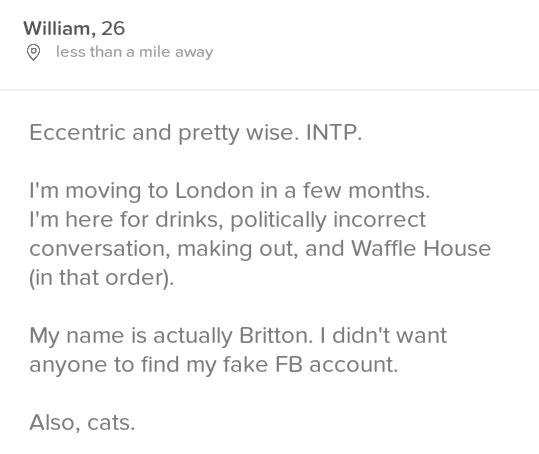
I’m Britton, as you should know, and below you’ll find the bio I wrote for my Tinder profile. If you don’t know what Tinder is, then get your head out of the sand, and read about it here.

2017-05-22 16.49.15

I was in New Orleans the other day, getting my swipe on, and then I came across this fine, older lady.

2017-05-22 12.40.00

The first things, ‘politically progressive’ and “the f-word”, I admit, probably should have raised red flags before even her shitty taste in music did. Those terms on their own hint at far-left political views, but the two of them together scream ‘SJW‘. However, she was hot, and that’s very rare of feminists, so I read into her words and saw deeper possibilities. I was hoping that maybe we could talk some philosophy, giving her the benefit of the doubt that her knowledge on that subject wasn’t confined to new-wave feminist crap. Hey, maybe she was even a feminist of the second-wave, non-radical kind, and ‘progressive’ just meant that she was kind of liberal and open to reasonable and necessary change. Maybe she’d even have a cat named Elvira. With this optimistic attitude, I swiped right and immediately tested her humor to see how “open” she really was.

2017-05-22 12.24.23

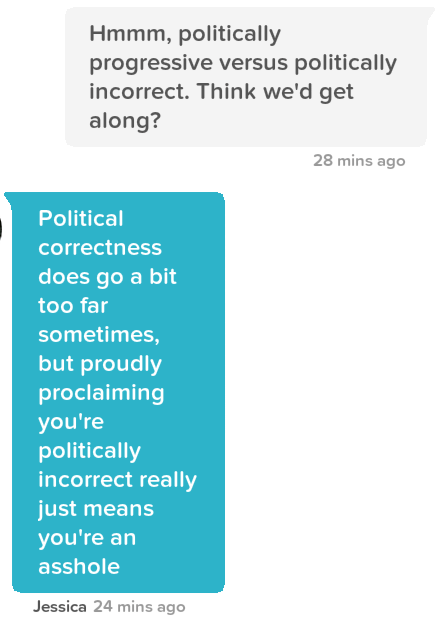
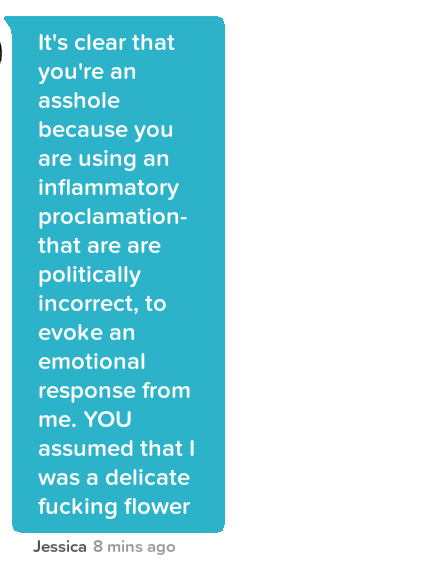
BOOM! No fun or games with this one. Did I “proudly proclaim” that I am politically incorrect? Reread my bio, and let me know. I think I’m just straightforward about what I want out of my Tinder experience. She could have easily swiped me left if my intentions didn’t line up with hers. Looking back, though, maybe I should have ended my first message with a winky face. 😉

2017-05-22 12.26.28

Do you value truth, Jessica? DO YOU? We’ll find out. Also, Jessica, I’ll be addressing you directly from here on. Wait, is it ok that I call you by your name, or would you prefer something else? I don’t want to be too incorrect and risk “invalidating your existence“.

2017-05-22 14.12.41

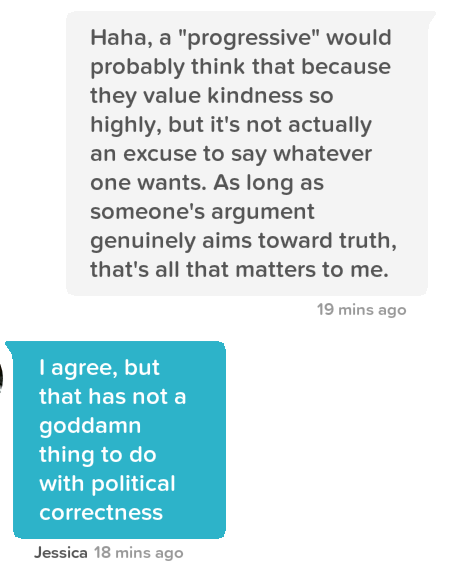
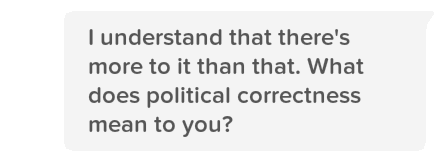
Yeah, let’s define a term together! That sounds like a fun philosophical exercise. Maybe you’ll even return the favor by asking me how I would define the term, and then we’ll find some common ground, bettering both of our conceptions of the world. Learning stuff is fun! You read philosophy, so you agree, right?

2017-05-22 12.29.22

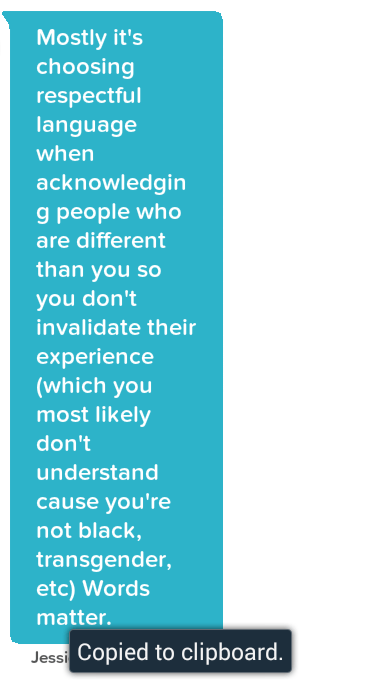
Annnnnd there it is. You pretty much nailed it, Jessica. I’m guilty of whiteness, so there’s no need to ask me what I think ‘political correctness’ means. Your understanding of how language works, on the other hand, seems a bit strange, and the philosophy you read may be of questionable quality. My validity on that topic comes from my education in linguistics and philosophy of language. But, you’re attempting to “invalidate” me because I’m… white? Hmmm.

I don’t think that speech is an activity so consciously aimed toward respect, nor do I think it’s a good idea to blindly respect people at all. In fact, it’s dangerous. I’ll spare you the technical linguistic part of the argument because I’m starting to sense that you have a screw or two loose, but I still must address the respect-issue.

Also, how are you so sure that I’m not black or transgender? If you respected me, then you would have asked about my preferred identity because race and gender are determined whimsically and have no biological basis, correct? No, you should have simply requested a dick pic, Jessica. Truth requires evidence, and I have plenty of it.

2017-05-22 12.31.40

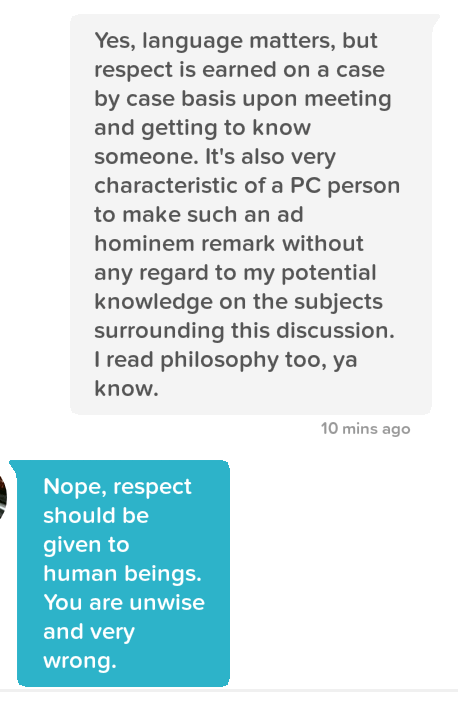
So, maybe there’s more to political correctness than your definition, Jessica, and maybe I know some stuff that you don’t. Maybe you’d be interested in hearing it. Maybe if you weren’t so keen on blindly respecting others, then you wouldn’t be so liable to get mugged and raped in a dark alley in New Orleans. Or, maybe you’d like that because you’d become a martyr for your ideology. At this point, you’re not giving me any reason at all to respect you, but I do fear for your safety. After all, you’re right that the world isn’t a very kind place.

2017-05-22 14.39.072017-05-22 14.40.34

I figured I’d play the “patriarchy” card since you already accused me of being part of it by virtue of my straightness, whiteness, and maleness. What did you expect? Why did you swipe me right if you hate me by default, unless you wanted to hate-fuck me (shit, I may have missed my shot)? I mean, you’ve seen my pictures. Chances are that I’m not black under my clothes. In fact, I’m even WHITER there. Well, actually, there is a very small part of me that is kind of tan.

2017-05-22 12.35.42

2017-05-22 15.00.48

*ignores grammatical errors and moves on*

I know I’m an asshole, Jessica. There is no need to repeat yourself. But, does being an asshole make me wrong? No, Jessica, you’re the meanie who committed ad hominem. I also didn’t appeal to emotion to argue my point. You just took it that way. Taking offense and giving it are NOT the same thing. That’s Philosophy 101.

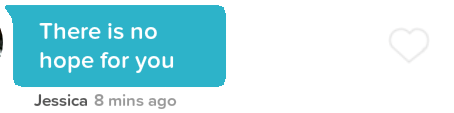
But…do save me! Please save me from my problematic ways so I can be more compassionate like you and make the world a more progressive place! Or, do I need a degree in women’s studies to be infected with your profound wisdom? If it’s LSU that infected you, then you’re right that there is no hope for me because I dropped out of that poor excuse for a higher-education institution after just one semester of grad school.

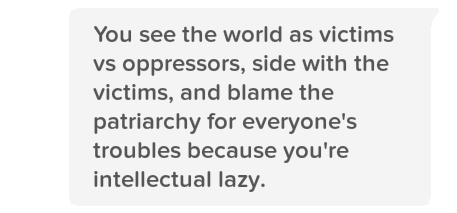
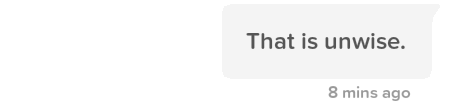
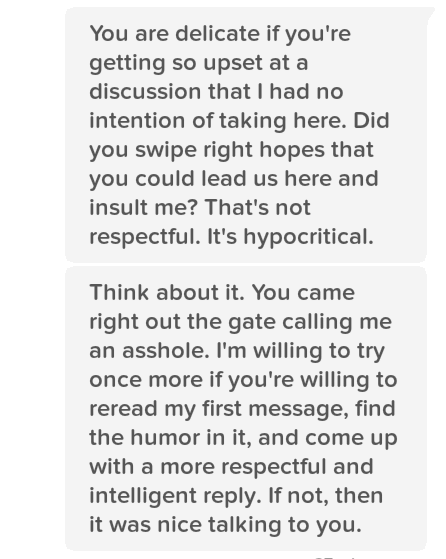
On the other hand, I could help you by revealing your greatest contradiction, and maybe even give you one more chance to get laid by me, knowing well that so few men would have gotten even this far with you. I mean, this is Tinder. Why else would you be here? Yeah, that’s what I’ll do because I want some too. I’ve learned to accept that liking sex makes women delicate flowers and men oppressive misogynists. It’s cool, really, I don’t need to be reeducated. I’ll even let you play the role of misogynist, and I’ll be the victim, and you can oppress deez nuts all you want.

2017-05-22 15.11.27

That’s where it ended. So…

What the hell is going on here?

I don’t think that I need to go into detail about what is going on here. There are plenty people who have done that very well already. For example, Dr. Jordan B. Peterson in this brilliant snippet from the most popular podcast in the world. The general point I want to make is that we are in a strange place where people like Jessica are multiplying exponentially by the semester, thanks to politically correct ideology infecting universities, business administrations, legislature, and now even Tinder (as if Tinder doesn’t already have enough spam)! This is the time for talented and capable people, mostly men, to stop ceding power to the people who live in those boxes; they’re wrong, and they’ve snuck their way into power without truly earning it. To stand up for truth is to stand up for yourself. However painful that may be now, it is absolutely necessary for the survival of our species. After all, if we were all angry, 35-year-old feminist virgins, of course humanity would end.

Since we aren’t all like Jessica, one day we will be without these people completely. Let’s give them what they want: spare their feelings, thus depriving them of the open, truth-seeking dialogue that would mold them into stronger moral beings and free them from the narrow and suffocating constraints of the feminist ideology. Since they aren’t open to that sort of thing, they will eventually self-extinguish under their childless philosophy and rot in the miserable hell that they’ve created for themselves.

Collective Subjectivity = Reality :: The Utility of Phenomenological Thought

In my last post, I explained the differences between and the proper uses of the terms ‘subjective’ and ‘objective’. To recap, these terms do not describe the positions from which one perceives. Of course, everyone perceives subjectively, and objects don’t perceive at all. Therefore, the subject/object spectrum is not a spectrum on which one may judge a matter’s truth-value. The spectrum simply describes the nature of the matter at hand — subjective means “of a subject” and objective means “of an object”. Having said that, how can we define truth more broadly? What determines it?

I think that we can, in many conceivable instances, equate truth with reality. This is based on one of two popular definitions of reality. The first, more popular definition in which we cannot equate truth and reality, and the one I reject, is that of objective, Newtonian-scientific reality. This holds that there are mathematical laws and principles out there in the universe, already discovered or waiting to be discovered, which the forces of nature can be reduced to. Proponents of this view hold “rationality”, in all of its vagueness, as the singular Platonic ideal which dictates what is true, real, and meaningful. It follows from this that mechanistic science holds the key to all knowledge. The problem here is that mechanistic science (not all science) is founded in the metaphysical belief in materialism. Materialism suggests that all reality is comprised of quantifiable matter and energy. Humans, and all living things, are “lumbering robots”, as Richard Dawkins claims. Consciousness, ethics, morality, spirituality, and anything else without a known material basis is subjective in nature and thus superstitious, irrational, and not real. As I have already explained, this worldview rests on a straw-man distinction between what constitutes subjective and objective, for it assumes that this distinction creates a spectrum on which to judge a matter’s truth-value (the more objective, the more true).

Remaining consistent with how I have distinguished subjective and objective is the second, less popular, and in my view, much more useful way of defining truth and reality: what is real is what affords us action and drives us toward a goal. The definition is as simple as that, but its implications have a tremendous amount of depth rooted in the unknown. Instead of holding one Platonic ideal (like rationality) as the key to all truth, there are an infinite number of ideals that humans conceptualize, both individually and collectively, in order to achieve their ends. Therefore, this view affords relevance to a wide range of perspectives even if the nature of the objects being perceived is unknown. The rationalist view, by contrast, is limited to the assumption that the nature of everything has already been determined to fit into one of two metaphysical categories: objective reality or subjective delusion. (This Newtonian theory of reality I have just explained, by the way, is a long-winded way of defining ‘scientism’, a term I often use in my posts.)

Nature doesn’t obey laws; humans do, so we tend to compartmentalize everything else in that way because that makes it easier for us to explain what we want to know and explain-away anything we don’t want to know. What we don’t want to know is what we are afraid of, and as it turns out, what we are afraid of is the unknown. So, when anomalies, whether personal or scientific, that don’t fit the already-established laws arise, a Newtonian thinker will categorize it as illusory in order to explain it away. This doesn’t work because even we humans have a propensity to break the laws that we create for ourselves, and this can be a very productive thing. The degrees to which this is the case depends on our individual psychological makeups. People who are high in the Big-5 personality trait conscientiousness, for example, tend to obey rules because of their innate need for outward structure and order. Those who are low in that trait are more likely to break rules, especially if they are also low in agreeableness which measures one’s tendency to compromise and achieve harmony in social situations. Openness, on the other hand, the trait correlated with intellect and creativity, allows one to see beyond the rules and break them for the right reasons — when they are holding one back from progress, for example. These are just three of five broad personality traits that have an abundance of scientific research to potentially confirm their realness and usefulness, even as a rationalist/Newtonian might perceive them. However, the tendency of someone to break rules as a result of their psychological makeup does not only apply to political laws. We also create collective social rules among groups of friends and unconscious conceptual rules for ourselves in order to more easily understand our environment, and those systems satisfy the same basic human needs and take the same hierarchical forms as political order does, and they serve purposes that contrast only in terms of their widespread-ness.

Regardless of our individual psychologies, there are commonalities that all humans share in terms of which types of goals we have and which types of things drive us toward or away from action. Those things are, therefore, collectively subjective across humanity and are what I would like to propose the most universally real and true things (insofar as anything can be universally real or true at all). This leads me to elaborate further on this goal-oriented view of reality.

Since I used Newton as a scientific lens through which to understand the rationalist theory of reality, I will do the same thing to explain the goal-based theory that I am proposing, but this time using Darwin. Philosophically speaking, Darwin did not commit himself to his theories in the same law-sense that Newton did his. In fact, many of Darwin’s ideas have recently been found to be rooted in psychology rather than in hard mechanistic biology. His main principle can be summed up with this: nature selects, and we make choices, based on what we judge to be most likely to allow us to survive and reproduce. That is all. Everything else is just detailed justification which may or may not be true or relevant. In fact, Darwin left open the possibility that the details of his evolutionary theory not only could be wrong, but that they probably were, and he was very serious about that. To take all of those details literally leads one into the same logical trap that the “skeptics/ new atheists” fall into when they obsess over the details of the Bible — they oversimplify and misrepresent its meaning, and therefore overlook the broader, most important points that exist. These are straw-man arguments, and they demonstrate a persistent, juvenile lack and rejection of intellect.

The reason Darwin’s main evolutionary principle is psychological is because it is consistent with Carl Jung’s idea of the archetype. An archetype is any ancient, unconscious pattern of behavior common among groups or the entirety of the human population and their ancestors. The need for all living beings, not only humans, to survive and reproduce, is undoubtedly real. It is something we understand so little, yet it drives an inconceivably wide range of behaviors, most of which are taken for granted to the extent that they are unconscious (e.g. sex-drive is causally related to the desire to reproduce). It is not only in the natural world that humans would have to desperately fight for their life against other species, but even among ourselves in the civilized world have there been instances of radical attempts to wipe out masses of people because one group saw another group’s ideologies as threatening to their own survival and prosperity (e.g. both Hitler and Stalin led such endeavors in the 20th century).

Perhaps, instead, if we equate truth with this archetypal, goal-oriented conception of reality, then we can come to a reasonable conclusion about what constitutes truth: that which affords and drives us to action. That is to say that (capital-T) Truth, in the idealistic, rationalist sense, probably does not exist, and if it does, our five senses will never have the capacity to understand it. The best we can achieve and conceive is that which is true-enough. For what? For us to achieve our goals: survive, reproduce, and make ends meet, and if we are very sophisticated and open, to also introspect, to be honest with ourselves and others, and to live a moral and just life.

On the Categorization of Terms

It seems that, since he characterizes language as a whole rather than dealing with the nature of individual words, later-Wittgenstein denies the existence of classes of objects, and thus our accuracy in creating language about them. For example, instead of recognizing the chair as a chair, we would simply recognize the chair as that chair. If his view is accurate, then I think categorization would be better suited for proper nouns rather than objects such as a chair, because reference accuracy in these cases is naturally much more clear, i.e. apply names to named individuals (e.g. Ludwig Josef Johann Wittgenstein). There are many different forms that something we call a chair can take. Of course, as Wittgenstein would agree, there is an endless realm of possible connotations of ‘chair’, but there are certainly objects that we could exclude from the class of ‘chair’, such as a baseball, so there are some current methods of usage by which we must abide when speaking of a chair. However, with the exception of those cases that we can very obviously include and exclude from being connoted by ‘chair’, there are plenty other cases (e.g. a “chair” nailed upside down to the ceiling of an art gallery) that are not so obvious, despite their form or function. At least with individual persons, we know exactly what one is referring to when he mentions ‘Ludwig Josef Johann Wittgenstein’, and we know that he is excluding everything that is not Ludwig Josef Johann Wittgenstein. The line is more clear with proper names. With everything else, not so much. Therefore, categories are irrelevant from a philosophical standpoint and need not exist at all. They only exist within a specific context.

However, more generally, if we apply the word ‘chair’ to a baseball, and if the majority of language-users, after using the term ‘chair’ to refer to a baseball by way of its constant usage in that context, eventually came to use ‘chair’ to connote a baseball (out of unconscious social habit, not conscious agreement), then this would have become an acceptable definition, or use, of ‘chair’. For now, this is not the case. If we used ‘chair’ to connote a baseball, we would not be adhering to chair’s current method of usage, and that usage would be rejected in a social and definitive light and thus in this philosophical one. Though, after much such usage, very gradually, and not at any one particular moment, ‘chair’ could certainly come to connote a baseball. It would, at that point, have become a collective social habit and therefore semantically correct.

Syntax = Semantics

Current Methods of Usage can be applied to both syntactical and semantic rules. In fact, it has deeper implications that there is very little difference, if any at all, between the functions of syntax and semantics.

We traditionally think of syntax as being the grammatical rules of language: punctuation, spelling, sentence structure, etc. Such rules formalize language so our expressions are precise and easily understood. Semantics, on the other hand, is supposed to deal with reference and connotation. The forms, but only the forms, of syntax and semantics are different. However, their functions (which is to say ‘their purpose’) point to the same thing: communication. One can arguably not exist without the other if effective communication is to occur. Syntax and semantics are dependent upon one another like two sides to the same coin. One side is not worth more than the other (as Tractatus would argue that syntax would carry more weight, and semantics is simply incidental). They are both necessary for communication, and therefore, equal in value, especially in spoken language. They are like categories, as described above, and therefore have no philosophical value per se.